



Overview
Planning for a daughter’s future can feel overwhelming when education costs keep rising. Sukanya Samriddhi Yojana offers parents a government-backed way to build long-term savings with attractive interest and tax benefits.
This guide breaks down the key Sukanya Samriddhi Yojana details, including eligibility, deposit rules, interest calculation, withdrawals, maturity, tax benefits, and common mistakes to avoid.
What Is the Sukanya Samriddhi Yojana?
Sukanya Samriddhi Yojana is a government scheme launched on January 22, 2015, by the Prime Minister under the Beti Bachao Beti Padhao campaign. The scheme combines long-term financial savings with tax benefits, helping families build financial security for a girl’s future aspirations.
Did You Know?
Sukanya Samriddhi Yojana Eligibility and Account Opening Rules
A Sukanya Samriddhi Yojana account can be opened for a girl child who has not completed 10 years of age on the account opening date. The account can be opened and operated by her parent or legal guardian.
Account Rules
Talk to an expert
today and
find
the right
insurance for you.


Sukanya Samriddhi Yojana Interest Rate and How Returns Are Calculated
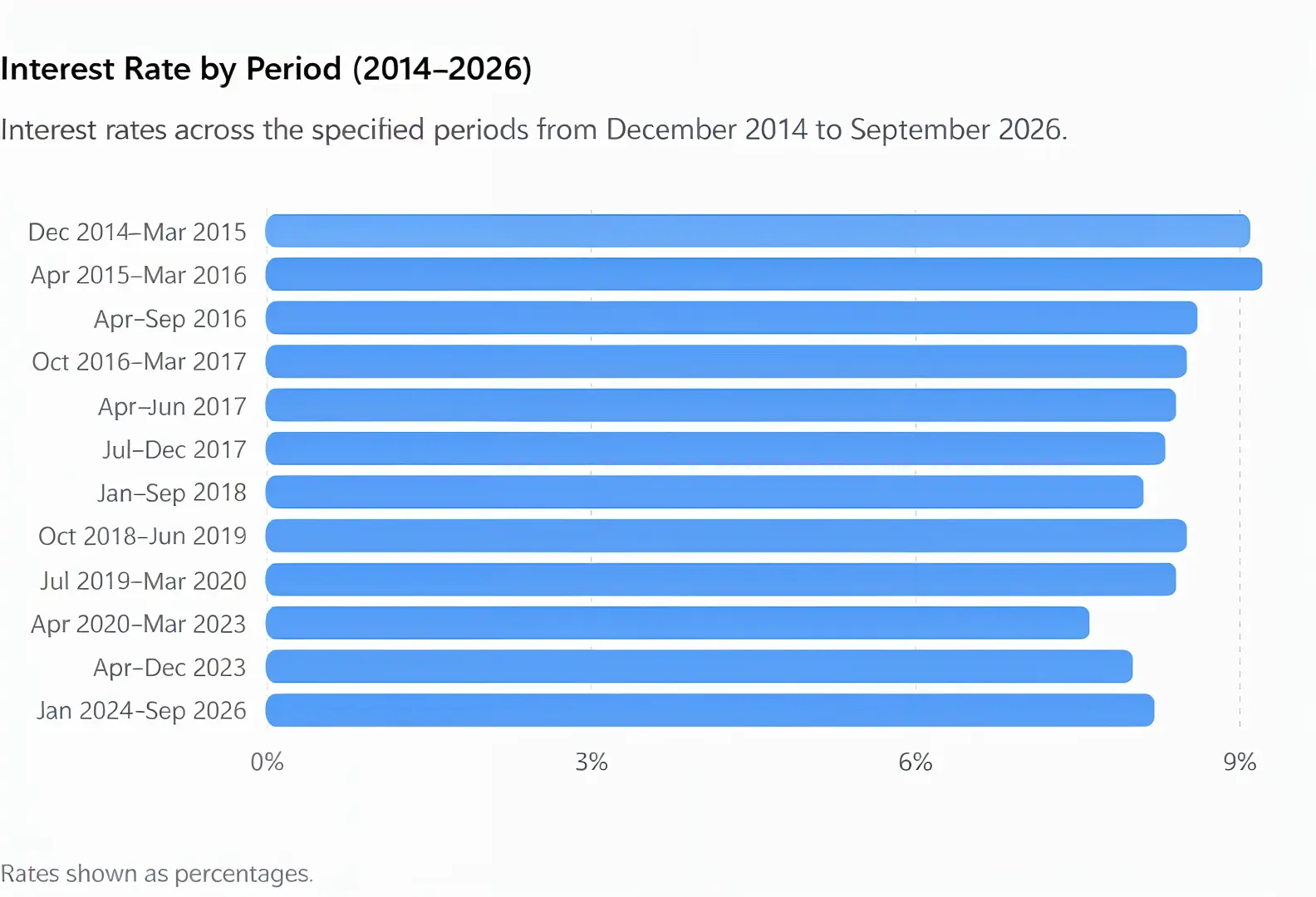
The current Sukanya Samriddhi Yojana interest rate is 8.2% per annum. It has remained unchanged since January 2024, but the government reviews small-savings rates every quarter. Therefore, the 8.2% rate is not guaranteed for the entire 21-year maturity period. You can use a third-party Sukanya Samriddhi Yojana calculator for rough estimates of returns.
Look at the bar chart below to have an idea of how SSY interest rates have changed over the years.
Note: SSY interest is calculated monthly on the lowest balance between the close of the fifth day and month-end. The accumulated interest is credited annually at the end of the financial year. Interest calculation continues smoothly even if the account is transferred between authorized account offices.
Deposit Limits and the 15-Year Contribution Window
- Minimum deposit is ₹250, making SSY accessible for small regular contributions.
- The maximum deposit is ₹1.5 lakh in a financial year. Deposits above this limit do not earn interest.
- Contributions are required for the first 15 years from the account opening date.
- The account remains active for 21 years from the opening date, even though deposits stop after 15 years.
Deposits above ₹1.5 lakh in a financial year do not earn SSY interest and may be returned. Contributions are required only for the first 15 years, while the accumulated balance continues earning the applicable SSY interest until the account matures after 21 years.

Maturity, Partial Withdrawal, and Premature Closure Rules
Normal Maturity
The SSY account matures 21 years from the opening date. The account holder receives the accumulated balance along with the interest earned.
Higher Education
Up to 50% of the balance at the end of the previous financial year can be withdrawn for higher education after the girl turns 18 or passes Class 10, whichever is earlier. The withdrawal must be supported by admission or fee documents and cannot exceed the actual documented education expenses.
Withdrawal Flexibility
The amount can generally be withdrawn as a lump sum or in installments, subject to the applicable rules. Withdrawals are generally limited to once a year for up to five years. If the previous year-end balance is ₹20 lakh, 50% would be ₹10 lakh. But if documented education expenses are ₹7 lakh, the withdrawal would ordinarily be capped at ₹7 lakh.
Marriage Closure
The account can be closed for marriage after the girl turns 18, but only within one month before or three months after the marriage.
Death of the Girl
The account can be closed after submitting the death certificate. The balance and applicable interest are paid to the nominee or eligible claimant.
Life-Threatening Illness
Premature closure may be permitted on compassionate grounds if the girl develops a serious or life-threatening illness.
Death of Guardian
If the guardian’s death creates extreme financial hardship, premature closure may be considered under the applicable rules.
Tax Treatment of Sukanya Samriddhi Yojana Deposits and Maturity
SSY follows an Exempt-Exempt-Exempt (EEE) style tax structure, but the upfront deduction depends on the tax regime you choose. From April 1, 2026, eligible SSY contributions qualify under the Section 123 and Schedule XV framework, subject to the overall ₹1.5 lakh deduction limit for qualifying investments and payments.
Common Mistakes That Cost You Sukanya Samriddhi Yojana Interest
1) Depositing After the Fifth of the Month
SSY interest is calculated each month based on the lowest balance between the close of the fifth day and the end of that month. So, a deposit credited after the fifth generally starts earning interest from the following month.
Thus, you should credit your deposit by the third or fourth working day. For an annual lump sum, aim to deposit it near the beginning of April. Additionally, prefer electronic transfers and initiate them a few working days before the fifth. Always check your passbook or account statement to confirm the actual credit date.
2) Waiting Until March to Make the Annual Deposit
You can make your annual SSY contribution during the financial year, but waiting until March can mean losing months of potential compounding. If your cash flow permits, make the annual contribution near the beginning of the financial year rather than waiting for March.
3) Missing the ₹250 Minimum Annual Contribution
You need to deposit at least ₹250 in each financial year during the 15-year contribution period. Missing this can make the account a default account. To avoid any default, set up at least a ₹250 annual contribution reminder or automatic payment. You can add more later when your cash flow improves.
4) Withdrawing the Full 50% When You Need Less
The education withdrawal limit is not automatically 50% of whatever amount you currently see in the account. The permitted withdrawal is generally the lower of 50% of the preceding financial year-end balance and the documented education requirement. Withdraw only what you actually need. Every rupee withdrawn stops earning future SSY interest.
5) Closing the Account for Marriage Too Early
SSY allows closure for marriage only when the girl is at least 18 and within the prescribed window. The request can generally be made up to one month before marriage or three months after marriage.
Closing the account also ends its future compounding. You should not close the account automatically just because the girl is getting married. First consider how much money is actually required and how close the account is to maturity.
6) Treating 8.2% as a Guaranteed 21-Year Return
The current SSY interest rate is 8.2%, but it is not fixed for the entire 21-year period. The government reviews small-savings rates periodically. Historical SSY rates have also changed significantly. The rate was 9.2% in 2015-16 and 7.6% from April 2020 to March 2023.
You should treat 8.2% as the current rate, not a guaranteed long-term return. For planning, model different scenarios such as 7%, 8.2%, and 9%. This gives you a more realistic picture of the potential corpus.
Sukanya Samriddhi Yojana Versus PPF and Equity Mutual Funds
Why Choose Ditto for Insurance?
At Ditto, we’ve assisted over 12,00,000 customers with choosing the right insurance policy. Why customers like Aaron below love us:

- 100% Free Consultation
- No Spam. No Sales Pressure.
- Rated 4.9/5 on Google Reviews by 30,000+ Happy Customers
- Backed by Zerodha
- Dedicated Claim Support Team
- Compare Plans and Premiums with a Trusted Insurance Advisor
Confused about the right insurance? Speak to Ditto’s certified advisors for free, unbiased guidance. Book your call now or chat with us on WhatsApp. Slots fill up fast!
Conclusion
Sukanya Samriddhi Yojana (SSY) should be one of the first options parents consider for a girl child’s long-term goals. It is government-backed, offers a competitive interest rate and provides tax benefits, making it a strong foundation for goal-based savings.
But before investing for your child, protect the family that funds that goal. Adequate term life insurance ensures the child’s financial future remains protected even if a parent is no longer around. Similarly, suitable health insurance can prevent a major medical expense from disrupting your savings plan.
So, start with adequate protection through the best term insurance plans and best health insurance plans for your family. Then use SSY as a core safe allocation before exploring other child investment plans. You can also explore other investment plans for a girl child.
Frequently Asked Questions
Last updated on: