




Overview
If you want a place to build long-term savings that won't lose value, won't get taxed, and is backed by the government rather than the market, Public Provident Fund (PPF) is usually the first product that comes up. The 15-year lock-in scares some people off, but it's worth treating that as a feature.
This Public Provident Fund guide covers the current interest rate, how to open and fund an account, when loans and withdrawals open up.What happens at the 15-year mark, tax treatment, common mistakes that quietly cost you interest, and how PPF stacks up against EPF, FDs, and debt mutual funds.
What Is the Public Provident Fund?
The Public Provident Fund scheme is a government savings product introduced in 1968, but the current product is governed by the Public Provident Fund Scheme, 2019, issued under the Government Savings Promotion Act, 1873.
It is available through post offices and authorized banks. It's a debt instrument, not market-linked, so your return doesn't move with the stock market. Instead, it moves only when the Finance Ministry revises the rate each quarter.
Ditto's Insight
Public Provident Fund Interest Rate and How Interest Is Credited
The public provident fund interest rate is currently 7.1% per annum for the July-September 2026 quarter, unchanged since April 2020. The Finance Ministry sets it each quarter, formally benchmarked to the average 10-year G-Sec yield plus a 25 basis point spread under the Gopinath Committee formula, though in practice the formula works more as a reference point than a rule.
Small savings schemes carry a social security mandate, so the government tends to hold rates up when bond yields fall rather than cut them in step, which is why PPF has sat at 7.1% through several rate-cut cycles elsewhere. There's a practical reason behind that reluctance too. Small savings schemes are a captive, sticky pool of household money that flows to the Centre and states through the National Small Savings Fund, a funding source the government doesn't need to roll over or reprice every quarter.
For savers, the upshot is asymmetry: when bank deposit rates fall, PPF usually holds, but the rate is a policy decision the government can revise, not a contractual guarantee.
Interest is calculated monthly on the lowest balance between the 5th and the last day of that month, then credited in full at year-end. This is why depositing before the 5th matters. Money deposited on the 6th earns nothing for that entire month, even after sitting in your account for 25 days.
Here's how the PPF interest rate has changed since the scheme began in 1968, shown in the image below:
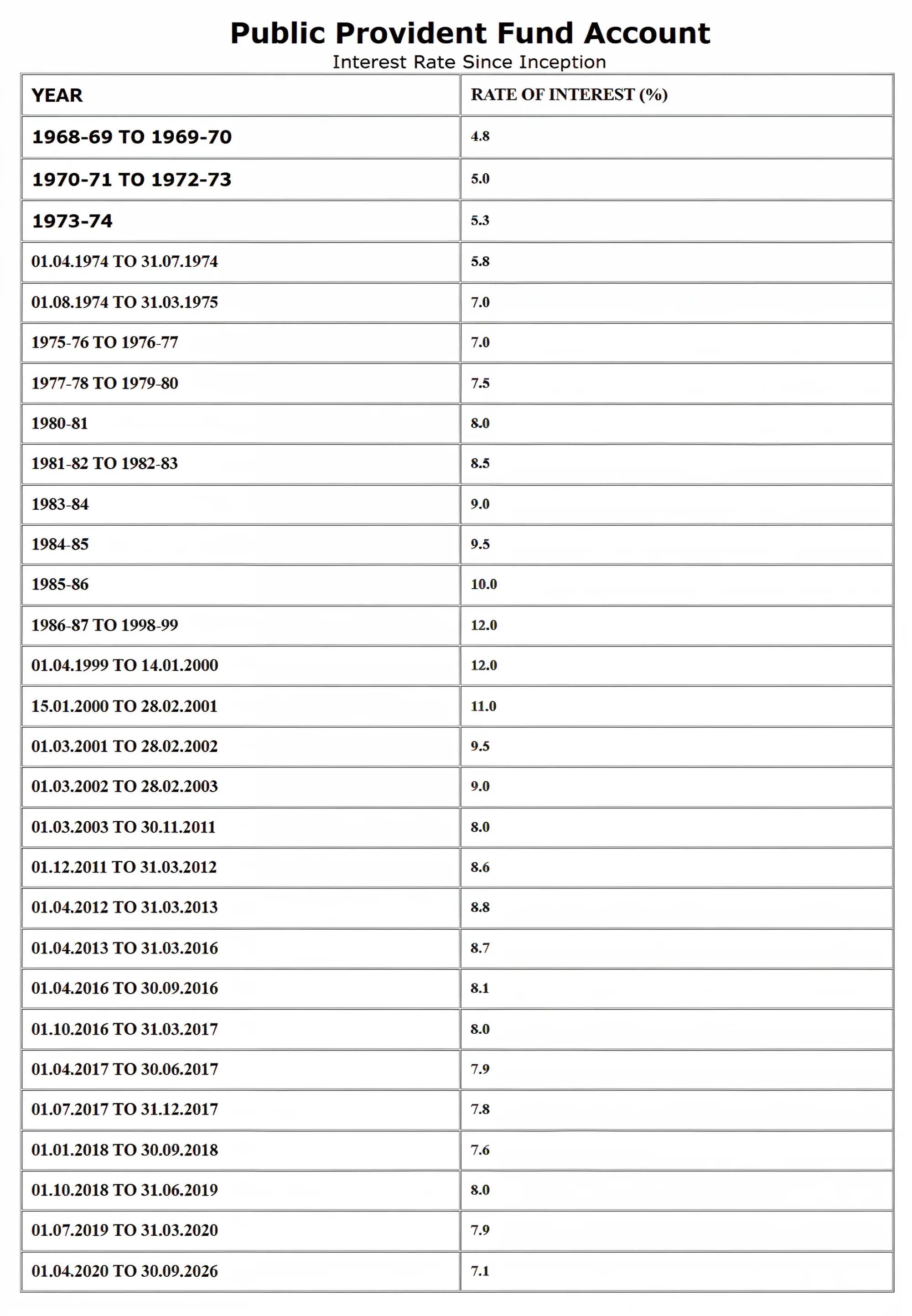
Source: National Savings Institute official website.
Eligibility, Deposit Limits, and How to Open a PPF Account
Any resident Indian individual can open a PPF account, and a guardian can open one on behalf of a minor. You're limited to one PPF account in your own name, though you can separately hold one as guardian for a child. The ₹1.5 lakh annual cap applies per person, not per account, so deposits into your own account and into any account you operate as guardian get added together against that same ₹1.5 lakh. Anything deposited above the cap earns no interest and gets refunded.
Opening one takes minutes online through most banks’ net banking or the India Post portal, or in person with your PAN, Aadhaar, and a photo. For anyone self-employed and outside EPFO (Employee Provident Fund Organization), this is often the closest thing to a guaranteed retirement account they have access to.
Loans and Partial Withdrawals From Your Public Provident Fund Account
Between financial years 3 and 6, you can take a loan against your PPF balance instead of withdrawing, up to 25% of the balance at the end of the second year preceding your application. After principal repayment, loan interest is charged at 1% per annum on the principal for the relevant loan period. If the loan is not fully repaid within 36 months, the outstanding amount attracts 6% per annum.
From year 7 onward, loans stop and partial withdrawals open instead, once per financial year, capped at 50% of whichever is lower: either your balance at the end of the immediately preceding year, or at the end of the 4th preceding year. Premature closure of the whole account is allowed after 5 years, but only for medical emergencies, higher education, or a change in residency status, with a 1% interest penalty on your balance for the years held.
What Happens at 15 Years: Closure, Extension With and Without Deposits
The 15-year lock-in counts from the end of the financial year you opened the account, not the exact opening date. At maturity, you have three choices:
- Withdraw the entire balance tax-free and close the account.
- Extend for another 5-year block while continuing to deposit and earn interest.
- Extend without further deposits, where your existing balance keeps earning interest, but you're limited to one withdrawal a year. Most people are better off extending with continued deposits if they don't need the money yet, since PPF's tax-free compounding rarely has a better place for the debt portion of a portfolio.
Tax Treatment of the Public Provident Fund Under Both Tax Regimes
Public Provident Fund investment carries EEE status. Your deposit qualifies for a deduction under Section 123 (the renumbered Section 80C) up to the combined ₹1.5 lakh cap, but only under the old tax regime. The new regime doesn't allow this deduction. Interest earned and the final maturity amount stay fully tax-exempt regardless of which regime you're on.
If you're salaried and your mandatory EPF contribution already uses up your ₹1.5 lakh limit, PPF gives you zero additional deduction. The entry-stage tax break is already spent elsewhere. And for the growing share of taxpayers now on the new regime by default, that entry exemption doesn't exist at all. Only the tax-free growth and maturity still apply.
This makes PPF's tax-adjusted return effectively higher than its headline 7.1% suggests, especially against instruments like Fixed Deposits, Government of India or Reserve Bank of India bonds or Debt Mutual Funds, where the return gets taxed at your slab rate.
Common Public Provident Fund Mistakes That Cost You Interest
- Depositing After the 5th: You lose that month's interest, even if it's just a day late.
- Treating PPF as an emergency fund: It's illiquid by design. Use a savings account or liquid fund for money you might need on short notice.
- Forgetting to Extend on Time: If you miss the extension form within a year of maturity, the account defaults to no-further-deposits mode. It is a choice you can't reverse.
- Assuming NRIs Can Keep Contributing: NRIs cannot open new PPF accounts, and a residency status change tightens contribution rules considerably.
- Letting the Account go Dormant: Miss the ₹500 minimum deposit in any financial year and the account gets discontinued. You lose access to loans and partial withdrawals, and reviving it costs ₹50 per defaulted year plus the ₹500 minimum arrears for each year missed.
Note: PPF is a debt instrument, and ignoring equity and equity mutual funds as engines for long-term compounding is its own mistake. PPF deserves a meaningful allocation in your debt portfolio, but true wealth creation over the long run usually needs an equity component alongside it, not instead of it.
Public Provident Fund Versus NPS and Equity Mutual Funds
PPF sits firmly in the debt category, guaranteed, government-backed, and slow-moving. NPS and equity mutual funds are different, as they are market-linked with no guaranteed return, but historically far higher growth potential over 15-20 year horizons.
Although they're not real substitutes, a well-built retirement plan usually holds: PPF for guaranteed downside protection, equity or NPS for growth.
For the debt portion of your portfolio specifically, here's how PPF stacks up against its closest peers:
EPF/VPF usually wins on rate if you're salaried and already have access, since it currently pays more than PPF with similar tax treatment. PPF's real edge is that it's open to everyone, including the self-employed, who have no EPFO account to fall back on.
Public Provident Fund Calculator: Maturity Value by Annual Deposit
The table below shows approximate maturity value after 15 years at the current 7.1% rate, assuming a fixed deposit amount at the start of each year (actual returns will vary if the rate changes over the term):
Why Choose Ditto for Life Insurance?
At Ditto, we’ve assisted over 12,00,000 customers in choosing the right insurance policy. Why customers like Saibabu below love us:

- 100% Free Consultation
- No Spam. No Sales Pressure.
- Rated 4.9/5 on Google Reviews by 30,000+ Happy Customers
- Backed by Zerodha
- Dedicated Claim Support Team
- Compare Plans and Premiums with a Trusted Insurance Advisor
Confused about the right insurance? Speak to Ditto’s certified advisors for free, unbiased guidance. Book your call now or chat with us on WhatsApp. Slots fill up fast!
Conclusion
PPF earns its place as one of the most reliable debt instruments available to Indian savers, tax-free at every stage, government-guaranteed, and structured to protect you from your own worst financial impulses. But it shouldn't be your only savings vehicle. Instead, treat it as the safe, guaranteed core of a long-term plan.
Before locking money away for 15 years, make sure your protection basics are covered first: adequate term life cover to secure the future of dependants, comprehensive health insurance for medical emergencies, along with an adequate emergency fund in place.
Frequently Asked Questions
Last updated on: