



Overview
What if you could estimate how much your contributions to your child’s NPS Vatsalya account could grow by the time they turn 18? The NPS Vatsalya calculator can help you do exactly that.
The calculator lets parents and guardians estimate the potential corpus under NPS Vatsalya based on the child’s date of birth, monthly contribution, and assumed rate of return. Since NPS Vatsalya offers market-linked returns, the result is only an estimate and is not guaranteed.
In this article, we explain how the NPS Vatsalya calculator works, what inputs you need, how your contribution can affect the projected corpus, and what to keep in mind when interpreting the results.
What Is the NPS Vatsalya Calculator?
The NPS Vatsalya calculator is an online tool that helps parents and guardians estimate the potential corpus that could accumulate in a child's NPS Vatsalya account.
The official NPS Vatsalya scheme calculator uses the minor’s date of birth, likely monthly contribution, and expected rate of return to project the potential corpus at age 18. It also shows the total amount invested and estimated gain.
Since NPS Vatsalya investments are market-linked, the calculator's projected corpus is an illustration and not a guaranteed amount. The actual value will depend on investment performance and other factors affecting the account.
How to Use the NPS Vatsalya Calculator
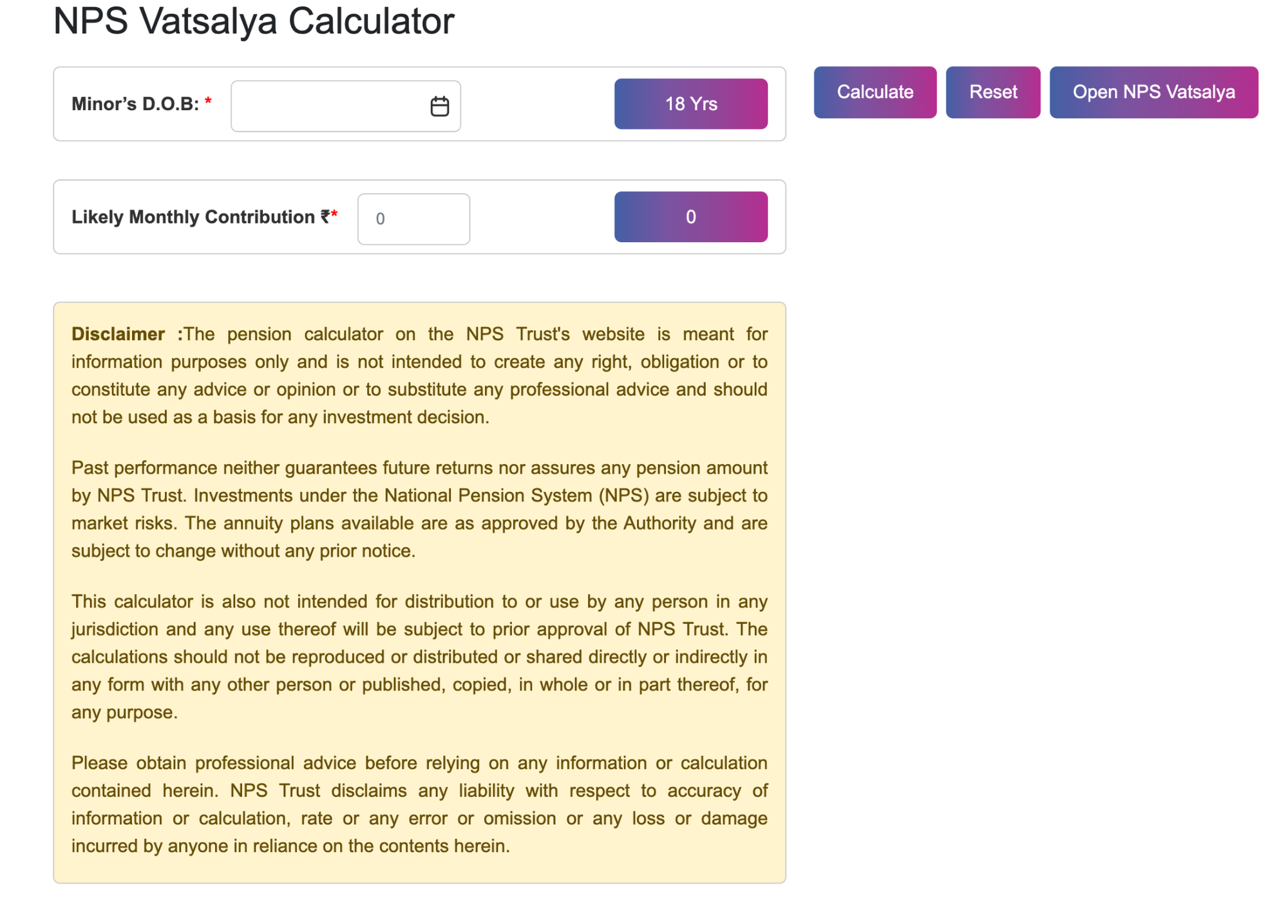
The official NPS Vatsalya calculator is available on the NPS Trust website. You need the minor's date of birth, the monthly contribution you plan to make, and an expected rate of return.
Step 1: Enter the Minor’s Date of Birth
Enter the child's date of birth in the calculator. The calculator uses this information to determine how long the investment can remain invested before the child turns 18.
Step 2: Enter the Monthly Contribution
Enter the amount you plan to contribute every month. For example, if you plan to invest ₹2,000 per month, enter ₹2,000 in the monthly contribution field. NPS Vatsalya has a minimum contribution of ₹250 to open the account and a minimum annual contribution of ₹250. There is no maximum contribution limit.
Step 3: Enter the Expected Rate of Return
Enter the annual return you want to assume for the calculation. For example, you could test the calculator at 8%, 10%, and 12% to understand how different return assumptions affect the projected corpus. Remember that the NPS Vatsalya interest rate is not fixed because the scheme provides market-linked returns. The return you enter is therefore only an assumption, and the actual returns can be higher or lower.
Note: Apart from the official NPS Trust calculator, several third-party websites also offer NPS Vatsalya calculators. These tools estimate the corpus using standard future value and compounding calculations based on contributions, investment period, and an assumed rate of return. However, their methodology and assumptions can differ, so projections from different calculators may not match exactly. For consistency, use the official NPS Trust calculator as the primary reference.
Details You Need Before Using the Calculator
- Minor’s Date of Birth: This determines the period for which the contributions can remain invested until the child turns 18.
- Monthly Contribution: Enter the amount you plan to contribute regularly. NPS Vatsalya requires a minimum annual contribution of ₹250 and has no maximum contribution limit.
- Expected Rate of Return: Since NPS Vatsalya returns are market-linked, treat this as an assumption rather than a guaranteed rate.
- Desired Corpus: If you have a specific target for your child's corpus at age 18, you can use this feature to estimate the monthly contribution required.
- Other Factors: The calculator's projection may not fully reflect the impact of factors such as applicable charges and eligible partial withdrawals.

Factors That Affect Your NPS Vatsalya Corpus
Contribution Amount
A higher monthly contribution can help you build a larger corpus over the same period.
Investment Period
Starting early gives your contributions more time to benefit from compounding.
Asset Allocation and Pension Fund
NPS Vatsalya investments can be allocated across equity, government securities, debt, and money market instruments. The selected allocation and pension fund can influence investment performance.
Return Assumption
Since returns are market-linked, the actual corpus may be higher or lower than the calculator's projection.
Partial Withdrawals
Eligible withdrawals before age 18 can reduce the amount available for further compounding and lower the eventual corpus.
Talk to an expert
today and
find
the right
insurance for you.


NPS Vatsalya Sample Projections by Contribution Amount
NPS Vatsalya Sample Projections for ₹1,000 Monthly Contribution
Note: The above examples assume a constant monthly contribution of ₹1,000 in all three cases.
NPS Vatsalya Sample Projections for ₹5,000 Monthly Contribution
NPS Vatsalya Sample Projections for ₹10,000 Monthly Contribution
Note: The child’s age, investment period, and assumed rate of return vary to show how these factors can affect the projected corpus. These are illustrative estimates, exclude charges, and actual NPS Vatsalya returns will vary because they are market-linked.
How Much Should You Contribute to the NPS Vatsalya Scheme?
There is no fixed amount that every parent should contribute. The right contribution depends on your child's age, financial goals, investment horizon, and household budget. The calculator can help you compare different contribution amounts and see how they could affect the projected corpus.
For example, if you invest ₹1,000 per month for 18 years at an assumed return of 10% per annum, the total contribution would be ₹2.16 lakh, and the illustrative corpus could be around ₹5.76 lakh.
If you increase the contribution to ₹5,000 per month, your total contribution would increase to ₹10.80 lakh, while the illustrative corpus could reach around ₹28,84,781 at the same assumed return. However, a higher contribution is not automatically better. Choose an amount that you can sustain comfortably over the long term, particularly because NPS Vatsalya has restricted liquidity before the child turns 18.
How Much Should I Invest in NPS Vatsalya to Reach My Target Corpus?
Common Mistakes When Using the NPS Vatsalya Calculator
- Treating the Projected Corpus as Guaranteed: NPS Vatsalya offers market-linked returns, so the calculator’s projected corpus is an estimate, not a guaranteed amount.
- Using Only One Return Assumption: Avoid relying on an optimistic return estimate. Check the projected corpus under different return assumptions to understand how the outcome could vary.
- Ignoring Partial Withdrawals: A partial withdrawal before the child turns 18 can reduce the amount available for further compounding and lower the final corpus.
- Overlooking Applicable Charges: Charges associated with NPS can affect the actual corpus, so the calculator’s projection should not be treated as the final amount you will receive.
- Assuming the Account Automatically Pays Out at 18: When the child turns 18, the subscriber needs to choose whether to continue the account for another 3 years, shift the corpus to the NPS All Citizen Model, or exit according to the applicable rules.
- Comparing the Projection Directly With Fixed-Return Products: Products such as Sukanya Samriddhi Yojana and Public Provident Fund have different return and risk characteristics. The NPS Vatsalya scheme interest rate is not fixed or guaranteed, so compare these options only after considering their different risk and return characteristics.
Why Choose Ditto for Insurance?
At Ditto, we’ve assisted over 12,00,000 customers choose the right insurance policy. Why customers like Pallavi love us:

- 100% Free Consultation
- No Spam. No Sales Pressure.
- Rated 4.9/5 on Google Reviews by 30,000+ Happy Customers
- Backed by Zerodha
- Dedicated Claim Support Team
- Compare Plans and Premiums with a Trusted Insurance Advisor
Confused about the right insurance? Speak to Ditto’s certified advisors for free, unbiased guidance. Book your call now or chat with us on WhatsApp. Slots fill up fast!
Conclusion
The NPS Vatsalya calculator can help parents estimate how their contributions could grow into a long-term corpus for their child. However, the projected amount depends on factors such as the contribution amount, investment period, and assumed rate of return. Since NPS Vatsalya offers market-linked returns, treat the calculator’s projections as estimates, not guaranteed outcomes.
Before investing, consider whether NPS Vatsalya fits your child’s financial goals and whether you are comfortable with its investment risks, charges, and withdrawal rules. You can also compare it with options such as PPF, Sukanya Samriddhi Yojana, or mutual funds based on your goals and risk appetite.
Most importantly, investments should not replace financial protection. Before committing to a child-focused investment plan, make sure earning parents have sufficient life cover through one of the best term insurance plans and comprehensive health insurance for the family.
Disclaimer: This article is for educational purposes only and does not constitute investment advice. Ditto is not a SEBI/PFRDA-registered investment adviser. Consider consulting one before making an investment decision.
Frequently Asked Questions
Last updated on: