


Overview
Imagine one of your employees fractures their spine in a road accident. They survive, but they cannot work for six months. Your company's group health insurance policy covers the hospital bill. What it does not cover is the salary they miss each week during recovery.
This is where the distinction between group health insurance and group personal accident insurance becomes critical for employers. Both are group policies, both cover employees, and both are often lumped under the label 'employee benefits.' But they protect against very different types of financial risk.
In this article, we will walk you through the difference between group health insurance vs group person accident insurance, what each policy actually covers, how they differ, where they overlap, and how to structure them for your workforce.
What Is Group Health Insurance?
Group health insurance, or Group Medical Coverage (GMC), is a single health insurance policy that covers all employees of a company under a single master contract. The employer is the policyholder, and employees (along with their dependents) are the insured members.
Think of it as buying health insurance in bulk. Because the insurer is covering a large group at once, premiums are significantly lower per person than what any employee would pay for an individual health plan.
GMC is issued under India's general insurance framework and is subject to IRDAI's group insurance guidelines. The employer renegotiates the policy annually, so coverage terms may change.
Note: IRDAI mandates that group insurance can be offered only to genuine, pre-existing groups, not to groups formed solely to buy insurance. For employer-employee setups, at least 7 people must be covered. Non-employer groups such as trade associations or clubs require at least 20 members.
What Is Group Personal Accident Insurance?
Group Personal Accident Insurance (GPA) is a policy that provides financial protection when an accident results in death, disability, or loss of income. Like GMC, it is purchased by the employer as a master policy covering all enrolled employees.
The keyword here is accident. GPA does not cover illness. It steps in only when an unexpected external event, such as a road accident, a fall, or a workplace injury, causes a defined outcome.
GPA pays on a benefit basis, not an indemnity basis. This means the payout is fixed (as per the policy schedule) and does not depend on actual bills. For example, if the Sum Insured (SI) is ₹30 lakh and the employee loses one hand in an accident, they receive a fixed percentage of ₹30 lakh regardless of the actual hospital cost.
Talk to an expert
today and
find
the right
insurance for you.

GMC vs GPA: Key Differences
What Each Policy Excludes and Covers
Common Exclusions
GMC Does Not Cover:
- Illnesses or injuries arising from self-inflicted harm
- Cosmetic or elective procedures not medically necessary
- Outpatient Department (OPD) expenses, unless specifically covered
- Treatments not falling under the policy's list of covered procedures
GPA Does Not Cover:
- Death or disability due to illness or disease
- Self-inflicted injuries or suicide
- Accidents under the influence of alcohol or drugs
- Injuries from participating in unlisted hazardous activities or adventure sports
- Pre-existing physical conditions that lead to increased disability from an accident
Coverage at a Glance
Do You Need Both for Your Employees?
For most employers, here is the recommended layering approach:
- Start With Group Health Insurance
GMC is the foundation. It covers the most common reason employees need financial support. A dengue hospitalization, a surgery, or a maternity case are far more frequent than life-altering accidents. Every employer should have this in place first.
- Add Group Term Life Insurance
If your workforce has financial dependents, group life insurance provides a lump sum to the family in case of natural or accidental death. This is broader than GPA's accidental death benefit, since it pays regardless of the cause of death.
- Layer With GPA for High-Risk Roles
For companies with field staff, delivery personnel, drivers, or employees in physically intensive or accident-prone roles, GPA is critical because its temporary total disability benefit can replace income when an employee is unable to work after an accident. Even for desk-based teams, GPA offers valuable protection against commute-related injuries and road accidents at a relatively affordable premium.
How to Choose and Structure Cover?
For GMC
- Sum Insured: A minimum of ₹5 lakh to ₹10 lakh per employee is the baseline. Consider higher limits if your workforce is older or in a city with high healthcare costs.
- Dependent Cover: Including spouse and children significantly increases the policy's value to employees. Including parents adds cost but is a strong retention signal.
- Add-Ons to Consider: OPD cover, maternity benefits (if not already included), and room rent without limits.
- Insurer Selection: Check IRDAI annual reports for claim settlement ratios and complaint volumes. These are public documents and give a real picture of insurer reliability.
For GPA
- Sum Insured Benchmark: 2 to 5 times the employee's annual CTC. For someone with a yearly salary of ₹10 lakh, that means a GPA cover of ₹20 lakh to ₹50 lakh.
- Coverage Scope: Ensure the policy includes partial, total, temporary, and permanent disability, not just accidental death. Death-only coverage misses the bulk of real accident scenarios.
- Global Coverage: Many GPA policies cover employees worldwide, useful for teams that travel internationally for work.
- Occupation Classification: Insurers classify occupations by risk level. A higher-risk occupation (like construction or transport) attracts a higher GPA premium. Disclose accurately.
Why Choose Ditto for Insurance?
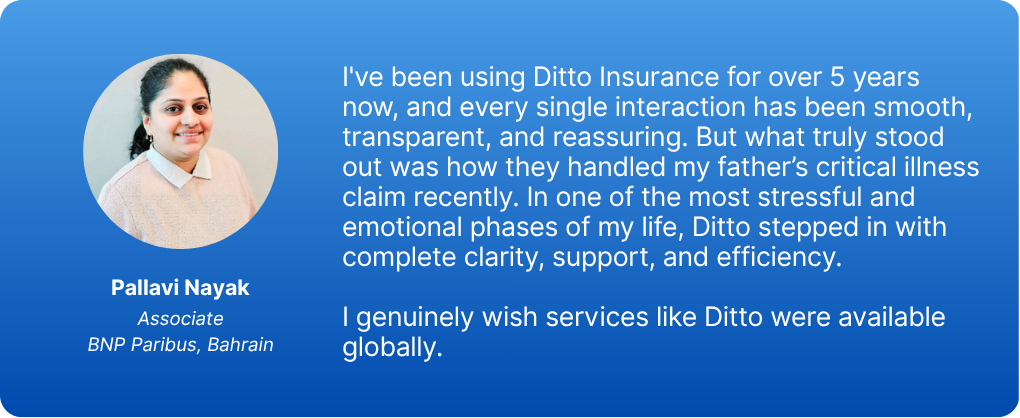
At Ditto, we’ve assisted over 8,00,000 customers with choosing the right insurance policy. Why customers like Pallavi below love us:
- No-Spam & No Salesmen
- Rated 4.9/5 on Google Reviews by 25,000+ happy customers
- Backed by Zerodha
- Dedicated Claim Support Team
- 100% Free Consultation
Confused about the right insurance? Speak to Ditto’s certified advisors for free, unbiased guidance. Book your call or chat on WhatsApp with us now!
Ditto's Take
Your employer’s group insurance policies (health, accident, and term) are useful benefits, but they should not be your only safety net. These covers are tied to your job, your company’s policy terms, and the sum insured your employer chooses.
That is why you should have your own individual health insurance policy. It stays with you across jobs, gives you control over the cover amount and benefits, and protects you even if your employer’s coverage changes.
Similarly, if your family depends on your income, do not rely only on group term life cover. Buy a personal term insurance policy that is independent of your employer and large enough to protect your family’s long-term needs.
To choose well, read Ditto’s guides on the best health insurance plans in India and the best term insurance plans in India.
Disclaimer: Group products like GMC and GPA are not currently part of Ditto's product offerings. Ditto's advisory services focus on personal health insurance and term life insurance.
Frequently Asked Questions
Last updated on: