



Overview
Most Indians know their insurance company, maybe HDFC Ergo, Care Health, Aditya Birla Health Insurance, or another insurer. But very few know the institution that quietly supports these insurers from behind the scenes. That is where General Insurance Corporation of India, or GIC Re, comes in.
It is India’s national reinsurer and a listed company majority-owned by the Government of India. GIC Re is also identified by the Insurance Regulatory and Development Authority of India (IRDAI) as a Domestic Systemically Important Insurer (D-SII), which means it plays a critical role in India’s insurance system.
This guide explains how the General Insurance Corporation of India functions, why it matters to insurers, and what its role means for policyholders indirectly.
What is the General Insurance Corporation of India?
The General Insurance Corporation of India is a public sector undertaking (PSU) incorporated under the General Insurance Business (Nationalization) Act. Headquartered in Mumbai, it became India's apex reinsurance body and has since grown into one of Asia's largest reinsurers.
Originally, GIC Re functioned as a holding company for four public sector general insurers:
- New India Assurance
- Oriental Insurance
- United India Insurance
- National Insurance Company
In 2000, those four became independent entities, and GIC Re was restructured exclusively as a reinsurer. That means it does not sell policies directly to individuals. It is also listed on the Bombay Stock Exchange (BSE) and the National Stock Exchange (NSE).
Talk to an expert
today and
find
the right
insurance for you.


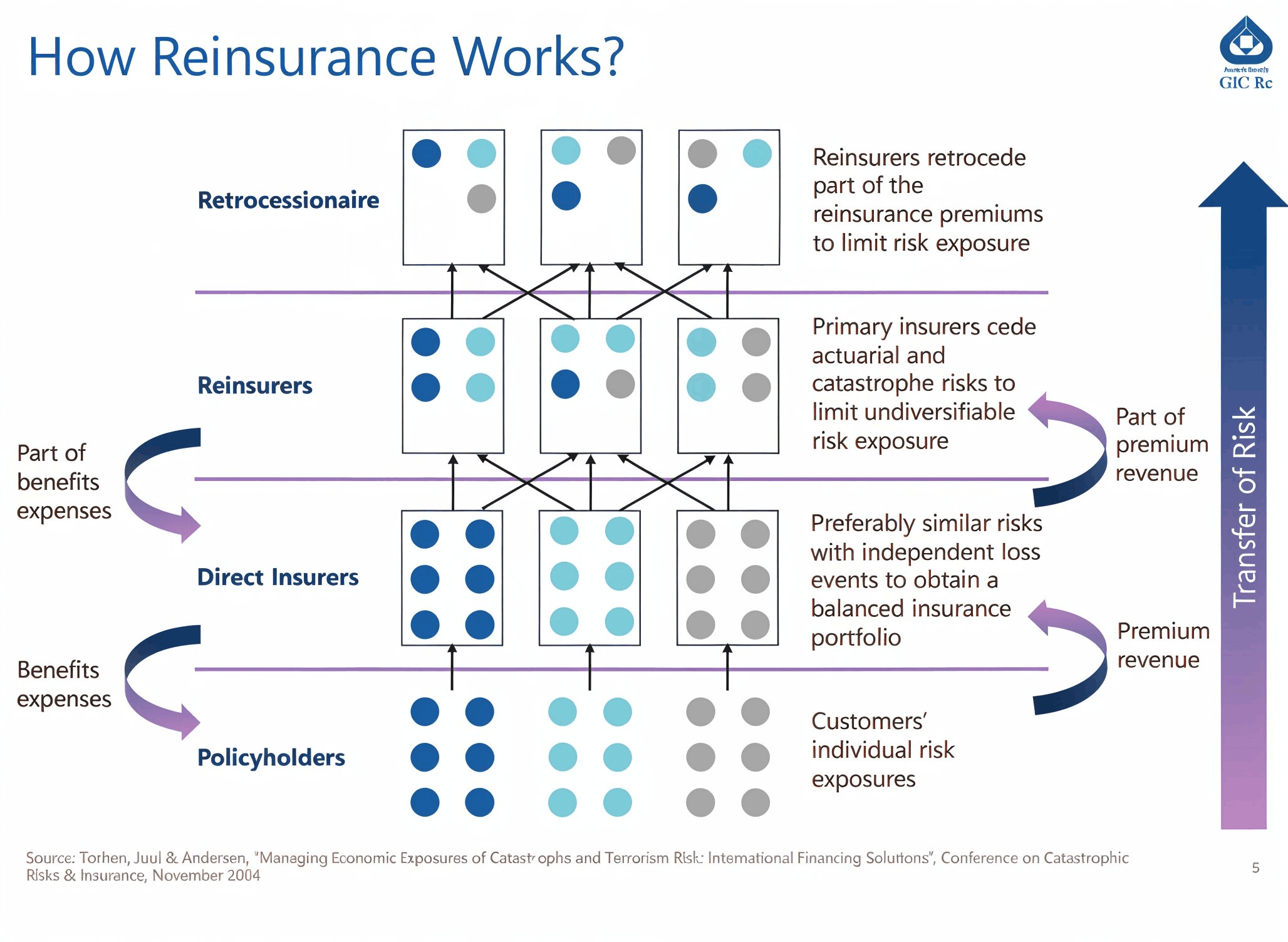
The following infographic explains how reinsurance works in India from GIC Re’s point of view:

Key Functions of GIC Re in Indian Insurance
Mandatory Cession
IRDAI mandates that every general insurer operating in India must share a fixed percentage of its premiums with GIC Re before approaching international reinsurers. This is called obligatory cession and currently stands at 4% (reduced from earlier higher levels as the market matured).
Risk Absorption
GIC Re absorbs catastrophic and large-ticket risks, including industrial fires, aviation accidents, and natural disasters such as cyclones and floods. This ensures that individual insurers do not bear the consequences alone.
Crop Insurance Support
Under the Pradhan Mantri Fasal Bima Yojana (PMFBY), GIC Re plays a key role in reinsurance for agricultural risks. It provides a financial safety net for millions of Indian farmers against weather-related crop losses.
Retrocession
GIC Re does not retain 100% of the risk it accepts. It further redistributes portions of very large risks to international reinsurers through a process called retrocession to maintain its own financial balance.
International Operations
GIC Re operates branch offices in London, Dubai, Moscow, Kuala Lumpur, and Suva (Fiji), and has clients across multiple countries. This international diversification reduces its dependence on domestic catastrophe events.
Technical Support and Capacity Building
The reinsurer provides actuarial, underwriting, and technical support to smaller Indian insurers. It helps them price risks more accurately and improve overall industry standards.
GIC Re's Role in the Reinsurance Market
India's reinsurance market is still maturing, but GIC Re dominates with over 50% market share. This makes it the single largest recipient of domestic reinsurance premiums. In FY 2024-25 alone, GIC Re reported the following achievements:
Source: GIC Re Annual Report 2024-25
From a claim stability standpoint, GIC Re's ability to honor its reinsurance obligations directly determines how smoothly your insurer can settle large claims. A financially weak reinsurer means insurers face liquidity stress, delays occur, and ultimately, policyholders bear the brunt. GIC Re's government backing provides a critical buffer against that scenario.
That said, GIC Re has faced challenges. In years marked by above-average catastrophe activity, like the Kerala floods (2018) or Cyclone Amphan (2020), its combined ratio (a measure of underwriting profitability) was stretched.
Despite these challenges, GIC Re has managed its risks effectively and remained profitable in its core insurance business.
Why GIC Re Matters for Your Insurance Policy?
As a policyholder, you may never interact with the General Insurance Corporation of India directly. You do not buy a policy from it, raise claims with it, or receive payouts from it. Your insurer remains responsible for approving and paying valid claims.
However, GIC Re still matters because it strengthens the financial system behind your insurance policy. When insurers face unusually large or numerous claims simultaneously, reinsurance helps them manage the pressure without placing their own solvency under severe stress.
For policyholders, this matters in three practical ways:
- It improves claim-paying stability during large losses.
- It helps insurers offer higher coverage limits.
- It reduces pressure on insurers during catastrophe-heavy years.
Why Choose Ditto for Insurance?
At Ditto, we’ve assisted over 8,00,000 customers with choosing the right insurance policy. Why customers like Vijay below love us:
- No-Spam & No Salesmen
- Rated 4.9/5 on Google Reviews by 15,000+ happy customers
- Backed by Zerodha
- Dedicated Claim Support Team
- 100% Free Consultation
You can book a FREE consultation. Slots are running out, so make sure you book a call now or chat with us on WhatsApp!
Ditto’s Take on GIC Re
The General Insurance Corporation of India is India's only national reinsurer. The government-owned entity absorbs large portions of risk from every non-life insurance company operating in the country.
Although GIC Re does not directly affect you as a policyholder, it is beneficial to understand how it supports the broader insurance system. It helps insurers remain financially stable during large-claim events, such as floods, cyclones, crop losses, or a sudden spike in health claims.
In simple terms, while your insurer handles your policy and claim directly, GIC Re works in the background to ensure that they have enough risk-sharing support when claims become unusually large.
Frequently Asked Questions
Last updated on: