
Overview

The top 10 term insurance companies in India by annual business include Life Insurance Corporation of India (LIC), SBI Life, HDFC Life, ICICI Prudential, Bajaj Life, Axis Max Life, Tata AIA, Aditya Birla Sun Life, Kotak Life, and PNB MetLife. Industry performance is generally assessed using life insurance metrics such as Annualized Premium Equivalent (APE) and New Business Premium (NBP). These rankings based on overall new business premium and annual business volume reflect strong market performance across the life insurance sector.

At Ditto, we consider insurers with ₹5,000 crore+ in annual business volume as one of several evaluation factors when choosing the best term insurance companies. This guide suits those who wish to explore some of the largest and most established term insurance companies in India.

According to the IRDAI Annual Report 2024–25, India's life insurance industry generated over ₹3.9 lakh crore in new business premiums, up about 5% year-on-year. But when buying term insurance, size alone is not enough. The insurer's scale, track record, claims experience, and long-term stability all play a crucial role in protecting your family's financial future.

In the next few minutes, this guide will walk you through the top 10 term insurance companies in India by annual business and explain how the rankings were calculated.

Top 10 Term Insurance Companies by Annual Business

RankLife InsurerFY 2022-23FY 2023-24FY 2024-25Average (FY 2022-25) in Crore
1Life Insurance Corporation of India₹2,32,050.6₹2,22,671.00₹2,26,785.49₹2,27,169
2SBI Life₹29,588.6₹38,238₹35,577₹34,468
3HDFC Life₹28,683.1₹29,631.4₹33,365.3₹30,560
4ICICI Prudential Life₹17,412.5₹18,678.2₹23,230.6₹19,774
5Bajaj Life₹10,737.8₹11,493.8₹12,292.9₹11,508
6Axis Max Life₹8,959.6₹11,023.1₹12,173.6₹10,719
7Tata AIA Life₹8,540.0₹8,898.4₹10,321.7₹9,253
8Aditya Birla Sun Life₹7,672.8₹8,100₹10,220₹8,664
9Kotak Mahindra Life₹7,668.7₹8,657₹8,214₹8,180
10PNB MetLife₹3,219.42₹3,410₹4,695₹3,775

Note: Annual business volume figures are based on the latest available data up to FY 2024–25 and sourced from the insurer’s public disclosures. Data for FY 2025–26 has not yet been fully released and is currently being compiled by insurers. 

These figures represent each insurer's total new life insurance business across all product categories, including term insurance, endowment plans, Unit Linked Insurance Plans (ULIPs), annuities, and group insurance. Since term insurance typically accounts for only a small portion of an insurer's overall premium income, these numbers should be viewed as a measure of an insurer’s scale rather than of term insurance sales alone.

The Life Insurance Council also publishes monthly new business performance data. This allows users to track insurer performance and business trends on a month-by-month basis.

CTA

How We Ranked These Companies

Our ranking is based primarily on the insurer's annual business volume, which reflects the scale of new premiums generated during the year. 

Here’s how we calculate the annual business:

    • Add the total first-year premium and single premium for the financial year.
    • Convert the resulting figure from lakh to crore.
    • The final number represents the insurer's annual business volume used for term insurance comparison.

Note: At Ditto, we do not consider renewal premiums for this ranking because they reflect business generated in prior years. Instead, we focus on first-year premiums and single premiums, as these better capture an insurer's ability to attract new customers and generate fresh business today.

What Annual Business Tells You 

    • Operational Scale & Stability: Higher annual business volumes often indicate a larger and more established insurer. Scale can help improve operational efficiency, strengthen servicing capabilities, and support smoother claims management.
    • Market Presence & Growth: Tracking annual business over time provides insight into whether an insurer is attracting new customers and expanding its footprint in the life insurance market. Consistent growth often reflects strong distribution and brand trust.
    • Business Sustainability: A steady flow of new premium income supports healthy cash flows and business continuity. It can also indicate that the insurer remains relevant and competitive in acquiring new policyholders.

However, annual business volume should not be viewed as a direct indicator of claim approval, customer experience, or product quality. A claim is ultimately paid based on its validity and the insurer's claims process, not on the insurer’s size. 

Similarly, insurers with comparable premium volumes can deliver very different service standards, turnaround times, and grievance resolution experiences.

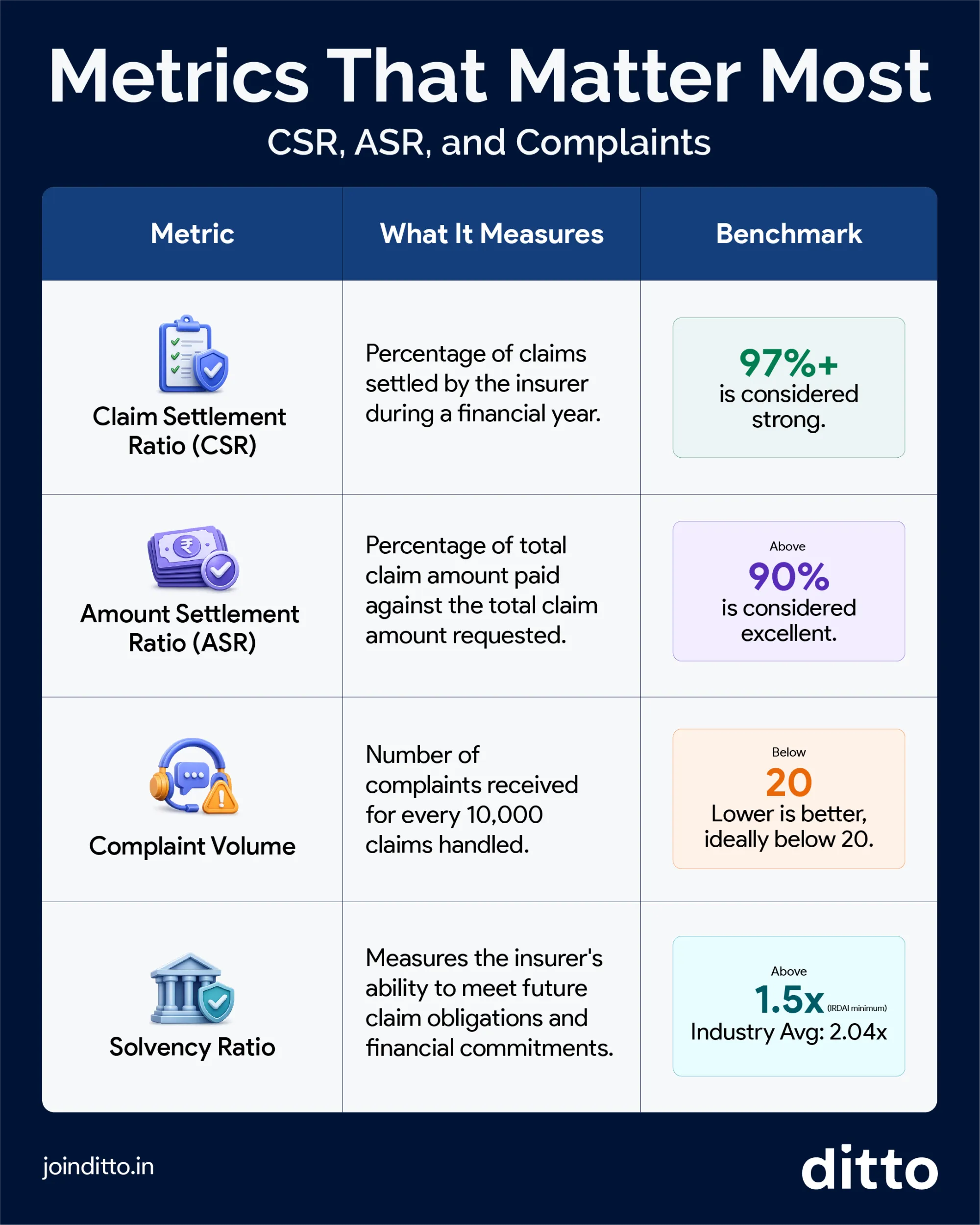
Metrics That Matter More Than Size: CSR, ASR, and Complaints

MetricWhat It MeasuresBenchmark
Claim Settlement Ratio (CSR)Percentage of claims settled by the insurer during a financial year.97%+ is considered strong.
Amount Settlement Ratio (ASR)Percentage of total claim amount paid against the total claim amount requested.Above 90% is considered excellent.
Complaint VolumeNumber of complaints received for every 10,000 claims handled.Lower is better, ideally below 20. 
Solvency RatioMeasures the insurer's ability to meet future claim obligations and financial commitments.Above 1.5x (IRDAI minimum) while the industry median is about 2.04x.
Background Image

How to Choose the Right Term Insurance Company for You

01

Evaluate Claims Metrics Altogether

Do not rely on a single metric when assessing an insurer. Instead, look at the complete picture, including CSR, ASR, complaint levels, claim handling reputation, and steady trends.

02

Review Long-Term Consistency

Focus on insurers that have delivered stable performance over multiple years. A consistent track record is often more meaningful than a single year of exceptional growth or unusually strong claims numbers.

03

Assess the Service Experience

Look beyond pricing and features. Consider the ease of buying the policy, the medical examination process, customer support quality, nominee assistance, and claim documentation support. For term insurance, both your purchase experience and family's claims process should be smooth.

Common Mistakes When Picking a Term Insurer

    • Do not choose a term insurer solely because it offers the lowest premium. Pricing differences may arise from underwriting standards, product design, or feature limitations.
    • Do not assume public-sector insurers are automatically safer or private insurers are automatically better. Both operate under the same IRDAI regulations and solvency requirements.
    • Pay attention to the claim support infrastructure. Dedicated claims teams, nominee assistance, digital claim submission, and clear documentation processes can make a significant difference when your family needs to file a claim.
    • Treating Claim Settlement Ratio (CSR) as the only decision-making metric without evaluating complaints, Amount Settlement Ratio (ASR), and solvency.
    • Allowing brand recognition, advertising, or agent recommendations to outweigh objective claims data and product features.
    • Overlooking exclusions, waiting periods, claim conditions, and policy definitions that can significantly impact payouts.
    • Misrepresenting or omitting details about health, income, occupation, smoking habits, or lifestyle factors during the application process.

Once the insurer is chosen, mistakes can be made while selecting the correct plan as well. Some mistakes to avoid while buying a term insurance policy include purchasing unnecessary riders or choosing the wrong sum assured. To get an understanding, use our cover calculator to find an estimated term cover for you. 

Why Choose Ditto for Term Insurance?

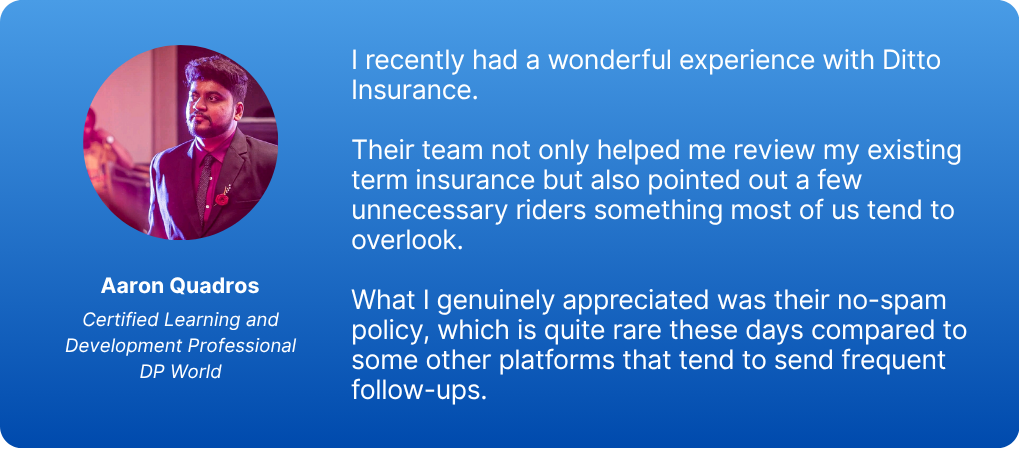
At Ditto, we’ve assisted over 8,00,000 customers with choosing the right insurance policy. Why customers like Aaron below love us:
Top 10 Term Insurance Companies in India by Annual Business
    • No-Spam & No Salesmen
    • Rated 4.9/5 on Google Reviews by 24,000+ happy customers
    • Backed by Zerodha
    • Dedicated Claim Support Team
    • 100% Free Consultation

You can book a FREE consultation. Slots are running out, so make sure you book a call or chat on WhatsApp now!

Conclusion

When choosing a term insurer, avoid focusing on a single metric. The ideal insurer combines strong scale, consistent claims performance, good customer experience, healthy solvency, and a reliable product portfolio.

Scale is not everything, but it does matter. A ₹5 crore claim is relatively small for an insurer that generates ₹10,000 crore or more in fresh annual business. For a much smaller insurer with only ₹100 crore in new business, the same claim represents a far larger obligation. Larger insurers often benefit from stronger financial resources, broader distribution, and more established claims infrastructure.

If you wish to explore some term plans from established term insurers, refer to our guide on the best term insurance plans in India in 2026.

Disclaimer

We strive to maintain the highest standards of accuracy across all articles, guides, and insurer comparisons. If you identify any factual errors, outdated metrics, or discrepancies, please contact our Editorial Team at editorial@joinditto.in for review.

Please include:

  • Source URL: The exact webpage or document containing the relevant data.
  • Identified Discrepancy: The specific metric, figure, statement, or section that requires correction.
  • Supporting Evidence: Official regulatory filings, insurer disclosures, statutory returns, or other credible sources that validate the proposed update.

Frequently Asked Questions

What are the top 10 term insurance companies in India by annual business?

Based on FY 2024–25 annual business volumes, the top 10 term insurance company in India are LIC, SBI Life, HDFC Life, ICICI Prudential, Bajaj Life, Axis Max Life, Tata AIA, Aditya Birla Sun Life, Kotak Life, and PNB MetLife. LIC remains the clear market leader (57%+ market share) with new annual business premiums exceeding ₹2.26 lakh crore, followed by SBI Life and HDFC Life. While these rankings reflect scale and market presence, they should not be the sole basis for selecting a term insurer. Claims performance, customer experience, solvency, and product quality are equally important factors to evaluate.

What are the top 5 term insurance companies in India?

Based on annual business volume and overall market presence, the top 5 term insurance company in India are LIC, SBI Life, HDFC Life, ICICI Prudential Life, and Bajaj Life. These insurers collectively account for a significant share of the country's life insurance market and offer a range of term insurance products with varying features and pricing. However, the best term insurer for you may not necessarily be the largest one. At Ditto, we recommend evaluating claims metrics, complaint levels, solvency ratio, product features, and customer support alongside insurer size before making a decision.

Why is Claim Settlement Ratio (CSR) more important than company size?

Company size tells you how large an insurer is, while the claim settlement ratio shows how consistently it settles claims. A large insurer with weak claims performance may not necessarily provide a better experience than a smaller insurer with strong claims metrics. CSR reflects the percentage of claims settled during a financial year and offers insight into the insurer's claims track record. At Ditto, we prefer to look at CSR alongside the amount settlement ratio, complaint ratio, and service quality. A balanced assessment is usually more useful than focusing only on business size or a single claims metric.

How much annual business volume should a term insurance company have?

There is no regulatory minimum annual business requirement for choosing a term insurer. However, at Ditto, we prefer insurers with annual business volumes above ₹5,000 crore as one indicator of scale and operational maturity. Larger insurers often benefit from stronger distribution networks, better infrastructure, and greater financial resources. That said, annual business should not be viewed in isolation. A smaller insurer with strong claims performance, low complaint levels, and good customer support may still be a suitable choice. The goal is to balance scale with overall insurer quality.

What is the difference between LIC and private term insurance companies?

LIC is India’s largest life insurer and operates as a public-sector company, while insurers such as HDFC Life, SBI Life, ICICI Prudential, and Axis Max operate in the private sector. Both public and private insurers are regulated by IRDAI and must meet the same solvency requirements. LIC benefits from its long operating history and extensive reach, while private insurers often focus on digital experiences and flexible advanced features like a premium break. At Ditto, we do not recommend choosing an insurer solely because it is public or private. Claims performance, service standards, and policy features matter far more.

Should I buy term insurance from the largest company by annual business?

Not necessarily. A large insurer may offer financial strength, operational scale, and a long track record, but that does not automatically make it the best choice for every buyer. The right insurer depends on a combination of factors, including claims performance, complaint levels, underwriting practices, customer support, and policy features. At Ditto, we view annual business volume as one useful indicator, not the deciding factor. A well-managed insurer with strong claims metrics and a product that matches your needs can be a better fit than simply choosing the largest insurer in the market.

How has annual business growth trended among top term insurance companies?

Most leading life insurers have reported steady growth in annual business over recent years. Companies such as SBI Life, HDFC Life, ICICI Prudential, and Axis Max have consistently expanded their new business volumes, reflecting stronger customer acquisition and broader market penetration. LIC has maintained its dominant position while continuing to generate substantial fresh business. Consistent growth over multiple years is often a positive sign, indicating sustained customer trust and business momentum. However, growth should always be evaluated alongside claims performance, profitability, and customer service quality.

What metrics should I check beyond annual business volume when choosing a term insurer?

Annual business volume provides useful information about scale, but it is only one part of the picture. At Ditto, we recommend reviewing Claim Settlement Ratio (CSR), Amount Settlement Ratio (ASR), complaints per 10,000 claims, solvency ratio, and overall claims reputation. It is also worth examining the insurer's customer support quality, underwriting process, nominee assistance, and policy features. No single metric can determine the best term insurance company in India. A balanced assessment across claims performance, financial strength, customer experience, and product quality usually leads to a more informed decision.

Last updated on: