Term insurance for freelancers provides life cover for a chosen policy term. Unlike many salaried employees, freelancers may not have employer-sponsored group cover, so an individual term plan helps protect their family even if their income is irregular.
Key Features for Freelancers
Income-Based Underwriting: Insurers usually ask for 2–3 years of Income Tax Returns (ITRs), with an income computation and bank statements.
Cash-Flow Flexibility: Some plans offer limited pay or cover continuance, letting you defer premiums while keeping your cover.
Buying Steps
Estimate Cover and Tenure: Add up your family's expenses, loans, and goals, and choose how long the cover should last.
Compare Plans: Check features, riders, premiums, and insurer metrics.
Gather Documents: Keep your PAN, Aadhaar, ITRs, and health details ready.
Apply and Pay: Disclose everything honestly, complete any medicals, and pay the first premium.
According toNITI Aayog's report on India's Gig and Platform Economy, India had about 77 lakh gig workers in FY 2020-21, and this number is projected to reach 2.35 crore by FY 2029-30. Many of them, including freelancers, have no employer-provided life cover, so their family's finances depend entirely on their own income.
Term insurance for freelancers fills this gap, but insurers judge your income differently from a salaried employee's, which can affect how much cover you get.
In this guide, we break down the eligibility rules, the best term plans for freelancers, sample premiums, the documents you need, and what to look for in a plan.
Age: Entry from 18 years, with a maximum entry age of 60 or 65, depending on the plan.
Income: Minimums vary by insurer and plan. For self-employed graduates, Ditto's recommended plans generally range from about ₹4 lakh to ₹5 lakh a year, and can go higher depending on other profile details.
Income Records: Insurers generally ask for 2 to 3 years of ITRs with a computation of income, and bank statements showing regular credits. They may request other or alternate proofs if needed and as per their underwriting.
Type of Income: Insurers count only professional or business income. Capital gains, F&O, trading, and interest income don't count.
Health and Lifestyle: Your medical history, existing illnesses, smoking habits, alcohol consumption, occupation, and lifestyle risks can influence underwriting. Depending on the findings, the insurer may approve the proposal at standard rates, charge an additional premium, reduce the cover or tenure, postpone or decline the application.
There's no separate term insurance plan for freelancers. You buy a regular term plan, subject to the insurer's financial and medical underwriting requirements. Here are Ditto's top-ratedterm insurance plans and the features that may suit freelancers, withratings based on our standard recommendations:
Offers an optional critical illness rider covering up to 64 illnesses. Also has an in-built feature that lets you defer premiums for up to 12 months after 3 policy years, while your cover stays active.
Pays part of the claim within 1 working day of claim registration, after the first policy year, so your family gets funds quickly. Also offers a premium break after 5 policy years.
Life stage benefit lets you raise cover by up to 50% on marriage, 25% for each of your first two children, and up to 100% on a home loan, subject to policy limits.
Cover continuance lets you defer premiums for up to 12 months after completing 5 policy years, while full cover stays active subject to conditions. Also offers optional accelerated critical illness cover for 42 illnesses.
Talk to an expert today and find the right insurance for you.
Sample Premium Illustration by Age and Cover
The illustrative annual premiums below are for healthy, self-employed, non-smoking profiles in Delhi (pincode: 110010), buying ₹2 crore cover till age 70, excluding first-year discounts. Actual premiums will differ based on your profile, the options you choose, and the insurer's underwriting.
Profile
Axis Max Life Smart Term Plan Plus
HDFC Life Click 2 Protect Supreme Plus
ICICI Life iProtect Smart Plus
Bajaj Life eTouch II
25, Male
₹18,952
₹19,280
₹17,184
₹16,471
25, Female
₹16,110
₹16,388
₹14,606
₹15,946
30, Male
₹23,234
₹24,300
₹21,449
₹21,187
30, Female
₹19,750
₹20,655
₹18,232
₹17,238
35, Male
₹28,336
₹32,350
₹28,520
₹27,563
35, Female
₹24,086
₹27,497
₹24,242
₹22,807
Key Takeaway: A 35-year-old man pays ₹27,563 to ₹32,350 a year for ₹2 crore cover, depending on the insurer. That's about 50% to 68% more than at 25, so buying early keeps your premium low for the whole term.
Bajaj Life has the lowest premium for most profiles, while HDFC Life has the highest, by about 12% to 21%. Women generally pay up to 15% less than men of the same age with HDFC Life, Axis Max Life, and ICICI Life.
If the policyholder passes away during the policy term, the payout can help replace the income their family relied on. This is particularly important because freelancers don't have employer-sponsored life cover and may not have other financial protection.
02
Premium Certainty
Once you purchase the policy, your premium stays fixed for the entire policy term, giving you clarity on your long-term financial commitment.
03
Loan Protection
The payout can help your family repay any outstanding home, car, or business loans.
04
Protection of Beneficiaries
Under Section 6 of the Married Women's Property Act, 1874, a married man can hold his policy in trust for his wife and/or children. If the statutory conditions are met, the payout is generally protected from his creditors.
05
Tax Benefits
Under the old tax regime, premiums qualify for a deduction under Section 80C (now Section 123 of the Income-tax Act, 2025), subject to the applicable conditions and the overall ₹1.5 lakh limit. The payout to your nominee is tax-free under Section 10(10D) (now Section 11, read with Schedule II, of the Income-tax Act, 2025). Read more about term insurance tax benefits.
Documents Required to Buy Term Insurance as a Freelancer
Identity and Age Proof: Aadhaar card, PAN card, or passport.
Address Proof: Aadhaar card, passport, or driving license.
Income Proof: ITRs with a computation of income for the last 2 to 3 years, and bank statements showing regular credits. The insurer may ask for other proofs if needed.
Supporting Documents: GST returns, Form 26AS, and business registration certificates, contracts, invoices, and other business records may help establish the nature and continuity of your professional income.
Bank Details: A canceled cheque or bank statement showing your name, account number, IFSC, and MICR, as requested by the insurer.
Other Details: Disclose your existing life insurance policies, previous applications, medical history, and any other information requested in the proposal form or during underwriting. Do not withhold material information.
What Should Freelancers Look for in a Term Plan?
When comparing a term insurance plan for freelancers in India, check these four things:
Adequate Cover and Policy Term
At Ditto, we use the expense and liability replacement method. We project your family's living expenses for as long as they'll depend on your income, adjust for inflation, and add outstanding loans and major goals like your children's education. Then subtract any existing life cover to find the extra protection you need. Choose a policy term that lasts until your dependents are independent, your loans are paid off, and liabilities are taken care of, usually till age 60 to 70. Use Ditto's cover calculator for a rough estimate.
In-Built Features
Look for features that help with irregular income, such as a premium break, which lets you defer premiums for up to a year without losing cover during a slow season. The rules vary by plan, and you usually have to pay the deferred premium later. Additionally, check for benefits like Life Stage Benefits, Terminal Illness, Instant Payout on Claim Intimation, and Health and Wellness Services.
Relevant Riders
At Ditto, we generally recommend Critical Illness (CI) and Waiver of Premium (WOP) riders. A CI rider pays a lump sum if you're diagnosed with a covered illness, and a WOP rider waives future premiums on critical illness or disability. Benefits vary by rider. Avoid Accidental Death Benefit (ADB) and Return of Premium (ROP) riders, since the base plan already covers accidental death and ROP plans can cost 60–100% more.
Premiums and Company Metrics
Compare premiums for the same cover across insurers, then check each insurer's operational metrics like claim settlement ratio, amount settlement ratio, complaint volume, service, and scale. A plan's features matter only if the insurer pays claims smoothly. You can compare insurers on Ditto's best term insurance companies page.
Why Choose Ditto for Term Insurance?
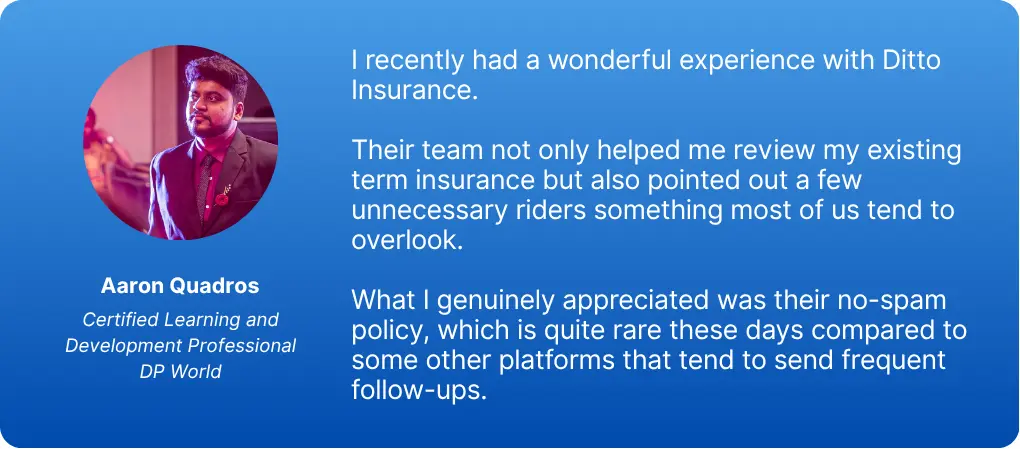
At Ditto, we’ve assisted over 12,00,000 people with choosing the right insurance policy. Why customers like Aaron below love us:
100% Free Consultation
No Spam. No Sales Pressure.
Rated 4.9/5 on Google Reviews by 30,000+ Happy Customers
Backed by Zerodha
Dedicated Claim Support Team
Compare Plans and Premiums with a Trusted Insurance Advisor
You can book a FREE consultation. Slots are running out, so make sure you book a call or chat on WhatsApp now!
Conclusion
As a freelancer, you may be supporting your family on an income that changes from month to month, with no employer cover to fall back on. A term plan ensures your family is looked after even if you're not around. Consistent ITRs and supporting financial records can strengthen your application by helping insurers assess the continuity and financial capacity of your income.
If you don't have standard income proof yet, start with a plan that doesn't need it, and get another regular plan once your documents are in place.
The bigger challenge is keeping your policy active through slow months, so build an emergency fund alongside it. Then, work out how much cover you need and compare plans before you apply.
Frequently Asked Questions
Can a freelancer with GST registration but no ITR buy term insurance?
Yes, but your options are limited. GST registration and returns can strengthen your application, but most standard term plans require ITRs, COIs, and bank statements as proof of income. Without these, plans like Bajaj Life iSecure II and ICICI Life iProtect Super can assess you based on bank balances, credit scores, and investments, with cover of up to ₹2 crore. However, approval and the sum assured aren't guaranteed, and the insurer may request supporting information. If you don't qualify, Saral Jeevan Bima offers basic cover of ₹5 lakh to ₹25 lakh.
How much term cover can a freelancer with irregular income get?
There is no fixed sum assured that every freelancer can obtain. Insurers assess your documented income, financial obligations, existing life cover, age, and occupation before deciding how much cover they can offer. They may consider your ITRs, income computation, and supporting financial records over multiple years. A decline in income or inconsistent documentation can affect the sum assured offered. Minimum income requirements also vary by insurer and product.
Is term insurance for freelancers more expensive than for salaried individuals?
Not necessarily. Term insurance premiums are primarily influenced by age, health, smoking habits, occupation-related risks, sum assured, and policy term. However, some insurers offer special premium discounts to salaried applicants or eligible customer categories. This means premiums can differ for two people buying the same plan. Freelancers may also face additional financial underwriting requirements if their income is irregular or difficult to document. The occupation itself does not automatically mean that the premium will be higher.
Can freelancers pay term insurance premiums monthly instead of annually?
Yes. Most term plans let you pay premiums yearly, half-yearly, quarterly, or monthly. Monthly payments can better match irregular cash flow, but they usually cost about 5% more over a year than paying annually because of modal loading. If your income comes in large, uneven payments, paying yearly or half-yearly and using a big payment to cover the premium can save money. When choosing the best term insurance plan for freelancers, also check whether it offers a premium break for slow months. Setting up auto-debit from a dedicated account also helps you avoid missing a premium.
Does having multiple sources of freelance income affect term insurance eligibility?
Not in itself. Insurers look at your total professional or business income declared in your ITRs, so income from several clients counts together. What matters is that it's documented and stable over 2 to 3 years. However, insurers don't count capital gains, F&O, trading, or interest income. If part of your income comes from these sources, it won't increase the cover you qualify for. Keep your ITRs, COIs, and bank statements consistent with the income you declare.
Can freelancers who work for international clients buy term insurance in India?
Yes. Freelancers living in India and working with international clients can apply for Indian term insurance, subject to the insurer's underwriting requirements. Income earned from overseas clients may be considered if it is properly documented through ITRs, bank statements, and relevant business records. The insurer may also examine your country of residence, travel frequency, and any planned relocation abroad. If you live in India, you can apply for a regular term plan. If you plan to move abroad, disclose this to the insurer, as non-disclosure can void the policy.
Can my family claim term insurance benefits if I die while working or traveling abroad as a freelancer?
Yes. Most Indian term plans cover death anywhere in the world, subject to underwriting conditions and relevant exclusions. Disclose your travel frequency and any plans to live abroad when you apply, as insurers may limit cover or charge more for high-risk countries. To claim, the nominee generally needs a death certificate issued by the competent authority in the country of death, along with other supporting documents as required. The insurer may require embassy attestation or additional verification. The claim is usually paid electronically to the nominee's verified bank account.