Term insurance eligibility depends on the following criteria:
Age: Entry is commonly allowed from 18 up to 60 or 65, with cover up to age 85 or 99-100 (whole life) on some select plans.
Income and Cover: Your income, education, age, and existing life insurance affect how much cover you qualify for.
Nationality: Resident Indians, Non-Resident Indians (NRIs), and Overseas Citizens of India (OCIs) (select plans) can apply.
Health and Lifestyle: Medical history, tobacco or alcohol use, and medical test results can affect approval and premiums.
Occupation: High-risk jobs may require additional checks, higher premiums, or rejection in severe cases.
Documents Needed:
ID proof, address proof, age proof, income proof (such as payslips or ITRs), and medical reports if requested.
Don’t Qualify?
IRDAI’s standard Saral Jeevan Bima offers basic cover of ₹5 lakh to ₹25 lakh with simpler criteria. Approval remains subject to underwriting.
Many people delay buying term insurance because they’re not sure whether they'll qualify. Others begin the application process only to face delays when the insurer asks for documents they don't have. Some applications are turned down, while others are approved for a lower cover amount than requested.
The good news is that term insurance eligibility is based on a few key factors, including age, income, health, and paperwork. Understanding these requirements before applying can help you choose the right plan, avoid common roadblocks, and make the approval process much smoother.
In this guide, we break down the eligibility criteria, who can buy a plan, the documents you need, the rules for NRIs, and how to improve your chances.
Here are the basic rules for eligibility for term insurance in India across most plans:
Parameter
Eligibility
Minimum Entry Age
18 years.
Maximum Entry Age
60 or 65 years, depending on the plan.
Cover Until Age
Usually up to 85, with some select plans going up to 99 or 100 (whole life).
Cover Amount
Usually starts at ₹25 lakh to ₹50 lakh, with no fixed upper limit on most plans, subject to underwriting and your eligibility.
Nationality
Resident Indians and Non-Resident Indians (NRIs), and Overseas Citizens of India (OCIs) on select plans.
Employment Type
Salaried or self-employed with a regular income, and certain other applicants, such as eligible homemakers, subject to insurer rules.
Minimum Income
Usually ₹2.5 lakh to ₹3 lakh a year for salaried graduates and ₹4 lakh to ₹5 lakh for self-employed graduates, though this varies by insurer, plan, and profile.
Education
Graduates generally qualify with all insurers. Class 10th or 12th pass applicants usually need a higher income depending on the overall profile.
Medical Tests
Tele-medical, video, or physical tests, based on profile and insurer’s assessment.
Who Is Eligible to Buy Term Insurance Plans?
01
Young Earners
Anyone 18 or older with a regular income can apply for a plan, provided you meet the insurer’s requirements. Buying in your 20s gets you the lowest premium for the longest cover.
02
Married People and Parents
If a spouse, children, or parents depend on your income, term insurance protects them if something happens to you.
03
Salaried, Self-Employed People, and Freelancers
You qualify if you can show steady income, usually through the eligible income proofs stated below.
04
Homemakers
Even without an income, under select plans, homemakers can get up to ₹1 crore of cover, based on their spouse’s income and existing cover. Read more in our guide on term insurance for housewives.
05
Senior Citizens
Some plans accept applicants up to 65, at higher premiums and with stricter medical checks. You may also need proof of continuing income, as a pension alone may not count. However, you should check whether life insurance for senior citizens fits your needs before buying.
06
NRIs
NRIs and some OCIs can buy Indian term plans, depending on the plan’s criteria and acceptance.
Talk to an expert today and find the right insurance for you.
Factors Affecting Term Insurance Eligibility
Age: The term insurance eligibility age decides both whether you can apply and how long you can be covered. If you apply at 30, you may get cover until 70, 85, or more. If you apply at 60, your options drop.
Income and Education: Insurers check whether your financial profile supports the cover you ask for. They may look at your income and its stability, along with your occupation, education, age, and existing life cover. Some insurers have stricter income rules for non-graduates.
Health and Lifestyle: Conditions such as diabetes, high blood pressure, or obesity can lead to extra tests and a loading (an extra premium) of around 10% to 40%, or sometimes higher, based on their severity and the insurer’s underwriting. Smokers and tobacco users typically pay 60% to 100% more.
Occupation and Lifestyle: Hazardous jobs, such as mining, certain aviation roles, offshore or construction-site work, and risky hobbies like skydiving or scuba diving may need an occupation questionnaire and additional underwriting.
Existing Cover: Insurers consider your existing individual life insurance policies when assessing how much additional cover they can offer.
Residence: Where you live affects which plans you can buy and what you pay. Some insurers, including Axis Max Life, ICICI Life, and Bajaj Life, don’t issue policies in certain restricted (negative) pincodes, while others, like HDFC Life, adjust premiums by pincode instead.
Note: These factors vary by insurer, plan, and profile. Meeting them doesn’t guarantee a policy, since your final cover and premium depend on the insurer's medical, financial, and other underwriting assessments.
Documents Required to Prove Eligibility for Term Insurance
Identity and Address Proof: Aadhaar, PAN, passport, voter ID, or driving license, subject to applicable KYC requirements.
Age Proof: PAN, passport, or Aadhaar.
Photograph and Medical Reports: A recent passport-size photo, plus medical reports if you have a health condition.
Income Proof: Depends on how you earn, as shown below.
Salaried
Self-Employed
Last 2 to 3 months' payslips
ITRs for the last 2 to 3 years
Form 16
Computation of income, certified by a Chartered Accountant (CA), for higher covers
Bank statement showing salary credits
GST returns or Form 26AS, if asked
Note: If you don’t have salary slips or ITRs to prove your income, some term plans assess your financial eligibility in other ways. Read our guide onhow to buy term insurance without income proof.
Term Insurance Eligibility for NRIs
Eligible NRIs can buy Indian term insurance plans online from their country of residence, often without traveling to India.
Criteria
NRI Eligibility
Age
Entry is usually allowed from age 18 to 60.
Income
Most plans require at least ₹10 lakh a year, and some ask for ₹15 lakh to ₹20 lakh, depending on your education.
Self-Employed NRIs
Usually need ITRs for the last 3 years, with income certified by a Chartered Accountant (CA).
Cover
Maximum up to ₹20 crore to ₹25 crore, subject to underwriting. However, these are product caps, not guaranteed eligibility amounts. The insurer determines your actual maximum cover based on financial and medical underwriting, existing insurance, and other risk factors.
Documents
Passport, visa or residence permit, overseas address and income proof, and an NRI questionnaire. Some insurers also ask for FATCA/CRS declarations or passport entry/exit records.
Medical Tests
Usually a video or tele-medical test first. In India, the insurer pays for tests, while some insurers arrange or reimburse tests abroad.
Premium Payment
Through NRE, NRO accounts, or approved overseas payments, depending on the insurer.
OCIs
Some select insurers may accept OCI cardholders, but only after pre-approval and depending on their eligibility criteria.
Tips to Improve Your Term Insurance Eligibility
Buy Early: Buying while you’re young and healthy usually gets you lower premiums for the same cover and more choice in term length. Approval still depends on the insurer’s underwriting.
Quit Tobacco: Quitting can help you qualify for non-smoker premiums after 12 to 36 months without tobacco or nicotine, depending on the insurer.
Manage Your Health: If you have a condition like diabetes or high blood pressure, follow your treatment and keep your medical records ready. Better control may improve your underwriting outcome.
Disclose Everything: Answer every question in the proposal form accurately, including your health, tobacco and alcohol use, occupation, existing policies and past applications.
Ask for the Right Cover: Use Ditto's cover calculator to work out your needs, so you don’t ask for more than you need.
Why Choose Ditto for Term Insurance?
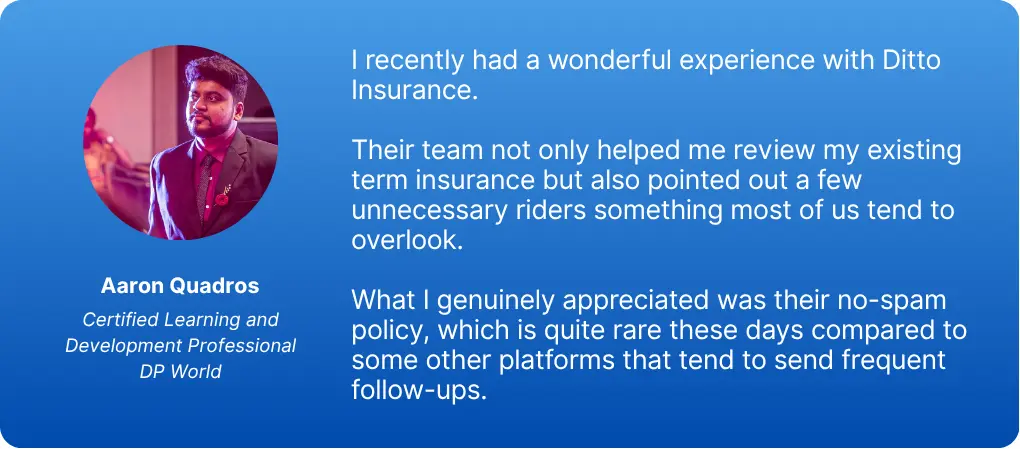
At Ditto, we’ve assisted over 12,00,000 people with choosing the right insurance policy. Why customers like Aaron below love us:
100% Free Consultation
No Spam. No Sales Pressure.
Rated 4.9/5 on Google Reviews by 30,000+ Happy Customers
Backed by Zerodha
Dedicated Claim Support Team
Compare Plans and Premiums with a Trusted Insurance Advisor
You can book a FREE consultation. Slots are running out, so make sure you book a call or chat on WhatsApp now!
Conclusion
Term life insurance eligibility depends on your age, income, health, occupation, and the insurer's requirements. Even if you meet the basic criteria, the insurer may offer lower coverage, charge a higher premium, or decline your application based on its assessment.
Before applying, work out how much coverage your family needs, gather your income documents, and accurately disclose your medical history and lifestyle habits. Then compare thebest term insurance plans in India to find one that suits your needs and budget.
Frequently Asked Questions
Do self-employed individuals without income tax returns qualify for term insurance?
Yes, but your options are limited. Most term plans need two to three years of ITRs from self-employed buyers. A few plans, such as Bajaj Life iSecure II and ICICI Life iProtect Super, accept other proof of financial strength instead, such as bank statements, investments, mutual fund SIPs, a car you own, or a home loan. These plans usually cap your cover, often between ₹25 lakh and ₹2 crore. Maintaining accurate ITRs and financial records can expand your options, although filing returns alone does not guarantee higher coverage.
Is a student without any income eligible for term insurance in India?
Usually not, unless there’s a clear need. Since term insurance replaces income, most insurers don’t cover students without earnings. However, some insurers may cover an adult student who needs to secure a liability, such as an education loan. In such cases, they verify income through the parents’ income or the loan sanction amount. Some also consider financial surrogates, such as SIP amounts, credit card limits, bank balances, or a car’s insured declared value (IDV). The maximum cover is usually ₹1 crore to ₹2 crore. Otherwise, you can apply once you start earning.
Can a freelancer without salary slips get term insurance?
Yes. Insurers usually treat freelancers as self-employed, so you don't need salary slips. Instead, you'll usually need your ITRs for the last two to three years, and for higher covers, a computation of income certified by a Chartered Accountant (CA). Bank statements, GST returns, or Form 26AS can support your application. The key is to show steady income over time. If you haven't filed ITRs, a few plans accept other proof of financial strength, though they usually offer a lower maximum cover.
Does smoking or having a pre-existing medical condition affect term insurance eligibility?
Yes, but it rarely makes you ineligible. Smokers can still buy term insurance, though they usually pay 60% to 100% more. Pre-existing conditions, such as diabetes or high blood pressure, may lead to extra medical tests, a loading, lower cover, or, if the condition isn't under control, postponement or rejection. Always disclose these honestly. Under Section 45 of the Insurance Act, an insurer can question a policy over non-disclosure in its first three years, which can put your family's claim at risk. After three years, claims can still be called into question in cases of proven fraud.
Is a person with a history of mental health treatment eligible for term insurance?
Yes, eligibility is possible, but it depends heavily on the diagnosis, treatment history, and current condition. Insurers may consider symptom severity and recurrence, medication use, hospitalization history, and the applicant’s stability. Mild, well-managed conditions may be considered at standard or higher premiums, while more severe conditions, including bipolar disorder, can face stricter underwriting and may be declined. Insurers may also request psychiatric assessments or treating-doctor reports.
Can a person with a dangerous or high-risk occupation qualify for term insurance?
Yes, in most cases. People in high-risk jobs, such as aviation, offshore work, mining, or construction, can still buy term insurance. The insurer will usually ask you to fill in an occupation questionnaire to understand the risks involved. Based on this, it may approve the policy at standard rates, add a loading, lower the cover, or, in rare cases, decline. Describe your duties, travel, and any hazardous work accurately, because incorrect occupation details can lead to a claim being questioned later.
Can a person with existing loans and financial liabilities qualify for term insurance?
Yes. Having loans doesn't make you ineligible. In fact, outstanding loans are a strong reason to buy term insurance, so your family isn't left to repay them. Insurers look mainly at your income and health when deciding eligibility. When you work out your cover, add your outstanding loans to your family's expenses, so the payout can clear the debt and still support them. Ditto's cover calculator includes your loans for this reason. Unlike a lender's loan cover, which only clears the debt, a term plan also supports your family.