



Term Insurance Eligibility Salary Overview
Before buying term insurance, it’s important to know how much income you need to qualify for coverage, since insurers use salary to determine both eligibility and affordable coverage limits. This blog explains how income affects term insurance approval, the minimum salary needed for different coverage levels, and options available for low-income or self-employed individuals. It also covers how insurers verify income and plans that offer coverage without traditional salary proof, helping you choose a policy that fits your income and protection needs.
Is Salary Required to Buy Term Insurance?
Yes. In most cases, salary or income proof is required to buy term insurance.
This is because term insurance replaces the income you would have earned for your family. If there is no income to replace, insurers see a higher risk or a financial mismatch.
However, traditional salary proof is not always mandatory, especially for people working in the informal sector or without formal income records. Some plans allow alternative verification methods.
Still, income matters because:
- Coverage approval depends on income
- Premium affordability is assessed
So while the income proof required may sometimes be flexible, term insurance eligibility salary remains central to approval.
Note
Minimum Salary Required for Term Insurance in India
Based on current underwriting practices, here is a practical estimate:
Basic Eligibility Benchmarks
Example:
- ₹5 lakh annual income ÷ 12 ≈ ₹41,600 per month
- This income usually qualifies for ₹1 crore coverage.
Insurers consider your fixed salary and consistent allowances when assessing eligibility. Variable components like bonuses or incentives are not considered unless they are consistently earned over time. For self-employed applicants, insurers primarily look at taxable profits declared in ITRs, along with income stability over the past few years, to determine term insurance eligibility.
If you have employer-provided term insurance, insurers may consider your existing employer group term cover while assessing eligibility, and very high existing coverage can slightly reduce the additional coverage they approve to keep total insurance financially justified. You can also apply for additional term insurance later as your salary increases, subject to fresh underwriting and income verification at that time.
Note
Other Factors Affecting Term Insurance Eligibility
Income isn’t the only factor. Eligibility changes depending on:
1.) Education Level
Applicants with higher educational qualifications are often seen as having better income stability, while lower qualifications may require higher income proof to qualify for similar coverage.
2.) Job Stability and Industry Risk
People working in stable industries or long-term roles are usually considered lower risk, whereas high-risk or unstable professions may face stricter eligibility checks.
3.) Age and Medical Profile
Older applicants or those with medical conditions may receive lower coverage eligibility or higher premiums due to increased health risk.
4.) Existing Insurance Coverage
If you already have multiple insurance policies, insurers may limit additional coverage to ensure total coverage remains financially justified. You can use our term insurance cover calculator to find out the perfect coverage for you.
5.) Employer Credibility and Documentation Quality
Applicants working with well-established companies or having proper income documentation often experience smoother approval compared to those with unclear employment records. In fact, you can usually buy term insurance after switching jobs or even while on probation, as long as you can provide income proof and show continued employment and income stability.
6.) Location of Residence
Applicants living in regions considered higher risk due to health, infrastructure, or claim trends may face stricter underwriting or coverage limits.
Term Insurance Eligibility Salary for Self-employed Applicants
Income rules are stricter for self-employed applicants.
Typically:
- Minimum income expected: ₹4 to 5 lakh annually
- Insurers prefer 2 to 3 years of stable income records
- Bank statements, CA Certified computation of income, and ITRs become important
So while salaried individuals may qualify earlier, business owners, freelancers, and people who are paid in cash often need slightly higher income for similar coverage.
Term Insurance Eligibility for Low-Income Individuals
If income is lower, options still exist, but coverage limits apply.
For individuals earning less than ₹2.5 lakh annually, regular term plans may reject applications or approve only small covers. In such cases, the Saral Jeevan Bima helps.
Saral Jeevan Bima
Saral Jeevan Bima is a standard term plan offered by all insurers to help individuals without formal income proof get life cover. It offers coverage between ₹5-25 lakh with simple underwriting and minimal documentation, making it the most practical option for very low-income applicants.
When it comes to purchasing term insurance without formal income proof, knowing about the following plans may come in handy:
Bajaj Life iSecure II
Bajaj Life iSecure II allows applicants without salary slips to qualify using alternate indicators like bank balance, CIBIL score, investments, or asset ownership. It offers higher coverage options, though premiums are typically higher due to relaxed income documentation.
ICICI Prudential iProtect Super
ICICI Prudential iProtect Super offers flexibility for applicants with income but limited documentation, with coverage starting around ₹50 lakh. Insurers may accept alternate financial proofs like bank statements or asset records for approval.
Other alternatives
- Joint life term plans (spouse cover eligibility)
- Term plans for housewives based on the husband’s income
- Coverage through employer group insurance
These help families secure protection even if one member lacks direct income proof.
Note
How Insurers Verify Salary for Term Insurance
Insurers use multiple methods to confirm term insurance eligibility salary:
Standard Verification Methods
- Salary slips and Form 16
- Income Tax Returns
- Bank statements showing salary credits
- Employment verification
Alternate Income Proofs Accepted Today
Many digital insurers now use alternative financial indicators:
- Average bank balance
- Credit score (CIBIL)
- Mutual fund or FD holdings
- Property ownership
- Vehicle ownership
- Loan repayment patterns
- Digital spending behaviour
This shift helps include India’s large informal workforce, where formal salary documents are uncommon. Still, term insurance eligibility salary remains a core underwriting factor, even if methods of verification change.
Why Choose Ditto for Term Insurance?
At Ditto, we’ve assisted over 8,00,000 customers with choosing the right insurance policy. Why customers like Aaron below love us:
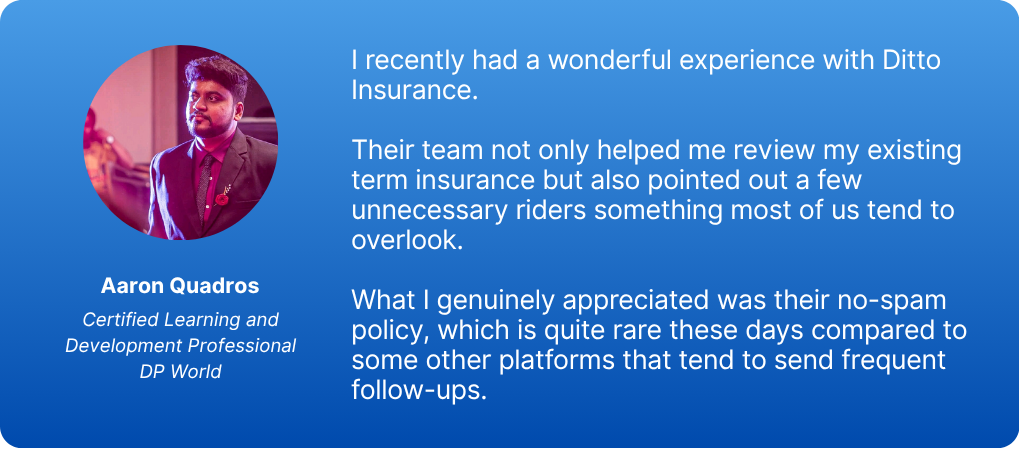
- No-Spam & No Salesmen
- Rated 4.9/5 on Google Reviews by 15,000+ happy customers
- Backed by Zerodha
- 100% Free Consultation
You can book a FREE consultation. Slots are running out, so make sure you book a call or WhatsApp us now!
Conclusion
Understanding term insurance eligibility salary helps you apply for coverage that matches both insurer requirements and your financial capacity. Whether you qualify through regular income proof or alternate verification methods, knowing your term insurance eligibility salary makes it easier to choose the right cover without facing application rejections or affordability issues. The goal is simple: secure adequate protection while keeping premiums comfortably within your income range.
Disclaimer: Bajaj Life Insurance and ICICI Prudential are partner insurers with Ditto. All the information stated in this article is taken from the insurer’s website or publicly available data. It is recommended to do your research and consult an IRDAI Certified advisor before making any decisions.
Frequently Asked Questions
Last updated on: