


Overview
Choosing between ICICI Life and Bajaj Life Insurance involves more than comparing premiums. ICICI has a larger business scale and is the 5th largest life insurer by market capitalization, while Bajaj offers a higher solvency ratio and fewer complaints per 10,000 claims.
In this guide, we compare ICICI Life vs. Bajaj Life Insurance on premiums, claim settlement records, financial strength, customer complaints, and policy features to help you decide which insurer best fits your long-term protection needs.
About the Insurers
ICICI Life
- Offices: 470
- IRDAI Registration Number: 105
- Advisors: 2,42,074
- Employees: 19,303
- Assets Under Management (AUM): ₹3.14 lakh crore as of March 31, 2026
- Ownership Changes: According to Moneycontrol, ICICI Prudential Life Insurance was renamed ICICI Life Insurance Limited on 22 September 2026 amid changes to Prudential’s India operations and ownership structure.
Bajaj Life
- Branches: 598
- IRDAI Registration Number: 116
- Agents: 1,64,917
- Employees: 26,356
- Assets Under Management (AUM): ₹1.46 lakh crore as of September 30, 2026
- Ownership Changes: According to Economic Times, Bajaj Allianz Life Insurance was rebranded as Bajaj Life Insurance on 7 October 2025 following a share purchase agreement with Allianz SE.
Talk to an expert
today and
find
the right
insurance for you.
ICICI Life and Bajaj Life: Performance Metrics
Note: The data represents the insurer's overall performance across insurance products. The data is based on Bajaj Life public disclosures, ICICI Life’s public disclosures, and IRDAI annual reports. Explore the Ditto Data Lab for more insurer metrics.
ICICI Life iProtect Smart Plus vs. Bajaj Life eTouch II: Key Features Compared
- Terminal Illness Benefit: iProtect Smart Plus pays 100% of the sum assured as an accelerated benefit upon terminal illness diagnosis, based on certification by two independent specialists and a life expectancy of six months or less. eTouch II caps this payout at ₹2 crore and waives the premium on the remaining sum assured.
- Life Stage Benefit: Smart Plus allows cover increases at marriage (up to 50%), the first and second child’s birth or adoption (25% each), and home loan disbursement (up to 100%). eTouch II offers increases at marriage (50%, capped at ₹50 lakh), childbirth (25% each, capped at ₹25 lakh), home loan (25%, capped at ₹50 lakh), and children’s education loan (25%, capped at ₹25 lakh).
- Smart Exit: Both iProtect Smart Plus and eTouch II allow policyholders to exit after 25 policy years, provided they are at least 60 years old and not in the final five policy years. ICICI restricts exit during a Premium Break period, while Bajaj disallows it if the Life Stage Benefit was used.
- Premium Break: Smart Plus offers a Premium Break after five policy years, allowing a 12-month premium deferral while cover continues. It cannot be used in the final three policy years, and deferred premiums are due with the next installment. eTouch II offers similar cover continuity after three policy years, subject to timely premium payments, but excludes the final year of the premium payment term.
- Insta Payout on Claim Intimation: Smart Plus offers an accelerated ₹3 lakh payout within one working day of claim intimation, subject to mandatory document submission, a three-year waiting period, and a minimum sum assured of ₹1 crore. eTouch II provides ₹2 lakh within three working days, with a one-year waiting period and minimum cover of ₹50 lakh.
- Health Management Services: Both plans offer health management services to support policyholders’ well-being. The specific services, eligibility criteria, and terms may vary, so check each insurer’s policy documents for details.
Riders Offered

Critical Illness (CI)
Smart Plus offers a critical illness rider covering 20 or 60 illnesses, with a 90-day waiting period and a 15-day survival period. eTouch II covers 10, 25, or 60 illnesses, with a 90-day waiting period and a 14-day survival period. Both offer up to ₹1.5 crore in additional cover for 20 years, subject to limits.
Waiver of Premium
iProtect Smart Plus offers a Waiver of Premium rider with Health and Health Care variants. The Health variant covers 15 critical illnesses and Accidental Total Permanent Disability (ATPD), while the Health Care variant covers ATPD, subject to a 90-day waiting period and a 15-day survival period for CI. eTouch II includes an inbuilt waiver benefit for accidental total permanent disability and terminal illness, subject to a 180-day waiting and survival period.
Accidental Death Benefit
iProtect Smart Plus pays an additional lump sum for accidental death, provided death occurs within 180 days of the accident. The maximum rider cover is ₹3 crore or the base sum assured, whichever is lower. eTouch II offers this rider under select variants, with cover capped at ₹1 crore under Life Shield and Life Shield ROP.
Disability Benefit
Smart Plus pays a lump sum for total and permanent disability caused by an accident, provided the disability occurs within 180 days. Cover starts at ₹5 lakh and is capped at ₹3 crore or the base sum assured, whichever is lower. eTouch II covers partial and total permanent disability, paying 50% and 100% of the rider sum assured, respectively.
Additional Riders Offered by Bajaj Life eTouch II
- Premium Holiday: eTouch II lets you skip premiums for 1, 2, or 3 years during the policy term. The first break is available after five policy years. If unused, the insurer waives the selected number of premiums at the end of the term, as per policy conditions.
- Family Protect - Parental Care Rider: This rider provides additional financial support if the policyholder suffers accidental total and permanent disability (ATPD). It pays 105% of rider premiums paid as a lump sum, plus a monthly income for your parents’ lifetime.
- Care Plus Rider: This health, wellness, and fitness rider offers a lump sum benefit and waiver of rider premiums in case of ATPD. It also includes teleconsultations, doctor and diagnostic vouchers, pharmacy discounts, gym sessions, nutrition support, preventive health checks, and psychologist consultations, subject to policy terms.
At Ditto, we recommend riders such as Waiver of Premium and Critical Illness to strengthen your term insurance coverage against major health and income risks.
Term Plan for Non-Standard Income Profiles
- ICICI Life iProtect Super: The ICICI Life insurance policy offers built-in features such as Premium Break, Smart Exit, and terminal illness cover, along with optional accidental death and disability riders. iProtect Super suits applicants without a stable or formally documented income source, subject to underwriting eligibility.
- Bajaj Life iSecure II: Includes an Early Exit Option (Zero-Cost Exit) and an Auto Cover Continuance Benefit, with optional accident, disability, and critical illness riders. iSecure II caters to salaried and self-employed applicants, including those without formal income documents, subject to eligibility criteria.
Note: In addition to the plans discussed above, ICICI Life offers iProtect Smart ROP and iProtect Care. Bajaj Life also offers other options, including Bajaj Life Superwoman and Bajaj Life Diabetic Term Plan II designed for people with diabetes, subject to eligibility.
Sample Premiums Comparison by Age and Cover
The comparison is based on a healthy, salaried, non-smoking male from Delhi (pincode: 110010), seeking ₹2 crore in term cover until age 65. First-year discounts are excluded.
Note: Actual premiums may vary based on underwriting and individual factors. You can use the Ditto term insurance premium calculator for rough premium estimates.
Pros and Cons of ICICI Life & Bajaj Life Insurance
Pros of ICICI Life
- Broader Business Scale: ICICI Life has a higher annual business volume compared with Bajaj Life.
- Flexible Life Stage Benefits: Policyholders can increase coverage at major life events, including marriage, childbirth, and home loan disbursement, subject to eligibility and underwriting.
Cons of ICICI Life
- Lower Solvency Ratio: ICICI Life has a solvency ratio below Bajaj Life, although both exceed the regulatory minimum.
- Higher Complaint Volume: ICICI records higher complaint volumes compared with Bajaj Life.
Pros of Bajaj Life
- Stronger Solvency Position: Bajaj Life has a solvency ratio of 3.52x, providing a larger buffer than ICICI Life.
- Inbuilt Waiver of Premium: Bajaj Life eTouch II includes a waiver benefit for accidental total and permanent disability and terminal illness, subject to policy conditions.
Cons of Bajaj Life
- Lower Instant Payout: Bajaj offers a ₹2 lakh instant claim payout within three working days, compared with ICICI’s ₹3 lakh payout within one working day for eligible policies.
- Higher Premiums in the Mid-40s: Bajaj Life offers a higher annual premium of ₹53,640 compared with ICICI Life’s ₹45,597 for a 45-year-old healthy male.
Why Choose Ditto for Term Insurance?
At Ditto, we’ve assisted over 12,00,000 customers with choosing the right insurance policy. Why customers like Aaron below love us:
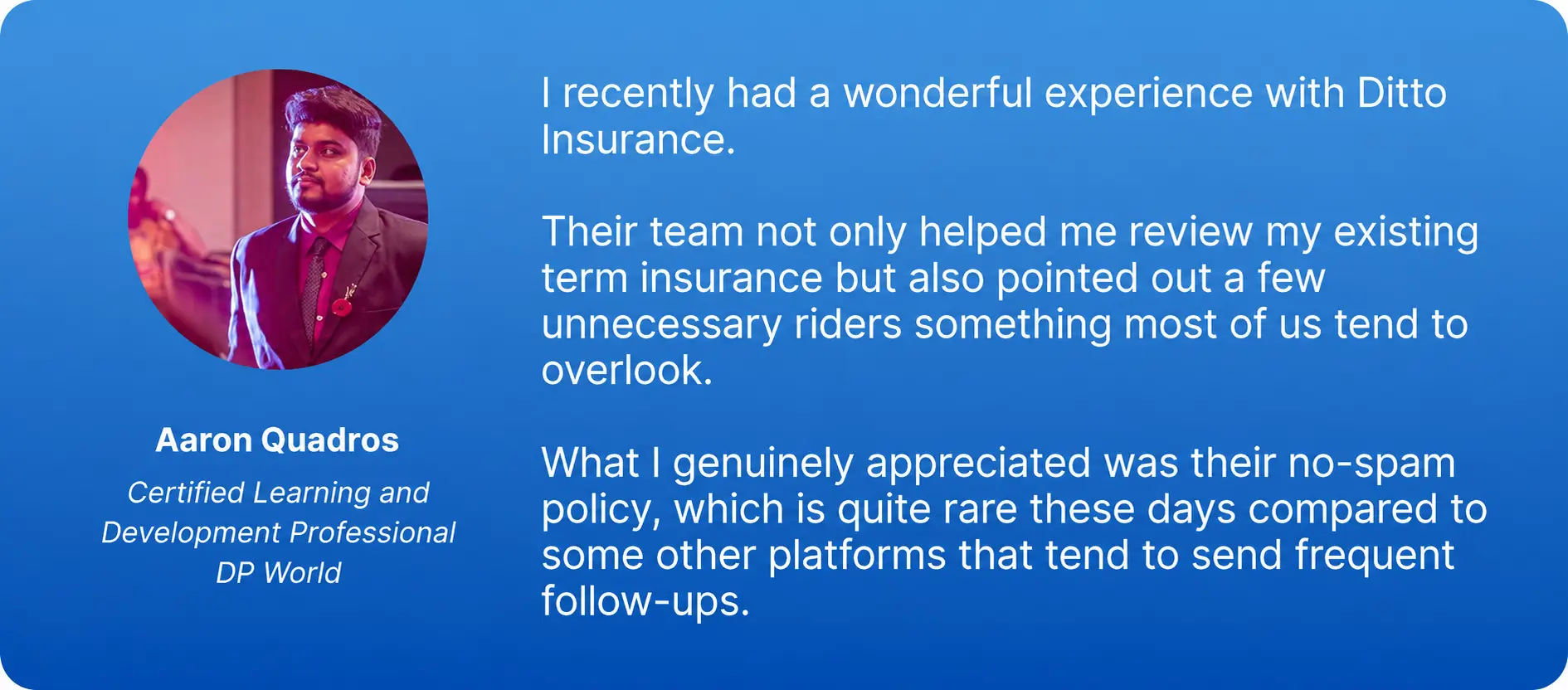
- 100% Free Consultation
- No Spam. No Sales Pressure.
- Rated 4.9/5 on Google Reviews by 30,000+ Happy Customers
- Backed by Zerodha
- Dedicated Claim Support Team
- Compare Plans and Premiums with a Trusted Insurance Advisor
Confused about the right insurance? Speak to Ditto’s certified advisors for free, unbiased guidance. Book your call now or chat with us on WhatsApp. Slots fill up fast!
Conclusion
Both ICICI Life and Bajaj Life Insurance are credible options, but the right choice depends on your coverage needs, premium, insurer metrics, service experience, and preferred policy features.
- Choose ICICI Life if you prioritize larger business scale, life-stage benefits, and a higher instant claim payout for eligible policies.
- Choose Bajaj Life if you value a higher solvency ratio, lower complaint volumes, and an inbuilt waiver of premium benefit.
Both plans feature in our comparison of the best term insurance plans. Compare premiums, exclusions, and rider conditions before choosing the cover that fits your needs.
Frequently Asked Questions
Last updated on: