




Overview
Think about your family for a moment. You work hard every day to give them a good life, a comfortable home, a good education for your kids, and a future full of possibilities. You are their financial superhero.
But have you ever had that thought late at night: "What would happen to them if I wasn't around tomorrow?"
It’s a scary thought, but an important one. Your income covers everything: rent or home loan EMIs, school fees, daily bills, and all the small expenses that keep life running. If that income were to suddenly stop, it would throw your family’s world into chaos, not just emotionally, but financially too.
This is where term insurance steps in. It’s a promise to your family that says, "Even if I'm not here, my financial support for you will be." If you’re planning to buy term insurance and want to understand how to choose the right cover, you can also get a personalised recommendation based on your needs.
Let’s now explore the benefits of term insurance in detail.
Affordable Premiums
One of the biggest myths about life insurance is that it's expensive. While some complex life insurance products, like ULIPs or endowment plans, can be, term insurance is the exact opposite. It is designed to be incredibly light on your pocket, especially when you buy it at the right time. At Ditto, we always say, "The best time to buy term insurance was yesterday. The second-best time is today."
Your Premium Gets Locked-In
The premium you start with gets locked in for the entire policy duration. If you buy a policy at age 25 for a premium of ₹10,000 a year for a 40-year policy term, you will still be paying ₹10,000 a year at age 59. The insurer can’t increase it, no matter how old you get or if your health changes.
For this example, we’ve considered profiles of healthy, non-smoking, salaried individuals living in a tier-1 city like Delhi (pin code: 110010) and covered for a sum assured of ₹2 crore until age 65. The premiums are indicative only and may vary based on your age, health conditions, lifestyle choices, and underwriting decisions.
Financial Protection
The core purpose of term insurance is to create an instant financial safety net. If the policyholder passes away during the policy term, their nominee receives the sum assured. This payout can help them:
- Maintain Their Lifestyle: Your family won’t have to compromise on their standard of living.
- Fund Your Children’s Education: The payout can cover school fees, tuition, and higher education, ensuring your children’s dreams are not sacrificed.
- Cover Daily Household Expenses: From groceries to utility bills, the money provides a financial cushion to manage day-to-day life without stress.
- Secure Your Spouse’s Future: It gives your spouse the financial independence to manage the family without being forced to take up a job immediately, especially if they have been a homemaker.
Income Replacement
Have you ever thought about how much money you’ll earn over your entire career? It’s a massive amount. For example, if you earn ₹10 lakh a year, over a 30-year career, that’s ₹3 crore, without even counting salary hikes.
Your family’s lifestyle is built on this future income, and a term insurance plan is designed to replace it. This is especially critical if you're the sole earner or if your income is significantly higher than your partner's. This is where term life insurance benefits become especially clear.
Flexible Policy Duration and Sum Assured
Policy Term
You can choose how long you want the coverage to last. The general rule of thumb is to take a policy that covers you at least until your retirement age (for example, until 65 or even 70). The logic is that by then, your children would be financially independent, and you would have paid off your major loans. However, there are special cases. For instance, if you have a child with special needs who will be dependent on you for their entire life, you might need longer coverage. For this reason, insurers have started offering cover for whole life (age 99/100 years).
Sum Assured
You also get to choose the amount of cover you need. A young person just starting their career might begin with a ₹1 crore cover, while someone in their 30s with a home loan and two kids might need a ₹3 crore cover. This flexibility ensures you are adequately covered without being over-insured. You can also refer to the cover calculator tool on our website to understand how much term insurance you need.

Multiple Death Benefit Payout Options
Lump Sum
The entire sum assured is paid out at once, making it best for paying off large loans or making large investments. At Ditto, we typically recommend this because it gives your family complete control over the money.
Regular Income
The sum assured is paid out as a fixed monthly income for a set number of years (e.g., 15-20 years). This acts like a monthly salary and is perfect for managing household expenses for families not confident in handling large lump sums.
Lump Sum + Regular Income (Hybrid)
A portion of the sum assured is paid as a lump sum (e.g., 25%), and the remainder is converted into monthly income. Your family can use the lump sum to clear immediate liabilities and use the monthly income for their living expenses.
Talk to an expert
today and
find
the right
insurance for you.


Built-In Terminal Illness Coverage
If you're diagnosed with a terminal illness that's medically certified to cause death within 6-12 months (depending on the insurer), a portion of, or sometimes the full, sum assured is paid out immediately. This early payout can provide immense peace of mind during a very difficult time. This is a valuable feature now included by default in most term insurance policies, such as Axis Max Life Smart Term Plan Plus.
Critical Illness and Other Riders
Critical Illness Rider
Waiver of Premium Rider
Accidental Total and Permanent Disability Rider
Apart from these, insurers may offer additional riders depending on the plan. You can refer to our detailed guide on term insurance riders to find the right fit for your needs.
Debt Repayment and Liability Coverage
Home loans, car loans, and personal loans don’t disappear if something happens to you. They still need to be repaid. Without a term plan, your family may have to dip into savings, sell assets, or struggle to manage EMIs. A well-sized term plan ensures these liabilities are covered. Your family can choose to pay them off or continue the EMIs, depending on their preference.
Modern Features
To attract customers, insurers are constantly innovating and adding new features that provide real value. Some of these modern benefits of term life insurance include:
- Instant Claim Payout: For immediate expenses such as funeral costs, some insurers offer an instant payout of a small amount (out of the total payout) upon reporting the claim. For example, in Axis Max Life Smart Term Plan Plus, nominees can receive up to ₹2 lakh within one working day of claim intimation, provided the first policy year is complete.
- Premium Break Option: Some new-age plans allow you to skip a few premium payments during the policy term if you face a financial emergency, such as job loss, without your policy lapsing. For example, HDFC Life Click2Protect Supreme Plus offers policyholders a premium break for up to 12 months once at least 5 policy years have been completed. It can be exercised multiple times in 5-year intervals
- Life-Stage Benefits: You can increase coverage at major milestones, such as marriage or childbirth. For example, ICICI Life iProtect Smart Plus allows you to increase the sum assured by 50% on marriage, 25% on the birth or legal adoption of first and second children, and 100% on home-loan disbursement, subject to policy conditions.
- Health Management Services: Many insurers now offer value-added health support with their term plans. For example, Bajaj Life eTouch II offers health management services such as medical second opinion, medical case management, and medical consultation. You can also refer to our detailed guide on health management services with term plans
Tax Benefits of Term Insurance
Under Section 80C (old regime), the premiums you pay for your term insurance policy qualify for a tax deduction of up to ₹1.5 lakh per year, which helps reduce your overall taxable income. Additionally, under Section 10(10D), the death benefit payout received by your family is completely tax-free, ensuring that the financial protection you intended for them is delivered in full without any tax burden.
Term Insurance Benefits by IRDAI
Free Look Period
The free-look period is a safety window provided by the Insurance Regulatory and Development Authority of India (IRDAI) that allows you to review your term insurance plan after buying it. You have 30 days to review the policy details. If something doesn’t feel right, you can cancel it and get most of your money back (after deductions like medical, stamp duty, and prorated coverage premium costs). It’s basically a “no-pressure” period to make sure you’re comfortable with your decision.
Grace Period
The grace period gives you extra time to pay your premium if you miss the due date. It’s 15 days for monthly payments and 30 days for yearly or other modes. The important part? Your policy still stays active during this time. Even if something happens to you during the grace period, your family can still receive the claim (after deducting the unpaid premium). This helps you avoid losing coverage due to a short-term delay.
Incontestability Clause (Section 45)
According to Section 45 of the Insurance Act, insurers cannot question or deny claims due to mistakes, missing details, or misstatements in your application after your policy has been active for 3 continuous years. However, claims can still be rejected in cases of proven fraud.
MWP Act
The Married Women’s Property Act (MWP Act), 1874, is a powerful feature for married individuals. If you add this endorsement to your term insurance (under Section 6), the payout becomes legally reserved for your wife and/or children. It ensures your family actually receives the full benefit, even if you have unsecured loans or business liabilities.
How to Choose the Best Term Insurance With the Right Cover?
Choose the Right Sum Assured and Policy Term
Select a sum assured that can genuinely replace your income, clear existing liabilities, and secure your family’s long-term goals. The policy term should align with your financial responsibilities, typically extending until retirement or until major obligations are fulfilled, ensuring continuous protection when it’s needed most.
Evaluate the Insurer
Assess the insurer beyond just premiums by reviewing key metrics like claim settlement ratio, amount settlement ratio, solvency ratio, complaint levels, and overall business performance. These indicators provide a clearer picture of the insurer’s reliability and ability to honor claims efficiently over time. If you’d like to learn more about which insurers perform well, you can refer to our guide on the best term insurance companies in India.
Add Riders Thoughtfully
Avoid overloading the policy with unnecessary add-ons. Instead, choose riders that meaningfully strengthen your coverage without significantly inflating costs. You can improve your base policy with relevant riders, such as critical illness, accidental total or permanent disability, or waiver of premium, based on your lifestyle and risks. For more details on what riders to add to your policy, you can refer to our comprehensive guide on term insurance riders.
Compare Plans
Before finalizing, compare multiple plans across insurers to evaluate premiums, features, exclusions, and flexibility. A thorough comparison helps you identify a policy that balances affordability with comprehensive coverage tailored to your needs. You can also use the plan comparison tool on our website for help.
Get Expert Advice
Get advice from unbiased, advisory platforms like Ditto. This can help you shortlist plans based on your profile, and also get continued support for any changes or claims that you might make later on in your policy.
Why Choose Ditto for Term Insurance?
At Ditto, we’ve assisted over 8,00,000 customers with choosing the right insurance policy. Why customers like Aaron below love us:
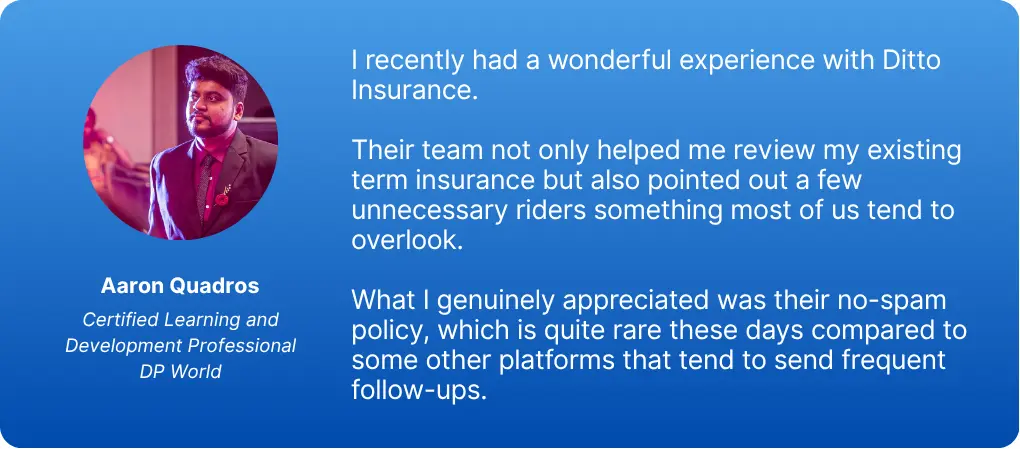
- No-Spam & No Salesmen
- Rated 4.9/5 on Google Reviews by 15,000+ happy customers
- Backed by Zerodha
- Dedicated Claim Support Team
- 100% Free Consultation
You can book a FREE consultation. Slots are running out, so make sure you book a call or chat on WhatsApp now!
Conclusion
There is one final benefit that is almost never discussed in conventional insurance articles, yet it is profoundly real. This is the psychological freedom you gain from owning a term insurance policy. You can:
- Consider quitting a stable but unfulfilling job to start your own business.
- Take a sabbatical to learn a new skill or travel the world.
- Switch careers to a lower-paying but more meaningful role for you.
It gives you the courage to take calculated risks that can lead to a more fulfilling life, benefiting not just your family in the future, but also you, right now.
If you’re ready to start comparing options, you can go through our comprehensive guide on the best term insurance plans in India.
Frequently Asked Questions
Last updated on: