


Overview

Popular pension plans in India fall into three broad categories: government-backed schemes, market-linked retirement products, and private annuity plans. Government-supported options include the National Pension System (NPS), Employees' Provident Fund (EPF), Public Provident Fund (PPF), and Atal Pension Yojana (APY). 

NPS offers market-linked growth with tax benefits, while EPF and PPF provide government-backed returns and long-term retirement savings. On the other hand, APY delivers a guaranteed pension for eligible subscribers. Popular pension and annuity plans in India include LIC New Jeevan Shanti, ICICI Pru Guaranteed Pension Plan, and Tata AIA Fortune Guarantee Pension, which focus on providing predictable post-retirement income through guaranteed annuity payouts and lifetime income options. 

This guide suits people who wish to explore popular pension plans in India and how to purchase the right one.

According to the IRDAI Annual Report 2024–25, pension and annuity products generated combined premiums of ₹1.67 lakh crore, accounting for nearly 18.87% of the Indian life insurance industry's total premium income. As retirement planning gains importance, choosing the right pension plan has become crucial.

This guide breaks down the most popular pension plans in India, including NPS, annuity plans, and retirement-focused products, to help you understand where each fits in your retirement strategy.

LIC Pension Plans: Jeevan Shanti and Saral Pension

1) LIC New Jeevan Shanti

A deferred annuity plan where you invest a lump sum today and start receiving a pension after a chosen deferment period. LIC New Jeevan Shanti is suited for those nearing retirement who want a predictable retirement income. There is no maturity benefit under this plan.

Key Features

EligibilityCriteria
Entry Age30 years to 79 years
Vesting Age31 years to 81 years 
Annuity OptionsOption 1 (Deferred annuity for single life) and Option 2 (Deferred annuity for joint life)
Annuity PaymentsYearly, half-yearly, quarterly, and monthly
Deferment Period1 year to 5 years

2) LIC Saral Pension

An immediate annuity plan that begins pension payouts immediately upon purchase. Suitable for retirees seeking an immediate regular income. Saral Pension is a standardized product issued by IRDAI and offered by every life insurer.

Take Note: Pension plans are broadly classified as linked and non-linked. Linked pension plans are market-linked products, typically Unit Linked Insurance Plans (ULIPs)-based, where returns depend on fund performance. 

Non-linked pension plans offer benefits that are not directly tied to market movements and may be structured as immediate annuities, deferred annuities, participating plans, or non-participating guaranteed-income plans.

National Pension System (NPS): Government-Backed Retirement Plan

National Pension System (NPS) is a Pension Fund Regulatory and Development Authority (PFRDA) regulated, market-linked retirement scheme that allows investors to choose their asset allocation and pension fund manager. 

The scheme combines long-term wealth creation with retirement-income planning and offers attractive tax benefits. Unlike guaranteed pension plans, returns depend on market performance, making it better suited for investors with a long investment horizon and retirement-focused goals.

NPS offers tax benefits under multiple sections. You can claim deductions within the ₹1.5 lakh limit under 80CCD(1), an additional ₹50,000 under 80CCD(1B), and tax benefits on eligible employer contributions under 80CCD(2), subject to applicable conditions and tax regime rules.

NPS subscribers can choose from multiple PFRDA-registered pension fund managers and can switch between them when needed. There are 10 pension fund managers, including HDFC Pension Fund Management Ltd and LIC Pension Fund Ltd.

UPS, EPF & EPS: Important Retirement Alternatives

    • Unified Pension Scheme (UPS): Available only to eligible Central Government employees covered under NPS. The Unified Pension Scheme offers an assured pension payout subject to prescribed conditions. The scheme provides a minimum assured pension of ₹10,000 per month after 10 years of qualifying service, with proportionate payouts available for service periods between 10 and 25 years.
    • Employees' Provident Fund (EPF): This helps salaried employees build a retirement corpus through mandatory contributions from both employees and employers. Under EPF, employees contribute 12% (or 10% in eligible cases) of wages, while the employer contributes 8.33% toward EPS. Employees do not contribute directly to EPS.
    • Employees' Pension Scheme (EPS): The scheme provides a monthly pension funded through employer contributions and government support. Employees earning up to ₹15,000 per month and contributing under EPF for a minimum period are eligible for the Employees' Pension Scheme

Note: Under the old tax regime, investments in EPF, PPF, and certain eligible savings or annuity products may qualify for deductions under Section 80C, subject to the overall ₹1.5 lakh limit.

How to Select a NPS Fund Manager?

When selecting a fund manager, do not base your decision solely on recent 1-year returns. A better approach is to compare long-term performance across Scheme E (Equity), Scheme C (Corporate Debt), and Scheme G (Government  Securities).  

Also evaluate 5-year and 10-year consistency, performance during market downturns, your preferred asset allocation, whether you want active or auto choice, and the level of equity exposure that aligns with your retirement goals and risk tolerance. Additionally, compare available lifecycle and multiple-scheme options.

CTA

Private Insurer Annuity Plans: HDFC, ICICI, and SBI

PlanFeaturesIdeal For
HDFC Life Click 2 Retire Plus 2ULIP pension plan with market-linked funds, Secure and Flexi variants, no premium allocation charge, and vesting benefits.Individuals in their 30s or 40s seeking long-term growth of their retirement corpus.
HDFC Life Systematic Retirement PlanDeferred annuity plan with limited premium payment and guaranteed lifelong income after the deferment period.Buyers who want to build retirement income gradually and lock in future pension payouts.
ICICI Pru Signature PensionMarket-linked pension ULIP with equity, debt, and balanced funds plus portfolio management options.Investors who are comfortable with market volatility and focused on retirement wealth creation.
ICICI Pru Guaranteed Pension Plan FlexiDeferred annuity plan with flexible premium terms, annuity start dates, and guaranteed lifetime income.Those seeking predictable retirement income without making a large upfront investment.
SBI Life Retire Smart PlusPension ULIP with multiple fund choices, market-linked growth potential, and loyalty additions.Long-term investors looking to accumulate a retirement corpus through market exposure.
SBI Life Smart Annuity PlusAnnuity plan offering immediate or deferred income, joint-life options, and increasing annuity choices.Retirees seeking guaranteed income and flexibility in payout structure.

Pension Plans vs Mutual Funds: Which Is Better for Retirement?

Pension plans and mutual funds serve different retirement needs. Pension plans focus on creating a structured retirement income, while mutual funds primarily help build a retirement corpus. 

For investors seeking a middle path, retirement-oriented mutual funds, such as those offered by most major Asset Management Companies (AMCs), can be worth considering. These funds typically follow a more balanced and conservative asset-allocation approach, gradually managing risk while aiming for long-term growth.

Take a look at the infographic, which compares pension/annuity plans with mutual funds.
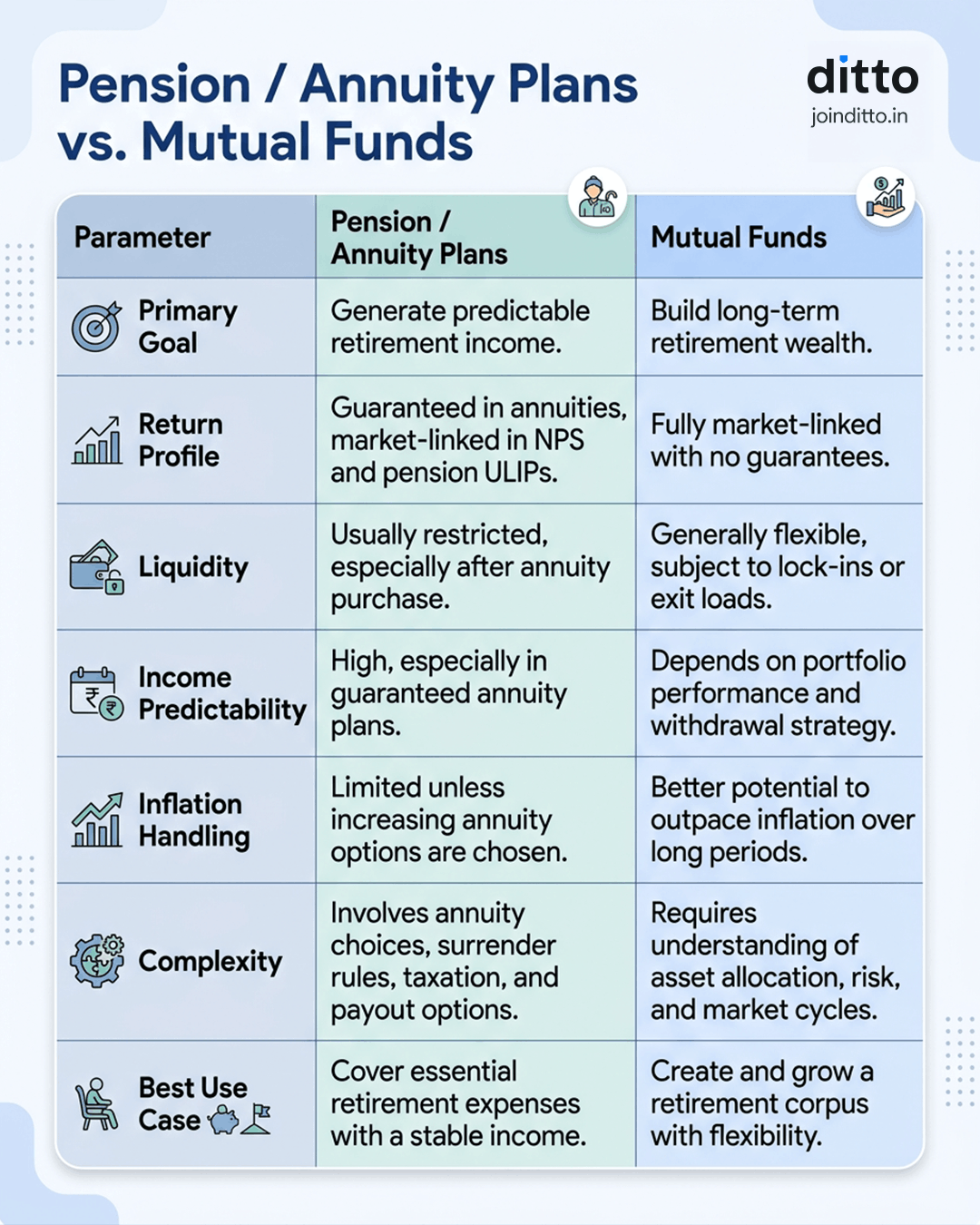
Pension/Annuity Plans vs. Mutual Funds
Background Image

How to Choose the Right Pension Plan for Your Needs

01

Accumulation vs Income

If retirement is years away, focus on building wealth through NPS, EPF, PPF, or mutual funds. Annuities make more sense as you get closer to retirement.

02

Need for Guaranteed Income

Use annuities to cover essential expenses such as food, utilities, rent, and healthcare, not your entire retirement corpus.

03

Liquidity Requirements

Keep a separate emergency fund. Pension and annuity products are not designed for easy and immediate access to money.

04

Tax Benefits & Employer Support

Maximize EPF, EPS, UPS, and NPS benefits first, especially if tax deductions are valuable for your situation.

05

Risk Tolerance

Use guaranteed products for stability and growth-oriented investments for long-term wealth creation.

06

Spouse Protection

Consider joint-life pension options if your spouse depends on your retirement income.

07

Inflation Protection

Retain some exposure to growth assets. Fixed pension income alone may lose purchasing power over time.

Note: Before choosing any pension plan, it helps to estimate how much retirement corpus you may actually need. Tools like the SEBI Annual Retirement Income Calculator and the NISM Retirement Calculator can help you project future expenses, inflation impact, required savings, and potential retirement income. This makes your planning more realistic and goal-driven.

Should You Buy a Pension Plan?

The right retirement strategy changes with age. What works in your 30s may be completely unsuitable in your 60s, so your pension planning should evolve as your financial goals, risk tolerance, and retirement timeline change. 

    • In Your 20s & 30s: Focus on building a retirement corpus. Market-linked options, such as NPS with higher equity allocation and equity mutual funds, offer better long-term growth potential.
    • In Your 40s: Balance growth with stability. Hybrid funds, NPS Auto Choice, or a mix of equity and debt investments can help reduce risk while continuing to create wealth.
    • In Your 50s & Near Retirement: Shift toward capital preservation and predictable income. Consider debt-oriented investments, Senior Citizens’ Savings Scheme (SCSS), PPF, high-quality fixed-income products, or deferred annuity plans for future pension income.

Did You Know?

SEBI has introduced Lifecycle funds, a new category of mutual fund schemes. They start with higher equity exposure in your younger years and gradually shift toward debt and government securities as retirement approaches, helping balance growth potential with risk management. However, returns remain market-linked and are not guaranteed.

Why Choose Ditto for Life Insurance? 

At Ditto, we’ve assisted over 8,00,000 customers with choosing the right insurance policy. Why customers like Pallavi below love us:

Popular Pension Plans
    • No-Spam & No Salesmen
    • Rated 4.9/5 on Google Reviews by 24,000+ happy customers
    • Backed by Zerodha
    • Dedicated Claim Support Team
    • 100% Free Consultation

Confused about the right insurance? Speak to Ditto’s certified advisors for free, unbiased guidance. Book your call now or chat on WhatsApp.

Conclusion

Pension plans have an important role in retirement planning. They can provide predictable income, reduce longevity risk, and create a financial safety net that continues even after your active earning years end. 

    • Use pension plans primarily for retirement income, not wealth creation.
    • Build your retirement corpus first through vehicles such as NPS, EPF, PPF, and mutual funds.
    • Consider annuity or pension products later to cover essential expenses like food, utilities, healthcare, and housing.

At Ditto, we believe insurance and investments work best when kept separate. Insurance should protect your family from financial risks, while investments should focus on growing wealth efficiently. 

Retirement planning is highly personal. Risk tolerance, income needs, tax situation, retirement age, and family responsibilities all matter. Ditto is not a SEBI-registered investment advisor, so consider consulting a qualified financial advisor before making retirement investment decisions. 

Our services are currently focused on health insurance and term life insurance, as these form the foundation of a strong personal financial plan and help protect against major financial risks.

Frequently Asked Questions

What are the main categories of pension plans in India?

Popular pension plans in India broadly fall into three categories: government-backed retirement schemes, market-linked retirement products, and private annuity plans. Government-backed options include NPS, EPF, PPF, and APY. Market-linked products such as NPS aim to build a retirement corpus through exposure to equity and debt markets. Private annuity plans from insurers like LIC, HDFC Life, ICICI Prudential, and SBI Life focus on providing predictable retirement income. According to the IRDAI Annual Report 2024-25, pension and annuity products generated ₹1.67 lakh crore in premiums, accounting for nearly 18.87% of the life insurance industry's total premium income.

What is the difference between LIC Jeevan Shanti and Saral Pension?

LIC New Jeevan Shanti and LIC Saral Pension serve different retirement needs. New Jeevan Shanti is a deferred annuity plan in which you invest a lump sum today and start receiving a pension after a chosen deferral period. Saral Pension is an immediate annuity plan that begins pension payouts almost immediately after purchase. Jeevan Shanti is suitable for individuals who are still a few years away from retirement and want to lock in future annuity rates. Saral Pension is better suited for retirees who need income right away. The right choice depends on your retirement timeline and income requirements.

How does NPS compare with LIC pension plans?

NPS and LIC pension plans address retirement planning in very different ways. NPS is a market-linked retirement scheme regulated by PFRDA, where returns depend on fund performance and asset allocation choices. LIC pension plans, on the other hand, focus on guaranteed lifetime income through annuity payouts. NPS may suit younger investors with a long investment horizon who are comfortable with market fluctuations. LIC pension plans may appeal more to retirees seeking certainty and predictable cash flow. NPS also offers tax deductions under Sections 80CCD(1), 80CCD(1B), and 80CCD(2). At Ditto, we recommend aligning your choice with your retirement stage and income goals.

What does an immediate annuity mean in pension plans?

An immediate annuity is a retirement product where you invest a lump sum and begin receiving pension payouts almost immediately. The income can be paid monthly, quarterly, half-yearly, or annually, depending on the option selected. Unlike deferred annuities, there is no waiting period before the pension starts. Immediate annuities are commonly chosen by retirees who need a regular income stream to cover living expenses. Once purchased, the invested amount generally becomes illiquid and cannot be freely withdrawn. This makes immediate annuities suitable for those prioritizing income certainty over liquidity and investment flexibility.

What is a deferred annuity, and when should I buy it?

A deferred annuity allows you to invest money today and begin receiving pension income after a chosen deferment period. During this period, the annuity rate remains locked, and the future pension amount is typically higher than that of an immediate annuity. Deferred annuities are often suitable for individuals in their forties or fifties who are planning for retirement several years in advance. The longer the deferment period, the higher the future pension generally becomes because the corpus is invested for longer. 

How much can I withdraw from NPS at retirement?

Under the current NPS exit framework, subscribers can withdraw a significant portion of their retirement corpus as a lump sum upon retirement. In most cases, up to 60% of the accumulated corpus can be withdrawn, with the remaining amount generally used to purchase an annuity from a PFRDA-approved life insurer that provides regular pension income. For eligible non-government subscribers, higher lump-sum withdrawal limits may apply under specific provisions. Additionally, if the total accumulated corpus is ₹8 lakh or less, the entire amount can be withdrawn as a 100% lump sum, offering greater flexibility while keeping the focus on long-term retirement income security. 

What is the Employees' Pension Scheme (EPS) and who is eligible?

The Employees' Pension Scheme (EPS) is a government-backed pension program available to eligible salaried employees covered under EPF. EPS is funded through the employer's contribution: 8.33% of eligible wages is directed toward the pension scheme, and employees do not contribute separately. The scheme is designed to provide a monthly pension after retirement, subject to eligibility conditions and service requirements. EPS can be particularly valuable for workers who spend many years in organized employment. While the pension amount may be modest for many individuals, it still provides an additional layer of retirement income alongside EPF savings.

What is the Unified Pension Scheme (UPS) and how much pension does it provide?

The Unified Pension Scheme (UPS) is an option available to eligible Central Government employees covered under the National Pension System. Introduced from 1 April 2025, UPS aims to provide greater pension certainty compared with a standard market-linked NPS account. Under prescribed conditions, it offers a minimum assured monthly payout of ₹10,000 after completing at least 10 years of qualifying service. Employees with 10 to 25 years of service may receive proportionate benefits, while those with longer service may qualify for higher assured payouts. UPS is available only to eligible government employees and not to the general public.

Last updated on: