




Overview
Launched on 23 May 2023 and benchmarked against the NIFTY Smallcap 100 Index, the Bajaj Life Small Cap Fund is designed for investors willing to embrace high volatility in pursuit of long-term wealth creation through small cap equities.
In the next few minutes, you'll discover how the Bajaj Life Small Cap Fund works, where it invests, how it has performed since inception, and the risks and charges you should consider before investing.
What Is the Bajaj Life Small Cap Fund?
The Bajaj Life Small Cap Fund is not a standalone mutual fund that you can purchase directly. Instead, it is an equity fund available within Bajaj Life's ULIP offerings. This means your money is invested through a ULIP structure, with the fund value linked to the performance of its underlying portfolio and reflected through its daily Net Asset Value (NAV).
The fund aims to achieve capital appreciation by investing in a diversified basket of predominantly small cap stocks, with Bajaj Life specifying a minimum 60% allocation to small-cap stocks. As with other market-linked ULIP funds, the policyholder bears the investment risk, and the fund value can rise or fall with market conditions.
Note: The Bajaj Life Small Cap Fund is available only through eligible Bajaj Life ULIP products. You cannot purchase it independently.
What Does Bajaj Life Small Cap Fund Invest In?
The Bajaj Life Small Cap Fund follows a diversified equity investment approach, with its portfolio spread across companies from different sectors. The fund primarily invests in small cap stocks, while also holding mid cap and large cap companies.
As of July 2026, the fund's equity portfolio was allocated as follows:
The fund also held 2.79% in bank deposits and money market instruments, while net current assets accounted for negative 0.16%. Overall, equities made up 97.37% of the portfolio.
In terms of individual holdings, the fund's largest exposures included Sona BLW Precision Forgings Ltd. (3.01%), Radico Khaitan Ltd. (2.78%), Karur Vysya Bank Ltd. (2.58%), CarTrade Tech Ltd. (2.45%), and Balkrishna Industries Ltd. (2.28%). The portfolio also included Devyani International, Multi Commodity Exchange of India, CRISIL, City Union Bank, and Coforge.
By sector, the fund had its largest exposure to Financial and Insurance Activities at 23.00%, followed by Computer Programming, Consultancy and Related Activities at 9.57% and Manufacture of Electrical Equipment at 6.03%.
Bajaj Life Small Cap Fund Performance and NAV Trends
Here’s a look at the Bajaj Small Cap Fund performance across different periods:
- Latest NAV: The Bajaj Small Cap Fund NAV stood at ₹21.757 as of 2 September 2026. This represents the value of a single unit of the fund.
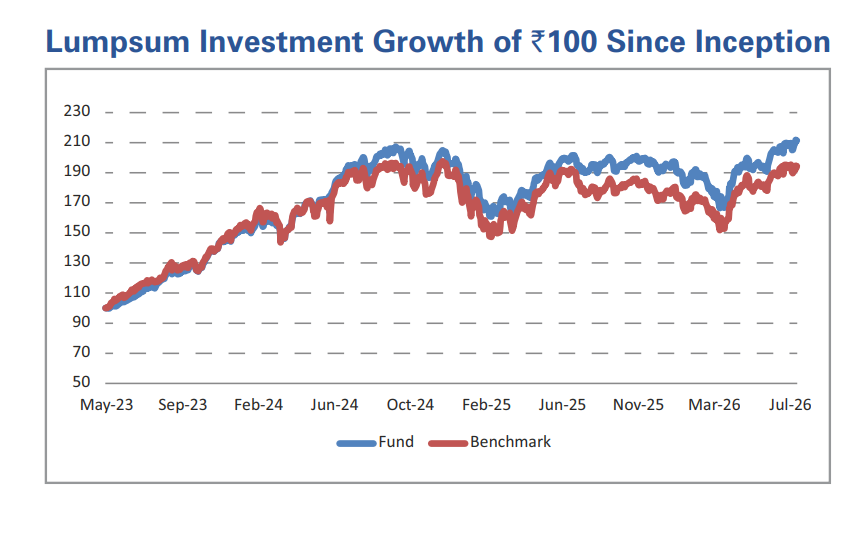
- Strong Long-Term Performance: Since its inception in May 2023, the fund has delivered a 26.44% annualized return, compared with 23.15% CAGR for the NIFTY Small Cap 100 Index.
- Strong 3-Year Outperformance: Over the 3-year period, the fund delivered a 23.09% CAGR, compared with 18.21% for the NIFTY Small Cap 100 Index.
- Mixed Recent Performance: As of 31 July 2026, the fund returned 9.20% over 3 months, 13.71% over 6 months, and 9.42% over 1 year.
- Healthy Fund Size: The fund had an AUM of ₹5,063.85 crore as of 31 July 2026, with ₹4,930.74 crore invested in equity.
The above data is derived from Fund Pro data for July 2026.
Note: The fund has a relatively short track record, having been launched in May 2023. Therefore, evaluate its historical returns with this limited performance history in mind.
Bajaj Life Small Cap Fund Benchmark: NIFTY Small Cap 100
The Bajaj Life Small Cap Fund is benchmarked against the NIFTY Smallcap 100 Index, which provides the reference point for evaluating the fund's performance. If you are looking to compare Bajaj Life Small Cap with other small-cap investment options, consider factors such as historical performance, risk, charges, liquidity, and the additional restrictions of the ULIP structure.
Bajaj Life's July 2026 Fund Pro data gives:
Note: Past performance is not indicative of future returns.
Bajaj Life: Performance Metrics
Note: The figures are for the life insurer as a whole and are sourced from IRDAI Annual Reports and Bajaj’s public disclosures. For more data like this, explore the Ditto Data Lab.
Talk to an expert
today and
find
the right
insurance for you.


Pros & Cons of Bajaj Life Small Cap Fund
Note: Tax treatment depends on the ULIP’s issue date and other applicable policy conditions. From 1 April 2026, the Income-tax Act, 2025 replaced the Income-tax Act, 1961. For relevant ULIPs issued on or after 1 February 2021, maturity exemption is subject to the applicable premium-to-sum-assured ratio and an aggregate annual premium limit of ₹2.5 lakh across relevant ULIPs.
Death proceeds are treated separately. Therefore, do not assume maturity proceeds are exempt from tax solely because the annual premium for one ULIP is ₹2.5 lakh or less. Consider consulting a tax professional before relying on the exemption.
Who Should Consider the Bajaj Life Small Cap Fund?
- Investors With a High Risk Appetite Seeking Aggressive Growth: The fund is classified as ‘Very High’ risk and invests predominantly in small cap stocks, making it more suitable for investors who can tolerate sharp fluctuations and are willing to take higher risks for potentially higher long-term capital appreciation.
- Long-Term Investors: Small-cap stocks can be volatile over shorter periods, so the fund is better suited to investors who can remain invested through market cycles.
- ULIP Investors Looking for a Small Cap Option: Policyholders whose Bajaj Life ULIP offers this fund and who want a predominantly small-cap allocation can consider it.
Who Should Not Consider It?
- Conservative Investors: The ‘Very High’ risk classification makes this fund unsuitable for investors who prioritize capital stability.
- Investors With a Short Investment Horizon: Those who may need the money soon may not be able to comfortably withstand small-cap market volatility.
- Investors Looking for Guaranteed Returns: This is a market-linked fund, so returns are not guaranteed, and the policyholder bears the investment risk.
- Investors Seeking a Standalone Investment: The fund is offered through ULIPs rather than as a standalone mutual fund. Investors who specifically want a direct mutual fund investment may find a small cap mutual fund more suitable.
Why Choose Ditto for Life Insurance?
At Ditto, we’ve assisted over 12,00,000 customers with choosing the right insurance policy. Why customers like Vijay below love us:

- No-Spam & No Salesmen
- Rated 4.9/5 on Google Reviews by 30,000+ happy customers
- Backed by Zerodha
- Dedicated Claim Support Team
- 100% Free Consultation
You can book a FREE consultation. Slots are running out, so make sure you book a call now or chat with us on WhatsApp!
Conclusion
The key takeaway is that the Bajaj Life Small Cap Fund is a high-risk option designed for investors seeking long-term growth. Its past performance has been strong, but that does not guarantee similar returns in the future.
If you are comfortable with high volatility and already intend to invest through a ULIP, this fund can be worth considering. But if your goal is simply to build wealth, compare the ULIP with the term insurance plus mutual funds alternative before investing. This can help you assess whether the ULIP's additional costs, complexity, and restrictions are justified for your needs.
Disclosure: Bajaj Life is a Ditto partner insurer, but Ditto does not recommend or sell ULIPs. Ditto is not a SEBI-registered investment advisor and focuses exclusively on helping customers understand and purchase health insurance and term life insurance policies. This article is for educational purposes. Make any investment decision after consulting a qualified financial professional.
Frequently Asked Questions
Last updated on: