



Overview
A health insurer may offer comprehensive benefits, reasonable premiums, and a smooth digital buying experience. But these features mean little if the claims process becomes difficult when you actually need the policy. This is why an insurer’s claim settlement performance deserves a closer look before you shortlist its plans.
And if Zuno General Insurance is among the insurers you are considering, you may be wondering how dependable it is during a claim. Formerly known as Edelweiss General Insurance, Zuno is a digital-first insurer offering plans such as Silver, Gold, Platinum, and Zuno HealthPlus.
The Zuno Health Insurance Claim Settlement Ratio (CSR) is one useful metric for evaluating its claims reliability, although it should not be considered in isolation.
This guide examines Zuno’s CSR, Incurred Claims Ratio (ICR), claims process, hospital network, customer support, and overall claims performance.
Zuno Health Insurance Claim Settlement Ratio and Other Metrics (FY 2024-26)
A claim settlement ratio should not be evaluated in isolation, as it does not reveal how much the insurer pays, how often customers complain, or how smoothly claims are processed. So, we assess it alongside the incurred claims ratio, complaint volume, and claims experience for a more complete view of the insurer’s reliability.
Source: IRDAI annual reports, Zuno General Insurance's public disclosures and Ditto’s Health Insurance Data Lab. Complaint figures reflect Zuno's entire portfolio (health, motor, and travel) and are not limited to health insurance alone.
Ditto’s Insight: Zuno’s claim settlement ratio declined overall from 98.83% in FY 2019-20 to 86.43% in FY 2024-25, despite brief improvements in between. It then recovered to 92.86% in FY 2025-26, marking a notable turnaround.
However, such year-on-year inconsistencies are not an encouraging sign, particularly for a relatively smaller insurer with a limited claims track record compared to larger players. For customers, this volatility may create uncertainty around claim approvals and increase the possibility of additional documentation, disputes, or out-of-pocket expenses.
Talk to an expert
today and
find
the right
insurance for you.


Zuno Claim Settlement Ratio vs. Incurred Claims Ratio: What's the Difference?
CSR and ICR both describe claim performance, but they measure different things, and mixing them up is one of the most common mistakes people make when researching an insurer.
- Claim Settlement Ratio: It's the number of claims settled divided by the number of claims received in a year. Zuno's average CSR of 89.67% means it settled approximately 9 out of every 10 claims filed.
- Incurred Claims Ratio: It's the total claims paid out divided by the total premium collected. Zuno's ICR of 89.39% means that for every ₹100 it collected in health premiums, it paid out roughly ₹89 in claims.
At Ditto, we generally prefer an ICR between 55% and 85%, as it indicates a healthier balance between paying out claims and maintaining sustainable pricing over the long run. Zuno's ICR runs higher than this range and above the industry average, which isn't automatically a red flag, but combined with its small scale, it's a metric worth watching as the insurer's scale increases.
How to File a Zuno Health Insurance Claim?
Zuno offers both cashless and reimbursement claims, and retail claims are processed through Third-Party Administrators (TPAs) such as Medi Assist, rather than an in-house claims team.
For a Cashless Claim
- Get admitted to one of Zuno's network hospitals.
- Show your health card or policy number at the hospital's insurance desk, and the pre-authorization form gets sent to the TPA for approval.
- Once approved, get treated without paying the covered bill amount upfront.
- At discharge, pay only the non-covered expenses. The hospital will bill Zuno through the TPA for the eligible amount.
For a Reimbursement Claim
You pay the hospital bill in full, then submit your claim form, original bills, discharge summary, and related medical documents to Zuno within 30 days of discharge. Reimbursement is usually done for non-network hospitals.
Zuno Health Insurance Network Hospitals and Customer Care
Zuno gives you access to a network of 10,000+ hospitals across India for cashless treatment. That's a reasonable number, but it's still smaller than that of larger insurers like HDFC ERGO (16,000+), though it's equal to Ditto's recommended benchmark of 10,000+ network hospitals.
Before buying or filing a claim, it's worth checking Zuno's hospital locator tool to confirm your preferred hospitals are covered.
Customer Care: Call Zuno’s toll-free number at 1800 12000 or paid landline at 022 423 12000. You can also email support@hizuno.com for policy-related assistance or claim queries.
Is Zuno Health Insurance Reliable? Pros and Cons
Why Choose Ditto for Health Insurance?
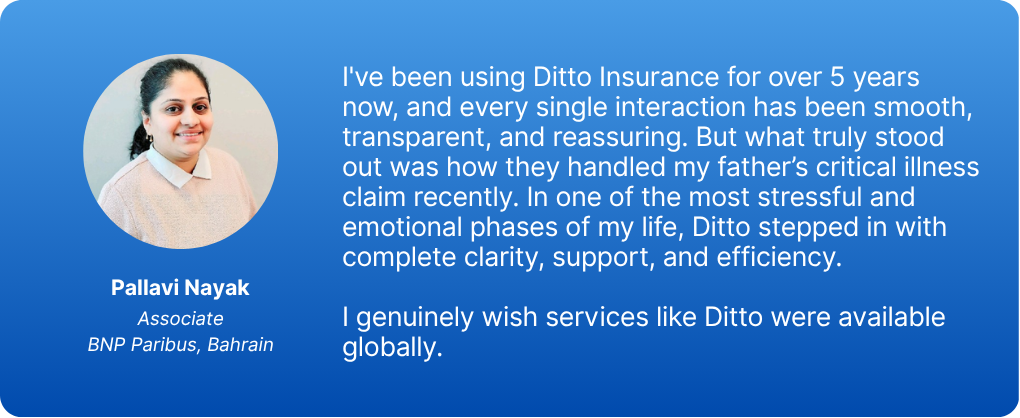
At Ditto, we’ve assisted over 8,00,000 customers with choosing the right insurance policy. Why customers like Pallavi below love us:
- No-Spam & No Salesmen
- Rated 4.9/5 on Google Reviews by 25,000+ happy customers
- Backed by Zerodha
- Dedicated Claims Support Team
- 100% Free Consultation
Confused about the right insurance? Speak to Ditto’s certified advisors for free, unbiased guidance. Book your call or chat on WhatsApp with us now!
Ditto’s Take
Zuno’s recent improvement in claim settlement performance is encouraging, but it does not offset the insurer’s broader limitations. It remains a very small player, with a health insurance business of around ₹383 crore compared to the industry average of ₹4,504 crore. Its average CSR of 89.67% is also only moderate and continues to fall behind the industry average of 92.02%.
Scale and CSR aside, Zuno offers a relatively limited product portfolio, and its retail health claims are processed through TPAs rather than an in-house claims team. None of these factors is necessarily a deal-breaker on its own. However, taken together, they make Zuno less compelling when several larger insurers offer more established claims track records, broader product options, and direct claims servicing.
So, before choosing a Zuno policy, it would be worth comparing it with the best health insurance plans to see whether another insurer offers a stronger overall combination of coverage and claims support.
Frequently Asked Questions
Last updated on: