Niva Bupa Senior First is a health insurance plan for older adults.
Key Details
Variants: Gold (sum insured: ₹5 to ₹10 lakh) and Platinum (sum insured: ₹5 to ₹25 lakh).
Entry Age: 61 to 75 years for the primary insured and 18 to 75 years for the spouse under a family floater.
Room Eligibility: Shared room under Gold and single private room under Platinum. Upgrades attract an additional 10% co-payment.
Co-Payment: Default 50%, with options to reduce it through optional modifications.
Waiting Periods: 30 days initially (except accidents) and 24 months for pre-existing diseases and specified conditions.
ReAssure Benefit: Unlimited restoration under Platinum, subject to policy terms.
Treatment Sub-Limits: No disease-wise caps on cataract, joint replacement, or cancer treatment. Certain robotic surgeries have a ₹1 lakh per-claim limit.
Safeguard Add-On: Covers specified non-payable items, provides inflation-linked sum insured additions, and protects loyalty additions for annual claims up to ₹50,000.
Buying health insurance for elderly parents can be challenging, especially when age or pre-existing medical conditions limit their options. Niva Bupa Senior First is designed for individuals aged 61 to 75, offering hospitalization coverage and a shorter waiting period for pre-existing diseases.
However, its standard 50% co-payment and room-category restrictions can leave you paying a significant share of hospitalization bills.
In this guide, we'll review Niva Bupa Senior First's coverage, benefits, premiums, and limitations to help you decide whether it suits your parents.
Not sure if Niva Bupa Senior First is right for your parents? Book a free call or chat on WhatsApp with a Ditto advisor to find out.
Eligibility Criteria for Niva Bupa Senior First
Criteria
Details
Entry Age
61 to 75 years for the primary insured, calculated as of the last birthday.
Individual Policy
Covers up to 2 adults (self and spouse), each with a separate sum insured. A 10% family discount applies when both are insured.
Family Floater Policy
Covers self and spouse under a shared sum insured. Spouse entry age is 18 to 75 years. Premiums depend on the eldest member's age.
Policy Tenure
1, 2, or 3 years.
Renewability
Offers lifetime renewability.
Pre-Policy Medical Checkups
Not mandatory by default. Tests may be required based on medical history. Niva Bupa pays the costs if the applicant is accepted. If declined, the applicant pays.
Niva Bupa Senior First Variants: Key Features and Add-Ons Compared
Niva Bupa Senior First plan comes in two variants, Gold and Platinum. Both cover inpatient care, day-care treatment, and eligible pre- and post-hospitalization expenses, but Platinum offers higher sum insured options, better room eligibility, and additional benefits.
Unlimited restoration after the first paid claim, up to the base sum insured per subsequent claim, applicable for both same and different illnesses
Annual Preventive Health Checkup
Not available
Available annually for listed tests from day 1, up to ₹500 per ₹1 lakh of base sum insured, capped at ₹5,000 for individuals and ₹10,000 for floaters
Loyalty Additions
Not available
10% increase in base sum insured up to 100% upon every completion of policy year
Note: Choosing a room category higher than the eligible limit attracts an additional 10% co-payment on the admissible claim.
Common Coverage Benefits
01
Ambulance and Modern Treatment Coverage
Covers road ambulance expenses up to ₹2,000 and air ambulance expenses up to ₹2.5 lakh per emergency hospitalization. Modern treatments are covered up to the sum insured, but certain robotic surgeries have a ₹1 lakh sub-limit. This limit does not apply to total radical prostatectomy, cardiac surgeries, partial nephrectomy, or cancer surgeries.
Safeguard Add-On: This optional benefit covers specified non-payable consumables, such as gloves and masks. It also provides cumulative inflation-linked additions to the base sum insured based on the specified Consumer Price Index (CPI) measure and protects loyalty additions against claims up to ₹50,000 per policy year, subject to policy terms.
Co-Payment Modification (Including Zero Co-Pay): You can change the standard 50% co-payment to 40%, 30%, or 20% when buying the base policy. Once selected, you can't change the base co-payment percentage. The 0% option is a separate Zero Co-pay add-on. However, the additional 10% co-payment still applies when you choose a higher room category.
Annual Aggregate Deductible: Allows policyholders to choose a deductible equal to 20% of the base sum insured. This waives the mandatory co-payment and offers premium discounts of up to 75% depending on the sum insured. An additional co-payment can still apply for a higher room category.
Note: Please refer to the prospectus and policy wordings for complete plan details, including eligibility, coverage, exclusions, and applicable terms and conditions.
Ditto's Take
We recommend considering the Zero Co-Pay and Safeguard add-ons if affordable. Zero Co-Pay removes the standard 50% co-payment, while Safeguard covers specified non-payable consumables.
An annual aggregate deductible may reduce premiums. However, whether it is cost-effective depends on your expected medical expenses. If you anticipate frequent claims, a deductible may be more attractive than a percentage-based co-payment. Compare the potential out-of-pocket costs under both options before deciding.
Sample Premiums by Age and Sum Insured
Profiles
₹15 Lakh Policy (Platinum Variant)
(Individual Plan): Age 65
₹28,136
(Family Floater, 2 Adults): Ages (66, 65)
₹51,241
(Family Floater, 2 Adults): Ages (72, 71)
₹71,547
Note: The premiums are illustrative and calculated for adults living in Zone 1 (Delhi NCR, Mumbai, Navi Mumbai, Thane, Kolkata, and Gujarat) for a one-year policy tenure and a default 50% co-payment. Zone 2 covers the rest of India. Your final premium will depend on your age, medical history, location, chosen plan, sum insured, and applicable discounts. For Zone 2 premiums, refer to the Niva Bupa Senior First Premium Chart.
Talk to an expert today and find the right insurance for you.
Gross Written Premium / Annual Business - Total Health (In Crore)
₹6,985.24
₹4,504.48
Note: This information is sourced from the IRDAI annual reports and Niva Bupa’s public disclosures and is not limited to one product. To explore more such data, please refer to Ditto Data Lab.
Pros and Cons of Niva Bupa Senior First
Pros
Senior-Friendly Entry Age and Lifetime Renewability: The plan allows new applicants aged 61 to 75 and offers lifetime renewability, subject to policy terms.
Shorter Pre-Existing Disease Waiting Period: Covers pre-existing diseases after 24 months, compared to the 36-month waiting period found in many other policies.
No Disease-Wise Sub-Limits for Major Treatments: Does not impose specific treatment limits on cataract surgery, joint replacements, or cancer surgeries, subject to the available sum insured.
Cons
High Mandatory Co-Payment: Comes with a default 50% co-payment, meaning policyholders must pay half of every admissible claim unless they choose an eligible co-payment reduction or deductible option.
Limited Sum Insured Options: The maximum base sum insured is ₹10 lakh under Gold and ₹25 lakh under Platinum.
Room Category Restrictions: Gold covers shared rooms, while Platinum allows single private rooms. Choosing a higher category attracts an additional 10% co-payment.
Robotic Surgery Sub-Limit: Specified robotic surgeries have a ₹1 lakh sub-limit, which may leave policyholders with substantial out-of-pocket expenses.
Why Choose Ditto for Health Insurance?
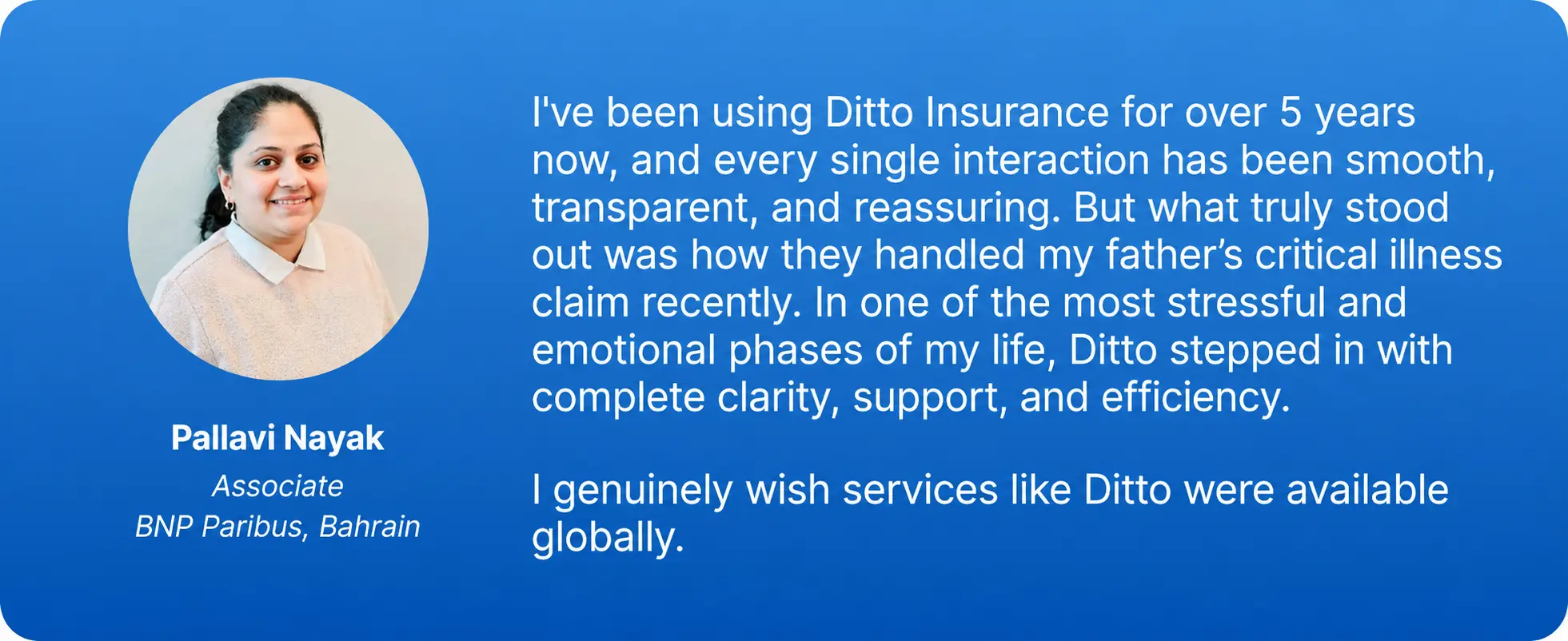
At Ditto, we’ve assisted over 12,00,000 customers with choosing the right insurance policy. Why customers like Pallavi love us:
100% Free Consultation
No Spam. No Sales Pressure.
Rated 4.9/5 on Google Reviews by 30,000+ Happy Customers
Backed by Zerodha
Dedicated Claim Support Team
Compare Plans and Premiums with a Trusted Insurance Advisor
Confused about the right insurance? Speak to Ditto’s certified advisors for free, unbiased guidance. Book your call now or chat with us on WhatsApp. Slots fill up fast!
Conclusion
Niva Bupa Senior First may be worth considering for parents aged 61 to 75 who struggle to get comprehensive health insurance because of age or medical history. Its 24-month waiting period for pre-existing diseases and additional Platinum benefits, such as ReAssure and preventive health checkups, make it an option for applicants who cannot obtain more comprehensive coverage.
However, the default 50% co-payment, room restrictions, and limited sum insured options can lead to significant out-of-pocket expenses. We recommend exploring comprehensive plans with no mandatory co-payment, no room rent limits, higher coverage, and no disease-wise sub-limits first.
If those options are unavailable, Senior First may be worth considering, provided you understand its limitations. You can also explore our guide to senior citizen health insurance plans to compare other options.
Frequently Asked Questions
Is Niva Bupa Senior First worth buying for parents aged 60 and above?
Niva Bupa Senior First is not available to 60-year-olds, as the minimum entry age is 61. It is worth considering for parents aged 61 to 75 who struggle to get comprehensive coverage due to age or medical history. It offers a 24-month waiting period for pre-existing diseases and no disease-wise sub-limits on certain major treatments. However, the default 50% co-payment, room rent restrictions under Gold, and limits on certain modern treatments are key drawbacks. At Ditto, we recommend exploring comprehensive plans with lower co-payments, fewer restrictions, and higher coverage first.
Can I buy Niva Bupa Senior First for my parents if they already have diabetes or high blood pressure?
Yes, parents with diabetes or high blood pressure can apply for Niva Bupa Senior First. However, you must disclose their complete medical history when applying. Pre-existing diseases are covered after a 24-month waiting period, subject to policy terms. Depending on the severity of their conditions, the insurer may request medical tests, charge a higher premium, modify terms, or decline the application.
Can I reduce or remove the co-payment under Niva Bupa Senior First?
Yes, Niva Bupa Senior First comes with a default 50% co-payment. You can change this to 40%, 30%, or 20% when buying the base policy. The 0% option is a separate Zero Co-pay add-on. The additional 10% co-payment still applies when you choose a higher room category. Alternatively, you can choose an annual aggregate deductible equal to 20% of the base sum insured. However, you must pay eligible expenses up to the deductible amount before the insurer starts covering claims.
Does Niva Bupa Senior First cover knee replacement and cataract surgery?
Yes, Niva Bupa Senior First covers knee replacement and cataract surgery without separate disease-wise sub-limits. Eligible expenses are covered up to the available sum insured, subject to room eligibility, co-payment, and other policy conditions. However, both procedures have a specific 24-month waiting period unless the treatment is required due to an accident. You should also check whether any other exclusions apply before making a claim.
Do I need to undergo medical tests before buying Niva Bupa Senior First?
No, Niva Bupa Senior First does not require mandatory pre-policy medical tests by default. However, the insurer may request tests depending on your age, medical history, and health disclosures. If your application is accepted, Niva Bupa covers 100% of the pre-policy medical checkup cost. If the application is declined, you must bear these expenses. Final policy issuance depends on the insurer's underwriting assessment.
Does Niva Bupa Senior First cover treatment for heart disease and cancer?
Yes, Niva Bupa Senior First covers eligible heart disease and cancer treatments, including hospitalization, chemotherapy, radiotherapy, angiography, and surgeries. Coverage is available up to the sum insured, subject to applicable limits and co-payment. If the condition existed before purchasing the policy, a 24-month pre-existing condition waiting period applies. Newly diagnosed illnesses generally have an initial 30-day waiting period, but specified-procedure waiting periods and exclusions may also apply depending on the condition.
What documents are required to file a reimbursement claim under Niva Bupa Senior First?
Submit the completed claim form, discharge summary, consultation papers, itemized hospital bills, payment receipts, prescriptions, diagnostic reports, KYC documents, and a canceled cheque. Accident-related claims may require an FIR or medico-legal certificate. Submit your claim within 30 days of discharge. If delayed for reasons beyond your control, provide a written explanation. The insurer reviews delayed claims on their merits. If your policy has an annual deductible, include supporting expense documents.
Where can I find the Niva Bupa Senior First brochure?
You can find the Niva Bupa Senior First brochure on the insurer's downloads section. It explains the Gold and Niva Bupa Senior First Platinum variants, coverage benefits, waiting periods, exclusions, co-payment options, and optional add-ons. Before purchasing, review the brochure alongside the policy wording to understand the exact terms and conditions. Pay particular attention to room eligibility, mandatory co-payment, and treatment-specific limits, as these can affect your out-of-pocket expenses.