



Overview
In 2024, IRDAI removed the maximum entry-age cap for health insurance, yet many insurers still hesitate to issue new policies to applicants over 65 because of the risk involved.
The National Senior Citizen Mediclaim Policy from National Insurance is one of the few Public Sector Undertaking (PSU)-backed plans built specifically for this age band, accepting entrants up to 80 years.
In this guide, we break down the plan features, eligibility, sample premiums, performance metrics, and whether it's worth buying over other senior-citizen-specific plans.
What Is the National Senior Citizen Mediclaim Policy?
The National Insurance Senior Citizen Mediclaim Policy is an indemnity health plan designed exclusively for the elderly. It covers in-patient treatment across allopathy, ayurveda, and homeopathy, along with domiciliary hospitalization and any illness or injury contracted during the policy period. Let’s have a look at the basic details of the plan.
Note: For the complete National Insurance Mediclaim policy details, please refer to the prospectus.

Key Features & Benefits for National Senior Citizen Mediclaim Policy
Bonus
In both variants, your sum insured grows by 5% for every claim-free year, up to a maximum of 50% over time. If you file a claim in any policy year, this bonus reduces by 5%, so it's a modest reward compared to private insurers offering higher and even unlimited accumulation.
Pre- and Post-Hospitalization Cover
The policy covers medical expenses for 30 days before admission and 60 days after discharge, including diagnostic tests and prescribed medication tied to the hospitalization. This helps offset costs that build up before and after a hospital stay.
Domiciliary Hospitalization
If a hospital bed isn't available or your condition doesn't allow transport, NSCMP reimburses up to 20% of the SI for treatment received at home. This is a practical benefit for elderly policyholders managing mobility or availability constraints.
Ambulance Charges
Both variants cover ambulance charges related to the hospitalization up to ₹2,500 for any one illness for each member.
Reinstatement of Sum Insured
Plan B offers reinstatement of SI during the policy period. However, this is only available for hospitalization arising from a road traffic accident.
Preventive Health Checkup
Plan A covers diagnostics up to 2% of SI (maximum ₹4,000) every 2 claim-free years, while Plan B offers consultations and diagnostics up to ₹1,000 every 6 claim-free months, on an individual or floater basis.
Funeral Expenses
Not covered under Plan A, while Plan B provides up to ₹5,000 per individual. This is payable only if the corresponding hospitalization claim has been approved.
Coverage for Pre-Existing Diabetes/Hypertension
Optional cover for pre-existing diabetes and/or hypertension, available from inception with no waiting period. Co-payment applies for the first two policy periods: 10% for diabetes alone, 10% for hypertension alone, or 25% if both are opted for.
Out-Patient Treatment
Optional cover for consultations, diagnostics, prescribed medicines, and dental treatment on an OPD basis. The cover limit ranges from ₹2,000 to ₹15,000 and can be used by any one or all insured individuals.
Limits and Restrictions
The plan imposes limits on room rent and certain treatments, including modern treatments.
- Room Rent Limits: Plan A covers room rent at 1% of SI per day capped at ₹5,000 and ICU at 2% of SI/day (max ₹10,000). Plan B doubles these limits with 2% of SI per day (max INR 10,000) for room rent and 4% of SI per day (max INR 20,000) for ICU.
Why This Matters?
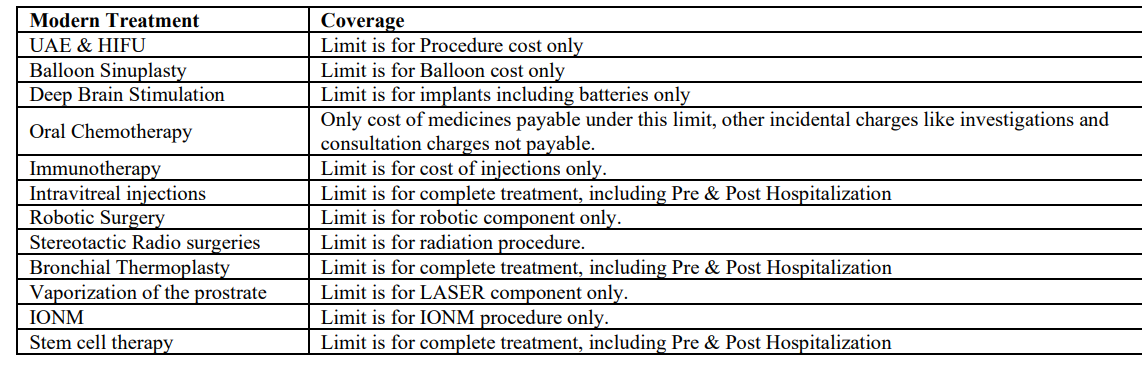
- Disease-Wise Sub-Limits: Plan A caps cataract surgery at 15% of SI or ₹75,000 per eye (whichever is lower) and Benign Prostatic Hyperplasia (BPH) at 20% of SI. Modern treatments (like robotic surgery, stem cell therapy, and immunotherapy) are also capped at 25% of SI per procedure, with coverage limited to specific components as detailed in the table below.
Why This Matters?
- Zone-Based Copayment: The claim amount depends on the zone where the premium is paid versus where treatment is taken. Zone 1 covers Gujarat, Delhi and NCR, Hyderabad, Mumbai and Mumbai Suburban, Thane, Navi Mumbai, Nagpur, and Pune. Zone 2 covers the rest of India.
Who Can Buy National Senior Citizen Mediclaim Policy?
Entry Age and Eligibility Criteria
The primary applicant must be between 60 and 80 years old when buying the policy, with no upper exit age, meaning the plan renews for life once issued. A pre-policy medical check-up is required for all insured members when applying through a fresh proposal.
Can Spouses Be Covered Under the Same Policy?
On a floater basis, you can cover yourself and your spouse under a single sum insured, provided the spouse is aged between 50 and 80 years at inception. This makes it one of the few senior-citizen plans that also accommodates a younger spouse.
Can Senior Citizens With Existing Health Conditions Buy the Policy?
Yes. Pre-existing diseases such as diabetes and hypertension are covered after a 2-year waiting period, shorter than the 3-year default most insurers apply. If you specifically have diabetes or hypertension, an optional add-on can bring this waiting period down to Day 1. Other conditions may still be assessed through medical underwriting or a loaded premium.
National Senior Citizen Mediclaim Sample Premium Illustration
Note: These premiums are for Zone 1 (Delhi) for healthy individuals. The values are indicative and may vary by age, location, underwriting, and medical history. For more cover options, you can refer to the National Insurance Mediclaim policy premium chart.
National Insurance - Performance Metrics
Note: This information is sourced from the IRDAI annual reports, Ditto Data Lab, and National Insurance public disclosures. For a complete picture of the insurer, check our National Health Insurance review.
Pros & Cons of the National Senior Citizen Mediclaim Policy
Pros
- Comparatively short two-year PED waiting period, reducible to day 1 for diabetes and hypertension.
- Covers AYUSH treatments and domiciliary hospitalization up to defined limits, both useful for elderly care.
- Backed by a PSU insurer with a CSR of 94%, above the industry average.
- Entry age extends up to 80 years, when several private insurers stop issuing fresh policies.
Cons
- Zonal co-payment applies if you receive treatment in a higher zone, regardless of plan or sum insured.
- Room rent and ICU charges are capped, which can trigger proportionate deductions on the entire bill.
- No restoration benefit, so the sum insured isn't replenished once exhausted in a policy year.
- Maximum sum insured of ₹10 lakh may fall short for high-value treatments common among seniors.
- Network of 5,300+ hospitals is smaller than several private insurers, which can limit cashless access outside metros.
Ditto’s Take: Avoid this plan if you can qualify for a comprehensive policy with no room-rent cap, fewer treatment sub-limits, a broader restoration benefit, and a higher sum insured.
Why Choose Ditto for Health Insurance?
At Ditto, we’ve assisted over 12,00,000 customers choose the right insurance policy. Why customers like Pallavi love us:
- 100% Free Consultation
- No Spam. No Sales Pressure.
- Rated 4.9/5 on Google Reviews by 30,000+ Happy Customers
- Backed by Zerodha
- Dedicated Claim Support Team
- Compare Plans and Premiums with a Trusted Insurance Advisor
Confused about the right insurance? Speak to Ditto’s certified advisors for free, unbiased guidance. Book your call now or chat with us on WhatsApp. Slots fill up fast!
Conclusion
NSCMP is a reasonable pick if you want a PSU-backed plan that accepts applicants up to 80 years and covers pre-existing conditions faster than most. The two-year PED wait, AYUSH cover, and domiciliary benefit add real value for elderly buyers who've been turned away elsewhere.
That said, the copayment, capped room rent, and absence of a restoration benefit mean your family will still carry a meaningful share of large hospital bills. Buy NSCMP if you or your parents need a plan built for advanced age with manageable premiums, are comfortable with the plan's room-rent limits, treatment sub-limits, and possible zonal copayment, and no other comprehensive option is available. If you’re still exploring options, you can refer to our guide on health insurance for senior citizens.
Frequently Asked Questions
Last updated on: