



Introduction
According to the Ministry of External Affairs, India has close to 1.77 crore Non-Resident Indians (NRIs) as of January 2026. Yet, many NRIs do not have a clear health insurance plan in place for themselves or their families back home. This is because choosing health insurance as an NRI can be tricky, since your healthcare needs are split across two countries.
This is why health insurance for NRI in India cannot be chosen based solely on the premium. You need to check NRI eligibility, premium payment rules, accepted documents, India-based claims, what happens after returning, and coverage for family members in India.
With so many NRI-specific rules to understand, comparing health insurance plans on your own can quickly become confusing. That’s where Ditto Insurance can make a difference. As a free insurance advisory platform, Ditto helps NRIs understand their options and compare plans objectively, all without any spam.
In this guide, we explain whether NRIs can buy health insurance in India, how premiums and claims work, what rules you need to know, which plans are worth considering, and how Ditto simplifies the entire process.
Common Questions NRIs Ask
What Is NRI Health Insurance?
IRDAI does not define a separate "NRI health insurance" product. It simply means a standard Indian health policy bought by an NRI, Persons of Indian Origin (PIOs), or Overseas Citizens of India (OCIs). These policies provide financial protection for medical treatments and hospitalizations incurred within India and work like any resident's plan. Only the documentation, payment method, and claims process differ.
Why NRIs Need It
- Geographical Limitations: Health insurance from the country where you are working (e.g., the US, UK, or UAE) often does not cover hospitalization expenses incurred in India.
- Visiting Family: It ensures continuous, cashless access to quality healthcare for you, your spouse, or your dependent children during visits back home to India.
- Parental Coverage: Health insurance for NRI parents in India serves as a safety net to cover hospitalization costs (for critical illnesses or emergencies).
How It Works
- Coverage Scope: Primarily covers hospitalizations, daycare procedures, and pre- and post-hospitalization costs at Indian hospitals.
- Premium Payment: Premiums can be paid online using Indian payment methods. Some insurers also allow international cards or payments through an NRE (Non-Resident External) or NRO (Non-Resident Ordinary) bank account.
- Tax Benefits: If the proposer has taxable income in India, the premiums paid qualify for a tax deduction under Section 80D (now Section 126, old regime) of the Income-tax Act.
Can NRIs Buy Health Insurance in India?
Yes, Non-Resident Indians (NRIs), Persons of Indian Origin (PIOs), and Overseas Citizens of India (OCIs) can buy health insurance in India from Indian insurers. These plans primarily cover hospitalizations incurred within India, but offer cashless care during your visits back home to India and ensure coverage is active if you permanently relocate back.
Core Features & Rules
- Geographical Coverage: Policies restrict claims to within India.
- FEMA & Premium Payments: According to Foreign Exchange Management Act (FEMA) guidelines, premiums must be paid in Indian Rupees using an NRE (Non-Resident External) or NRO (Non-Resident Ordinary) account. The premiums can also be paid through Indian channels like net banking, UPI, or debit/credit cards.
- Waiting Periods: Plans include waiting periods (e.g., a 30-day initial waiting period, 1-2 years for specific illnesses, and 2-3 years for pre-existing conditions). Buying a policy early, even while abroad, helps to serve out the waiting period if and when you plan to return to India.
Documentation Required
To purchase a plan online, you will generally need to submit the following:
- Copy of your valid Indian passport (and PIO/OCI card, if applicable).
- Indian and overseas address proof (e.g., utility bill, driver's license).
- PAN card or Form 60.
- A medical checkup may be required before policy approval, particularly for older applicants or those with pre-existing conditions.
You can apply fully online and will need to fill out a residency declaration stating your country, phone number, and visa details.
Some insurers, including HDFC ERGO and ICICI Lombard, offer an NRI discount if all insured members reside abroad for the entire policy year. Be careful here. If a covered family member actually lives in India, or a claim happens in India, or the discount conditions are not met at the time of claim, the insurer may need you to pay the differential premium linked to the discount.
Does NRI Health Insurance Cover Treatment Outside India?
No, not by default. Most standard Indian health plans cover hospitalization only within India. For cover abroad, you would need a separate add-on or international plan, and NRIs usually cannot access most of these. Treat your India plan and any cover where you live as two separate policies, not one plan trying to do both jobs.
However, you can manage healthcare across borders by checking the following options:
- Expat & International Health Insurance: If you need reliable coverage for medical treatments in your country of residence or globally, you will need a specialized international health policy rather than an India-specific NRI plan.
- Emergency Travel Insurance: For short trips outside your country of residence, basic travel insurance can cover unexpected overseas emergencies, but it will not cover planned, routine, or long-term hospitalizations.
What Is the Best Health Insurance for NRI in India?
The "best" health insurance for NRI depends on whether you need coverage for yourself while traveling to India, for aging parents, or for family members residing in India.
Top Plans Comparison
Talk to an expert
today and
find
the right
insurance for you.


Can NRIs Pay Health Insurance Premiums From an NRE or NRO Account?
Yes, NRIs can pay health insurance premiums from either an NRE (Non-Resident External) or an NRO (Non-Resident Ordinary) account. As per FEMA and Reserve Bank of India (RBI) regulations, payments can be made in Indian Rupees (INR) via direct bank transfer, cheque, or UPI linked to these accounts, or via SWIFT transfer from a foreign bank account. Most insurers also accept Indian debit or credit cards, UPI, and net banking.
When managing your premium payments and eventual claim payouts, keep these key differences in mind:
- NRE Account: An NRE account holds foreign earnings converted into INR and is repatriable (returnable). If you pay premiums from an NRE account, then repatriating eligible reimbursement payouts may be simpler later. However, this still depends on the insurer’s process, bank documentation, and FEMA/RBI rules. Also, remember that payouts credited to an NRE account are credited in INR, not in foreign currency.
- NRO Account: An NRO account is generally used for India-sourced income and other permitted INR credits. You can usually pay premiums from an NRO account if the insurer accepts it. But if reimbursement proceeds are credited to an NRO account, repatriation is governed by RBI’s NRO/remittance-of-assets framework, not Liberalised Remittance Scheme (LRS). Such remittance is allowed up to USD 1 million per financial year, subject to documentation, tax compliance, and checks by authorized dealer banks.
Do NRIs Have to Be Physically in India to Buy or Claim a Policy?
No, NRIs do not need to be physically present in India to buy a health insurance policy since the KYC, the proposal form, and payment can all be completed online. The one exception is medical underwriting. If a test is needed, it is usually scheduled during your next visit to India.
For claims, since they can only be made in India, the insured person receiving treatment must be admitted to an Indian hospital.
How Do NRIs File a Claim, and Can the Payout Be Sent Abroad?
NRIs can file insurance claims the same way as residents. For cashless treatment, the hospital sends the pre-authorization request directly to the insurer. For reimbursement, you pay first, and the insurer credits the approved amount to your registered bank account.
Can the Payout Be Sent Abroad?
Yes, but not automatically. If it is a cashless claim, the insurer pays the Indian hospital directly. If it is a reimbursement claim, the approved amount is credited in INR to the registered bank account, subject to the insurer’s process and bank documentation.
- NRE Account: If premiums were paid from an NRE account or through foreign inward remittance, repatriating eligible claim proceeds is smoother because the source of funds is foreign earnings. However, the money is handled in INR first, and outward remittances depend on the insurer, the Authorized Dealer (AD) bank, KYC, FEMA documentation, and tax checks.
- NRO Account: If premiums were paid from an NRO account, reimbursement proceeds can be credited to the registered Indian or NRO account. These funds can be repatriated under RBI’s NRO/remittance-of-assets framework, up to USD 1 million per financial year, subject to documentation, tax compliance, and AD bank checks.
Do NRIs Get Tax Benefits (Section 80D) or Pay GST on Health Insurance?
Yes. NRIs get the same Section 80D (now Section 126, old regime) deduction benefit on health insurance premiums if they are filing an Income-Tax Return in India, up to ₹25,000 for self and family, and up to ₹50,000 for senior citizen parents. Note: Even if NRIs are above 60, they do not qualify for the higher ₹50,000 self/family premium limit, as senior-citizen tax benefits apply only to residents.
Regarding GST, individual health insurance policies have been exempt from GST since 22 September, 2025. Earlier, NRIs could claim a refund on the 18% GST if they paid via an NRE account.
What Documents Do NRIs Need to Buy Health Insurance in India?
To purchase health insurance in India, NRIs typically need to submit their passport, proof of NRI or OCI status, such as a copy of their visa or work permit, proof of overseas address, and an Indian KYC document, such as their PAN. Insurers also ask for a residency declaration with your current country and phone number. Keep NRE bank statements handy if you want the NRI discount. These documents verify your background and ensure compliance with FEMA regulations, allowing you to easily manage coverage for yourself or family members.
Required Documentation Includes:
- Identity Proof: A clear copy of your valid Indian passport.
- NRI Status Proof: A copy of your current, valid visa, work permit, or residence permit.
- Address Proof: Utility bill, bank statement, or rental/lease agreement from your country of residence.
- Financial and Tax Details: Your PAN card (or Form 60) and, in some cases, recent Income Tax Returns (ITRs).
- Medical Reports: Depending on your age and medical history, you may need to undergo a telemedical checkup or submit recent medical reports.
Should NRIs Buy an Indian Health Plan or an International/Global Plan?
Deciding between an Indian health plan and an international/global plan depends entirely on where you spend most of your time and where you prefer to receive medical treatment.
For most NRIs, the practical answer is to keep two separate plans. Use a standard domestic Indian plan for India visits and for parents back home, and rely on local cover where you actually live.
Global health plans sold by Indian insurers, such as HDFC ERGO's Optima Secure Global, are primarily designed for resident Indians and are not available to NRIs. So, do not count on an Indian global plan to cover you overseas.
Ditto's Unique Insights on Health Insurance for NRIs
Why NRI and OCI Health Insurance Needs Extra Care
Health insurance works a little differently for Non-Resident Indians (NRIs) and Overseas Citizens of India (OCIs). The biggest factors are your long-term plan, whether you intend to return to India soon or stay abroad, the logistics in your country of residence, and the financial compliance involved, such as paying through the correct account and disclosing your residency status accurately.
Why Overseas Claims Can Get Complicated
Claims can become tricky when the diagnosis, prescription, or treatment happens outside India. Every country follows different medical practices, diagnostic methods, formats, and terminologies. So, even if the claim is genuine, the insurer may need extra time to verify foreign medical records, prescriptions, and the medical necessity of the treatment.
Why Documentation Matters More
Foreign medical records may also be in a different language or format. In such cases, the insurer may ask for translated documents or additional clarification. They may also need to contact the treating or diagnosing doctor abroad, which can be difficult due to time zone differences, language barriers, or the doctor’s unavailability.
Ditto’s Take on NRI Discounts
On NRI discounts, our honest take is similar to what we tell resident customers about conditional discounts. Unless the terms are simple and every covered member clearly qualifies, it is often safer to skip the discount than to risk a clawback or dispute at claim time.
How Ditto Can Still Help
We would still be glad to help with any general queries you may have about how health insurance works in India, what NRIs and OCIs should keep in mind, and what to check before making a decision.
Why Choose Ditto for Health Insurance?
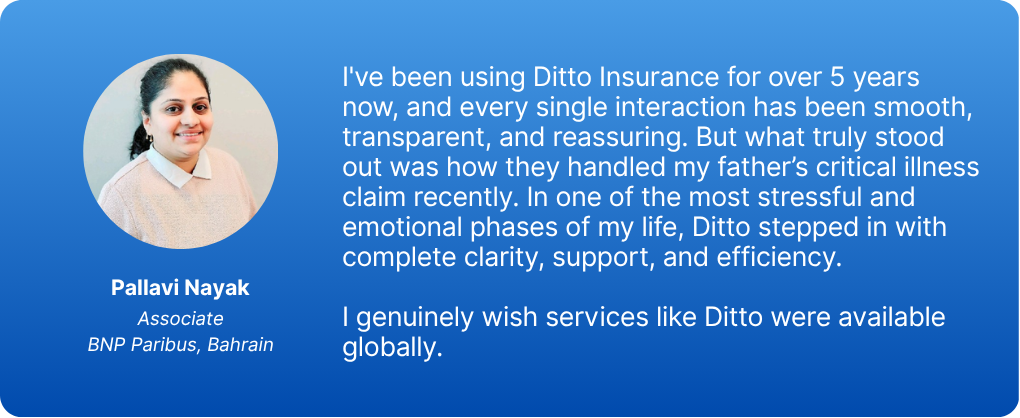
At Ditto, we’ve assisted over 8,00,000 customers with choosing the right insurance policy. Why customers like Pallavi below love us:
- No-Spam & No Salesmen
- Rated 4.9/5 on Google Reviews by 25,000+ happy customers
- Backed by Zerodha
- Dedicated Claim Support Team
- 100% Free Consultation
Confused about the right insurance? Speak to Ditto’s certified advisors for free, unbiased guidance. Book your call or chat on WhatsApp with us now!
Conclusion
If you are an NRI, the smartest move is to buy a comprehensive domestic health insurance plan before you actually need it. This way, your waiting periods can start running early and may be over by the time you visit India or move back.
Premium payment is fairly flexible, so use the account that works best for you. But if you may want to repatriate claim payouts later, paying through an NRE account can make things smoother. Also, be careful with NRI discounts. Unless the terms are simple and every insured member clearly qualifies, it is usually safer to skip them.
Most importantly, disclose your residency status honestly at every stage. That one step can prevent many claim-time disputes for NRI families.
Disclaimer: At Ditto, we offer general guidance on health insurance for NRIs in India and help with India-only plans for families living in India. We do not currently handle purchases or active policy management for NRI, PIO, or OCI applicants who are themselves living abroad.
Last updated on: