



Overview
Imagine planning a trip back to India, only for an unexpected hospitalization to wipe out months of savings. For millions of NRIs, this is not a hypothetical. It is a real gap that catches people off guard.
According to data from the Ministry of External Affairs (MEA), India has about 3.54 crore overseas Indians, including 1.59 crore NRIs. Yet, planning for health insurance in the home country for a visit or a permanent move back remains an afterthought.
In this guide, we walk you through whether NRIs can buy health insurance in India, what features to look for, which plans are worth considering, and how buying and claiming actually work.
Can NRIs Buy Health Insurance in India?
Yes. NRIs, OCIs, and PIOs are all eligible to buy health insurance from Indian insurers. However, there are no special health insurance plans for NRIs in India. You simply buy the same standard Indian health plans that residents do. But insurance companies will ask about your residence status. For example, you can refer to HDFC ERGO's NRI declaration, which asks for residential status, current country, international phone number, etc.
That said, a few things are specific to NRIs:
- Coverage: These plans cover hospitalization only in India. If you want overseas treatment covered, you need a separate global or expat plan, since most Indian health insurance plans covering global treatment are not offered to NRIs.
- Claims: NRI claims can get complicated when a diagnosis or treatment happens abroad. Foreign medical records, language barriers, and time zone differences between insurers and treating doctors can slow or complicate settlements.
- Discounts: Some health insurers offer NRI discounts (not always available through all insurance aggregators), but they come with conditions. For example, HDFC ERGO offers a 40% discount if you are abroad for the full policy year. But here is the catch: if you claim in India, then the insurer can deduct the discounted premium from your bill or ask you to pay it back before processing the claim.
Key Features to Look for in NRI Health Plans
Since most NRIs end up buying standard plans, the evaluation criteria are broadly similar to what any Indian resident would look for.

No Restrictions
Restrictions like co-payment, disease-wise sub-limits, and room-rent limits can quietly eat into your coverage. For example, if your policy caps the room at, say, ₹3,000 per day and you pick a ₹6,000 room, the insurer can proportionally deduct your entire claim. Choose plans that cover your entire bill without any restrictions.
Waiting Period Flexibility
IRDAI caps pre-existing disease (PED) waiting periods at 36 months. Some plans allow you to reduce this by paying an additional premium. If you have a planned move back or surgery in India within the next 1-2 years, look for plans with PED waiver add-ons.
Sufficient Sum Insured (SI)
Medical costs in India are significantly lower than in other developed countries, which is one reason many NRIs prefer to get critical procedures done here. But medical inflation is real. A ₹5 lakh cover bought today may not be enough in the next 5 years. Aim for ₹15-25 lakh as a base, and consider layering it with a super top-up for total protection.
Restoration and Bonus Features
Restoration replenishes your SI if it gets exhausted in a year. A no-claim or loyalty bonus builds your cover over time. Both are valuable features for long-term coverage, especially if you maintain the policy for several years before returning.
Reliable Insurer and Large Hospital Network
Choose an insurer with a sustainable Incurred Claim Ratio (ICR), low complaints, healthy business volume, and a wide cashless hospital network in the city where you’re likely to be treated. These metrics build confidence, but claim approval still depends on policy terms, exclusions, disclosures, and proper documentation.
Talk to an expert
today and
find
the right
insurance for you.


Best Health Insurance Plans for NRIs in India
There is no specific NRI health insurance in India. What NRIs need are strong, clean India-based plans with no sub-limits and a wide hospital network. The plans below have been evaluated by Ditto's six-point framework.
1) HDFC ERGO Optima Secure
Optima Secure is a solid all-rounder plan for NRIs planning to use it as their India base.
Key Features
- The Secure Benefit doubles your sum insured from day one (buy ₹15 lakh, get ₹30 lakh coverage instantly).
- There are no room-rent caps, no disease-wise sub-limits, and the plan covers consumables like gloves and masks by default, which most plans exclude.
- With a network of 13,000+ hospitals and a 96.71% claim settlement ratio (FY 2022-25), it is dependable for cashless care.
2) Care Supreme
Care Supreme is a reliable, no-frills plan for NRIs who want clean, practical coverage for themselves or their families back home.
Key Features
- The plan has no co-payment, no room-rent restrictions, and no disease-wise sub-limits, so you get flexibility during hospitalization.
- It offers unlimited restoration of the sum insured within a policy year, along with a cumulative bonus in which the cover increases by 50% each year, up to 100% of the sum insured (which can be increased up to 500% or unlimited through add-ons).
- Care Health has a network of 11,400+ hospitals and a 93.13% claim settlement ratio, calculated as a 3-year average (FY 2022-25), making it a dependable option for cashless access across India.
3) Aditya Birla Activ One Max
Aditya Birla Activ One Max is a feature-rich plan for NRIs seeking broader protection beyond basic hospitalization coverage.
Key Features
- The plan offers flexible sum insured options up to ₹2 crore, along with coverage for pre- and post-hospitalization care, day-care treatments, and modern procedures.
- It includes HealthReturns, which rewards healthy habits by giving you up to a 100% discount on your renewal premiums and an unlimited restoration benefit.
- Aditya Birla Health has a network of 12,000+ hospitals and a 95.81% claim settlement ratio, calculated as a 3-year average (FY 2022-25), providing strong hospital access and credible claims support across India.
For more details, you can check out our guide on the best health insurance plans in India.
How to Buy and Claim NRI Health Insurance?
How to Buy?
Most people can buy NRI health insurance entirely online while still abroad. Here is how it works:
- KYC: Requirements vary by insurer and applicant category. Common documents include a passport, PAN/Form 60, OCI card if applicable, Indian and overseas address proof, photo, and insurer-specific NRI/FATCA/residency declarations.
- Premium Payment: Pay in INR from your NRE or NRO account. You can also use Indian debit or credit cards, UPI, or net banking.
- Medical Underwriting: Depending on your age, sum insured, and health history, a tele-medical or lab test may be required. Physical tests can only be scheduled for your next visit to India.
- Policy Issuance: You will receive an e-policy with a 30-day free-look period. Update your insurer about any changes in residency status or diagnoses going forward.
How to Claim?
Claims for NRIs broadly follow the same process as those for Indian residents, but NRI and OCI claims can involve extra checks if any diagnosis, treatment, or medical history is from another country.
Cashless: Get admitted at a network hospital, show your policy document or e-card and photo ID, and the hospital will submit the pre-authorization request.
Reimbursement: Pay the hospital bill, collect all invoices, prescriptions, test reports, and discharge documents, and submit them to the insurer within the claim window, usually 30 days from discharge.
Important: Keep your insurer informed about any diagnosis, treatment, or ongoing condition in India or abroad. Overseas medical records can be harder to verify because formats, terminology, languages, and treatment practices differ across countries. Insurers may also need to contact the foreign doctor or hospital for clarification, which can delay or complicate claim settlement.
Why Choose Ditto for Health Insurance?
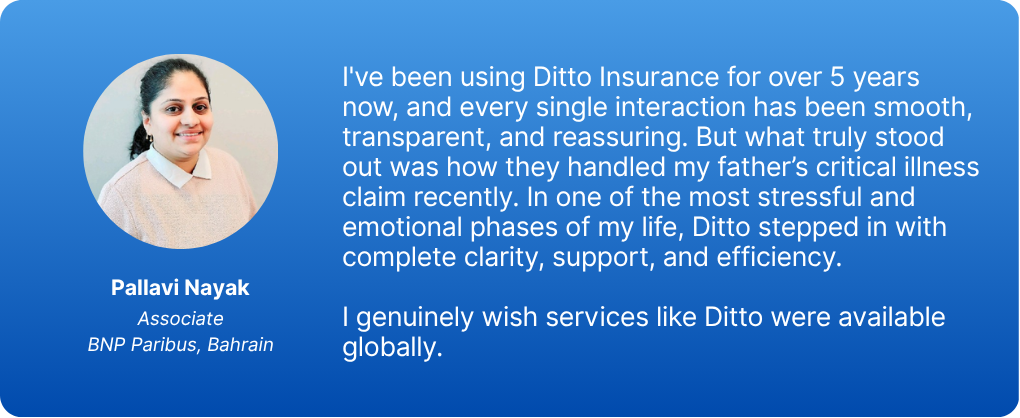
At Ditto, we’ve assisted over 8,00,000 customers with choosing the right insurance policy. Why customers like Pallavi below love us:
- No-Spam & No Salesmen
- Rated 4.9/5 on Google Reviews by 25,000+ happy customers
- Backed by Zerodha
- Dedicated Claim Support Team
- 100% Free Consultation
If you'd like to learn more about how Ditto helps you find the best health insurance for NRIs, you can check our detailed guide on the same.
Confused about the right insurance? Speak to Ditto’s certified advisors for free, unbiased guidance. Book your call or chat on WhatsApp with us now!
Ditto's Take: What Should NRIs Actually Do?
Here is the honest, practical advice we would give a friend:
- Keep Two Separate Plans: One India-specific plan (to cover visits and eventual return) and one local plan in the country you live in. Do not rely on one plan to do both jobs.
- Buy the India Plan Early: Ideally, 24-36 months before you plan to use it. Full coverage only starts after all waiting periods are complete.
- Skip the NRI Discount: Unless the terms are genuinely simple, we recommend avoiding it. The discount clawback at claim time is not worth the savings or the hassle.
Keep both your Indian and foreign insurers informed about any diagnoses or treatments. This is the single most important thing you can do to avoid claim rejections.
Disclaimer
Frequently Asked Questions
Last updated on: