


Overview
For many employees in India, health insurance does not start with buying a policy themselves. Instead, it starts with getting a corporate job.
That is why group health insurance plays such a large role in India’s insurance landscape. As per IRDAI’s Annual Report FY 2024-25, 47.4% of all lives covered under health insurance were in group business, compared to 42.3% in government-sponsored schemes and just 10.3% in individual policies.
At first glance, this sounds like a good thing. Your employer provides the cover, the onboarding is simple, and you mostly don’t have to pay the full premium yourself. But the biggest drawback is that this cover isn't tailored to your personal needs.
This guide explains what are the disadvantages of group health insurance in India, including pre-existing disease coverage and job-linked benefits, low sum insured, limited hospital access, and the need for individual health insurance.

What Are the Main Disadvantages of Group Health Insurance in India?
Coverage Ends With Employment
The moment you resign, retire, or are laid off, your group policy lapses immediately.
Zero Customization
Your employer controls all policy terms. You cannot increase the sum insured or add riders suited to your family's health needs.
Benefits Can Change Overnight
Group policies are renegotiated annually. Employers can reduce coverage, exclude parents, or add co-payment clauses without your consent.
Portability Is Uncertain
Converting your group policy to an individual plan is not guaranteed. Insurers can reject the transfer or impose fresh underwriting conditions.
No or Minimal Tax Benefits
In most cases, the employer pays the group health insurance premium, so employees cannot claim Section 80D tax deductions (old regime). You can claim deductions only if you pay a portion of the premium yourself.
No Restoration or Cumulative Bonus
If a family member exhausts the shared sum insured on a single admission, the rest of the family has zero coverage for the remainder of the policy year.
Consumables Excluded
Items such as gloves, syringes, and PPE kits, which can account for 5%-10% of a hospital bill, are rarely covered by group health insurance.
Should I Buy Individual Health Insurance Even If I Have Group Cover?
Yes, and the earlier you buy, the better. Each year you delay, comprehensive coverage moves farther away. A new diagnosis can make it harder to get good individual plans, and waiting periods begin only after purchase.
There is also a continuity problem with group health insurance. Since the policy belongs to your employer and not to you, you do not build long-term history with the insurer. In a retail health plan, staying covered over the years can help you move closer to moratorium benefits and build bonuses that increase your coverage. But with a group plan, that advantage remains limited because the coverage is tied to the company, not to your individual insurance journey.
Use your group cover for smaller, everyday claims where possible. But treat an individual health insurance plan as non-negotiable, not optional.
Talk to an expert
today and
find
the right
insurance for you.


What Happens to My Health Cover When I Leave My Job?
It stops immediately. Whether you resign, retire, or are laid off, your group health insurance benefits and coverage end on your last working day. If you are hospitalized the very next day, you are entirely on your own. There is no grace period.
That said, you can try converting your group policy to an individual plan, but this isn't always possible. Insurers may apply fresh underwriting, modify terms, or reject the porting request altogether, especially if you have made recent claims. This employment-linked termination is one of the most serious disadvantages of group health insurance, and that’s why relying solely on it is a risk no one should take.
Why Is the Sum Insured in Group Plans Often Too Low?
Most group health insurance plans offer a sum insured between ₹3 lakh and ₹5 lakh. That sounds reasonable until you see estimates of a major hospitalization in a metro city.
A single cardiac surgery in a private hospital in Delhi or Mumbai can cost anywhere from ₹6 lakh to ₹10 lakh. With Indian medical inflation running at 12.9%- 14% annually, a ₹5 lakh cover loses real value every year.
There is also the multi-admission trap. If one family member undergoes a major procedure early in the policy year and exhausts the shared sum insured, the rest of the family has zero coverage until renewal. Unlike individual plans, group health insurance policies do not include restoration benefits or cumulative bonuses to reload coverage mid-year.
Considering these factors, we recommend ₹15 lakh to ₹25 lakh as a starting point for determining a sufficient sum insured.
Can I Use Group Health Insurance at Any Hospital in India?
Does Group Health Insurance Cover Pre-Existing Diseases?
Yes, and this is one of the genuine advantages of group health insurance for employees. Most group policies cover pre-existing conditions from day one, unlike individual plans, which typically have a waiting period of 2 to 3 years. This matters most for employees whose family members have serious medical histories.
Shrehith, one of Ditto’s co-founders, uses his corporate group cover primarily for his father. Why? His father’s medical history makes it difficult for him to get a regular retail health insurance policy. In such cases, a corporate group health policy can be the only practical safety net, as it provides coverage even when individual plans are hard to access.
Why Talk to Ditto for Health Insurance?
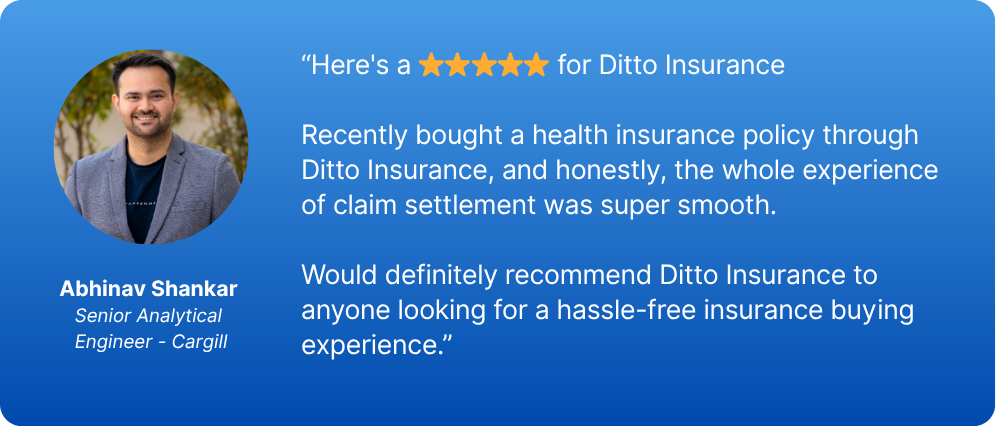
At Ditto, we’ve assisted over 8,00,000 customers with choosing the right insurance policy. Why customers like Abhinav below love us:
- No-Spam & No Salesmen
- Rated 4.9/5 on Google Reviews by 24,000+ happy customers
- Backed by Zerodha
- Dedicated Claim Support Team
- 100% Free Consultation
Confused about the right insurance? Speak to Ditto’s certified advisors for free, unbiased guidance. Book your call or chat on WhatsApp with us now!
Conclusion
Group health insurance is a benefit, not a backup plan. At the end of the day, it is a useful supplement, but it was never designed to be your only cover.
Here is what we recommend:
- Buy an individual health plan early, ideally in your 20s, while premiums are low and waiting periods can be completed.
- Use your group plan for smaller claims to protect your individual policy's no-claim bonus.
- If a parent cannot get retail coverage, your group plan can fill that gap, but still buy individual plans for everyone who qualifies.
- Review your group policy every year, check the sum insured, room rent limits, hospital network, and whether your parents are still included.
A health insurance policy is only useful if it actually protects you when you need it most. As a starting point in your journey to get an individual plan, refer to our guide on the best health insurance plans in India.
Frequently Asked Questions
Last updated on: