


Overview
Delhi has some of India's best government hospitals: AIIMS, Safdarjung, and GB Pant. Treatment there is heavily subsidized. And yet, families still abandon treatment midway. Why? Because "subsidized" isn't the same as "free."
Implants, high-end diagnostics, and specialized procedures still generate bills that low-income families simply cannot afford. This is where the Delhi Arogya Kosh (DAK) comes in, as the Delhi government's initiative to cover the financial gap.
In this guide, we'll cover what the Delhi Arogya Kosh scheme actually pays for, who's eligible, how to apply, which hospitals are empaneled, and whether you still need private health insurance.
What Is Delhi Arogya Kosh?
Delhi Arogya Kosh (DAK) is a registered society under the Delhi government’s health administration, not a health insurance company. Its core program provides financial assistance of up to ₹5 lakh to eligible patients receiving treatment for an illness or medical intervention at specified government hospitals.
Current Status: Delhi Arogya Kosh is still active, but its referral process was tightened in May 2026. Under the revised guidelines, authorities must first check whether free EWS beds are available at identified private hospitals before referring patients for planned surgeries. Imaging referrals are also allowed only when the required test is unavailable at a government hospital or cannot be provided within three days. In simple terms, private referrals are now meant to be a fallback option, not a parallel route running alongside government facilities.
Did You Know?
Eligibility Criteria for Delhi Arogya Kosh
Eligibility depends on which component of the scheme you're applying under.
- ₹5 Lakh Financial Assistance
- Annual family income up to ₹3 lakh.
- Bona fide Delhi resident for the last 3 years.
- Undergoing or requiring treatment at a government hospital in the NCT (National Capital Territory) of Delhi (Delhi government, Central government, AIIMS, autonomous institute, or local body).
- Free Surgeries and Diagnostics at Empaneled Private Hospitals
- The income and residency criteria don't apply here.
- Any bona fide Delhi resident, identified via Aadhaar, Voter ID, passport, driving license, an electoral roll extract, or a birth certificate (with a parent's ID for children under 5), can qualify.
- But you must already be undergoing treatment at a GNCTD-run hospital, with a surgery date more than one calendar month after pre-anesthesia clearance. CABG referrals are accepted only from GIPMER (GB Pant Hospital).
- Free diagnostics like ultrasound, Doppler, mammography, EEG, EMG, TMT, and ECHO are available at empaneled imaging centers to anyone treated at a GNCTD hospital or polyclinic
- PET and radionuclide scans are restricted to seven hospitals.
- Since May 2026, imaging referrals must first undergo a three-day unavailability check at government facilities.
- Road Accident, Acid Attack, and Burn Victims
- No income or residency requirement.
- The incident just needs to have occurred within the NCT of Delhi.
Benefits and Coverage Under Delhi Arogya Kosh
Delhi Arogya Kosh is not restricted to a fixed list of critical illnesses.
The approval authority depends on the amount:
- Up to ₹25,000: Approved at the DGHS level
- Above ₹25,000 and up to ₹1.5 Lakh: Approved by DGHS after Finance Department clearance
- Above ₹1.5 Lakh and up to ₹5 Lakh: Approved by the Chairman of DAK
The sanctioned amount is not paid to the patient. It is transferred directly to the treating government hospital through ECS.
DAK also supports specified surgeries and high-end diagnostic tests at empaneled private facilities, subject to the applicable referral, waiting-list, and package-rate rules.
Separately, it funds cashless emergency treatment for victims of road accidents, acid attacks, and thermal burns when the incident occurs within Delhi. Eligible registered private hospitals and nursing homes treat the patient and seek reimbursement through DAK.
Talk to an expert
today and
find
the right
insurance for you.


How to Apply for Delhi Arogya Kosh?
The official DAK guidelines currently describe the application process as primarily offline and require completion through the concerned government hospital.
- Visit a Delhi government hospital where the patient is receiving or will receive treatment, and consult the treating doctor.
- Fill out the Delhi Arogya Kosh application form and gather the required supporting documents.
- Ask the treating doctor to prepare the treatment estimate, diagnosis details, and medical recommendation. This estimate must be certified by the Medical Superintendent.
- Submit the completed application and documents either:
- At the Delhi Government Dispensary Building, S-1, 3rd Floor, School Block, Shakarpur, Delhi – 110092, or
- In the office of the Medical Superintendent/Medical Director of the concerned government hospital.
- After submission, the case goes through administrative scrutiny and approval. If sanctioned, the financial assistance is released directly to the treating government hospital.
Delhi Arogya Kosh Empaneled Hospital List
The Delhi Arogya Kosh hospital list is wide, though which facility applies depends on the benefit you're using.
These seven hospitals are:
- GB Pant Hospital
- Lok Nayak Hospital
- Guru Tegh Bahadur Hospital
- Deen Dayal Upadhyay Hospital
- Dr. Baba Saheb Ambedkar Hospital
- Janakpuri Super Specialty Hospital
- Rajiv Gandhi Super Specialty Hospital
Patients receiving treatment at another Delhi government hospital may be referred to one of these seven facilities for PET or radionuclide scans. Since the hospital list may change, check the official DGHS Delhi Arogya Kosh page for the latest details.
Delhi Arogya Kosh vs. Private Health Insurance: Do You Still Need Personal Cover?
Let’s understand why it still cannot replace private insurance:

Based on Approval
Applications move through multiple government approvals. The published guidelines do not promise a fixed processing or settlement timeline. Since DAK is not regulated as insurance, complaints cannot be taken to IRDAI or the Insurance Ombudsman.
Provider Choice Is Limited
The core assistance is tied to eligible government hospitals. Where private treatment or diagnostics are permitted, access is referral-based and subject to the relevant rules. Patients cannot freely choose any private hospital.
Eligibility Is Narrow
The current core guidelines require a National Food Security Card and at least 3 years of residence in Delhi. This may exclude many salaried households.
DAK Is Delhi-Specific
It does not provide nationwide portability. By contrast, AB PM-JAY beneficiaries can use their benefits at empaneled hospitals across India, whereas retail health policies generally provide broader geographic access, subject to their policy terms and hospital networks.
Rules Can Change
DAK eligibility, referral processes, and implementation conditions are set through government guidelines and administrative orders. Unlike an insurance policy, there is no contractual wording locked in for the policy term.
For eligible low-income families, DAK and AB PM-JAY can complement each other, but their benefit limits should not be treated as an automatic combined coverage. Also, income is not the only consideration: everyone aged 70 or above can qualify for AB PM-JAY irrespective of economic status.
Key Takeaway: Private insurance remains useful for broader hospital choice, better contractual benefits, nationwide access, and greater predictability. Public schemes can then serve as an additional safety net rather than the family’s only healthcare plan.
Why Choose Ditto for Health Insurance?
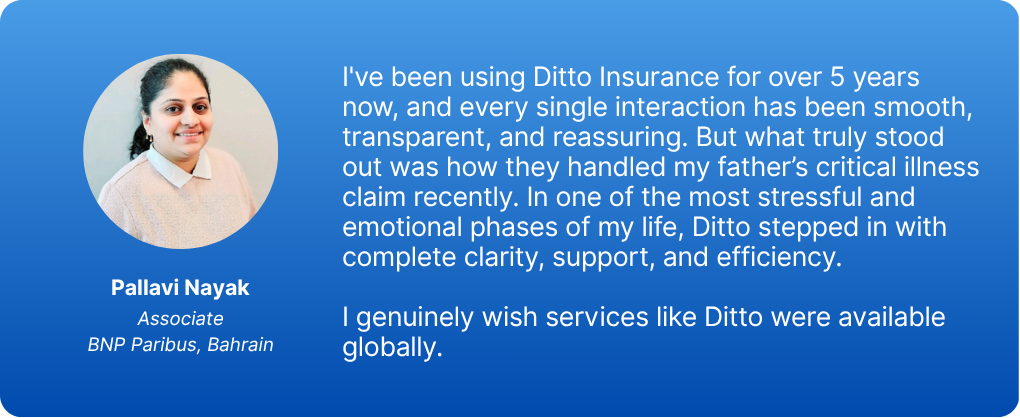
At Ditto, we’ve assisted over 8,00,000 customers with choosing the right insurance policy. Why customers like Pallavi below love us:
- No-Spam & No Salesmen
- Rated 4.9/5 on Google Reviews by 25,000+ happy customers
- Backed by Zerodha
- Dedicated Claim Support Team
- 100% Free Consultation
Confused about the right insurance? Speak to Ditto’s certified advisors for free, unbiased guidance. Book your call or chat on WhatsApp with us now!
Conclusion
Delhi Arogya Kosh remains one of the few real safety nets for low-income families needing treatment at Delhi's government hospitals.
If your family income is under ₹3 lakh, check your eligibility on the DGHS website and start your application through your treating hospital's Patient Welfare Cell.
If you're above that threshold, compare the best health insurance plans in India and get covered before you need it, not after.
Frequently Asked Questions
Last updated on: