



Overview
Medical treatment is expensive, especially for families with limited financial resources. This is where the Rajiv Aarogyasri Scheme steps in to help eligible families access cashless treatment for major illnesses and specialized procedures, reducing the financial burden of critical healthcare.
This guide walks you through Rajiv Aarogyasri’s eligibility, coverage, application process, card verification, benefits, and comparison with private health insurance.
What Is Rajiv Aarogyasri?
Rajiv Aarogyasri is best understood as a package-based cashless healthcare scheme, rather than an unrestricted ₹10 lakh reimbursement account. Beneficiaries are identified through the Food Security Card and the Civil Supplies Department database. To receive coverage, a patient generally needs to meet four key conditions:
- Be an eligible beneficiary under the scheme.
- Have a disease and proposed treatment covered under an approved Aarogyasri package.
- Receive treatment at an empaneled hospital.
- Obtain the required package approval or preauthorization from the Trust.
This means that the ₹10 lakh coverage limit does not automatically apply to every medical expense. Coverage depends on the beneficiary’s eligibility, the approved treatment package, the hospital’s empanelment, and the required authorization.
Note: Rajiv Aarogyasri and Dr. YSR Aarogyasri are not the same schemes. Both trace their origins to the same pioneering public healthcare program launched in undivided Andhra Pradesh in 2007. Following the state’s bifurcation, the program continued under different names and with separate state-level administration and updates in Telangana and Andhra Pradesh.
Eligibility Criteria for Rajiv Aarogyasri
To qualify for the Rajiv Aarogyasri Scheme, applicants must be residents of Telangana and belong to an eligible low-income household recognized under the state’s beneficiary database. Valid documentation, including the required food security or ration card, is needed to verify eligibility and access to covered healthcare services.
Even after a beneficiary’s eligibility is verified, the proposed treatment must fall within an approved package, be performed at an empaneled hospital, and receive the required preauthorization before coverage can be approved.
Talk to an expert
today and
find
the right
insurance for you.



Benefits, Coverage, and Diseases Covered Under Rajiv Aarogyasri
Wide Treatment Coverage
The scheme covers 1,672 medical procedures across 21 specialties, including several specialized and high-cost treatments.
Major Organ Systems Covered
Coverage extends to treatments involving the heart, lungs, liver, pancreas, kidneys, nervous system, and other critical organ systems.
Cochlear Implant Support
Cochlear implant surgery with Auditory Verbal Therapy is covered for children under three years of age. Children aged three to five may also qualify in exceptional cases, subject to case-by-case approval.
Specialized Procedures
The scheme covers treatments such as cochlear implant surgery with Auditory Verbal Therapy, for which the Rajiv Aarogyasri Health Care Trust provides financial assistance of up to ₹6.50 lakh per case. This provision is subject to applicable scheme guidelines.
How to Apply for Rajiv Aarogyasri?
Step 1: Verify Your Food Security Card Details
Start by checking your Food Security Card (FSC) record through the official Telangana ePDS portal. You may search using your FSC reference number, ration card number, or district details. This helps confirm whether your household record is active in the Civil Supplies database.
Most eligible Food Security Card households do not need to purchase a separate policy or complete a conventional insurance enrollment process. The process generally begins with verifying the beneficiary record, after which the patient can visit an empaneled hospital. The hospital’s Aarogyamithra then assists with registration, eligibility verification, and the required preauthorization process.
Step 2: Correct or Update Household Details
If your card is missing, inactive, or contains incorrect information, you can request corrections through Telangana MeeSeva or the relevant Civil Supplies services. Common requests include issuing a new ration card, adding or removing family members, updating the household head, recording migration, or correcting missing database details.
Step 3: Visit a Government or Empaneled Hospital
Once eligibility is confirmed, visit a government hospital, an empaneled private hospital, a Primary Health Center, a referral facility, or an Aarogyamithra help desk. The Aarogyamithra can assist with registration, eligibility verification, and coordination of the treatment approval process.
Step 4: Hospital Initiates Preauthorization
The network hospital generally handles the preauthorization process on the patient’s behalf. It uploads the diagnosis, medical records, and proposed treatment details to the Trust’s system for approval. Since covered treatments are cashless, beneficiaries typically do not need to file a separate reimbursement claim themselves.
Note: The required documents may vary depending on the beneficiary’s circumstances and the treatment requested. Applicants should generally carry their Food Security Card or other eligible beneficiary identification, Aadhaar or another accepted identity document, relevant medical records and diagnostic reports, along with any additional documents requested by the hospital or scheme authorities.
How to Download and Check Your Rajiv Aarogyasri Card
As of July 2026, there does not appear to be a consistently accessible official public portal that allows every beneficiary to directly download a standalone Rajiv Aarogyasri card using only an Aadhaar number or ration card number.
Some third-party websites claim to offer direct card-download services, but beneficiaries should exercise caution and verify that any link is hosted on an official Telangana government or Aarogyasri Trust website before sharing personal information.
For the latest card verification, download options, and beneficiary-specific instructions, visit the official Aarogyasri website or contact the Trust through its official channels for accurate guidance.
Rajiv Aarogyasri vs. Private Health Insurance: Do You Still Need Cover?
Yes, in many cases, private health insurance is still useful even if you are eligible for the Rajiv Aarogyasri scheme. The two serve different purposes.
Private health insurance can offer broader hospital choice, additional coverage like restoration benefits, and greater flexibility in accessing healthcare. It may also be particularly valuable for expenses such as treatment at hospitals outside the scheme’s network or healthcare needs not covered by Rajiv Aarogyasri.
Additionally, the ₹10 lakh coverage limit can sometimes create the impression that Rajiv Aarogyasri works like comprehensive private health insurance. However, the scheme generally pays for specific approved therapies and treatment packages, rather than every medical expense a beneficiary may incur.
Depending on the scheme rules and package conditions, coverage may not automatically extend to:
- Routine outpatient consultations
- Regular medicines for common or chronic conditions outside an approved treatment package
- Minor illnesses that do not correspond to a listed therapy
- Every diagnostic test or investigation
- Treatment at a non-empaneled hospital
- Procedures that have not received the required package approval
- Upgraded rooms, non-medical expenses, or optional services
- Every modern treatment recommended by a doctor
- Travel, food, attendant expenses, or income lost during treatment
The key point is that eligibility for the scheme and a ₹10 lakh coverage limit do not guarantee that every treatment will be paid for. The proposed treatment must fall within the approved therapy list, meet the package conditions, and generally receive the required preauthorization. If the disease or treatment does not fall within the scheme’s listed therapies, financial assistance may not be available.
Why Choose Ditto for Health Insurance?
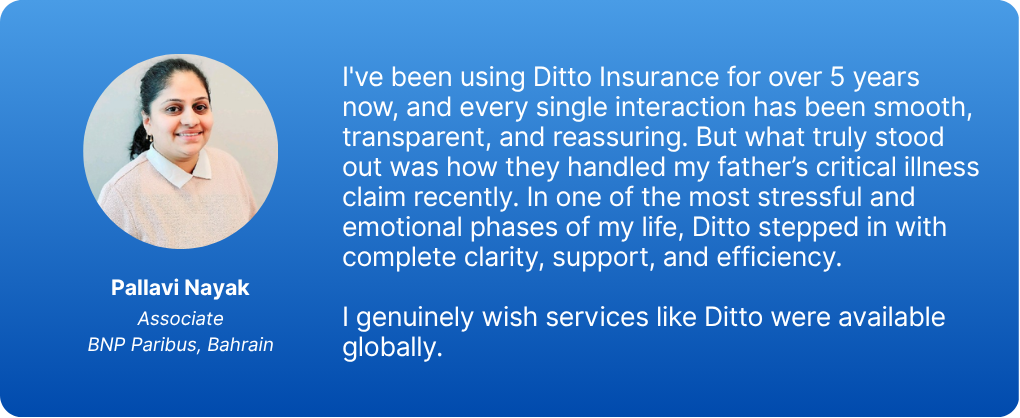
At Ditto, we’ve assisted over 8,00,000 customers with choosing the right insurance policy. Why customers like Pallavi below love us:
- No-Spam & No Salesmen
- Rated 4.9/5 on Google Reviews by 25,000+ happy customers
- Backed by Zerodha
- Dedicated Claim Support Team
- 100% Free Consultation
Confused about the right insurance? Speak to Ditto’s certified advisors for free, unbiased guidance. Book your call now or chat with our advisors on WhatsApp.
Conclusion
If you are eligible for Rajiv Aarogyasri, it should remain your primary healthcare safety net. However, if you can afford the additional premium, a suitable private health insurance policy can provide broader protection, greater hospital choice, and added financial flexibility. The best approach is to use private insurance as a supplement to, rather than a replacement for, your government healthcare coverage.
Disclaimer: Coverage limits, treatment packages, empaneled hospitals, documentation requirements, and other operational rules may change based on government notifications and policy updates. The information provided is for general awareness and should not be treated as official confirmation of eligibility or coverage. Always verify the latest details through the official Aarogyasri Trust or relevant state government channels before seeking treatment.
Frequently Asked Questions
Last updated on: