Health Insurance

Best Health Insurance in India: Top 5 Plans

Swetlana Neog

Written by Swetlana Neog

Editorial Associate

Gaurav Bhat

Reviewed by Gaurav Bhat

IRDAI-Certified Expert at Ditto

SP0738578124

Certified
Best Health Insurance in India: Top 5 Plans

Overview

The "best" health insurance plan depends on factors like your age, medical history, budget, and location. However, based on Ditto’s proprietary 5-point rating framework, which evaluates insurer reliability (using IRDAI data), policy features, and affordability, the top-rated health insurance plans in 2026 are:

  • HDFC Ergo Optima Secure+ (4.6/5)
  • Care Supreme (4.5/5)
  • Aditya Birla Activ One MAX (4.4/5)
  • Niva Bupa ReAssure 2.0 Platinum+ (4.3/5)
  • SBI Super Health Platinum Infinite (4.1/5)

The highest-rated health insurance companies in 2026 are:

  • HDFC Ergo (4.99/5)
  • Bajaj General (4.99/5)
  • Niva Bupa (4.99/5)
  • Aditya Birla (4.49/5)
  • Care Health (4.23/5)

These plans stand out for their combination of affordable premiums, comprehensive coverage, and insurer reliability. For example, a 25-year-old in Delhi can get ₹15 lakh coverage under HDFC Ergo Optima Secure+ for around ₹13,459 per year. As a result, these plans are well-suited for first-time buyers, families, and individuals looking to switch insurers.

Finding the best health insurance in India can feel confusing. Every insurer claims to offer the best coverage, the best features, and the best claim support. But once you start comparing plans, you realize that small details like room rent limits, waiting periods, and claim settlement experience can make a huge difference when you actually need to use the policy.
Confused about which plan actually fits your needs? Instead of comparing everything yourself, you can talk to an expert and shortlist the right policy in minutes.

Confused about the best health insurance policy that aligns with your needs? Book a free call or chat with us on WhatsApp today.

Which Health Insurance Is Best in India: Ditto’s Top 5 Choices

Ditto’s Rating Methodology

The health insurance plans included in this guide are rated using Ditto's transparent policy rating framework, which scores each plan across three dimensions:

  1. Feature Rating (45%): This measures how comprehensive the policy is, including room rent rules, co-pays, waiting periods (and options to reduce them), restoration, bonuses, consumables coverage, and more.
  2. Insurer Rating (45%): Assesses the reliability of the company behind the policy, based on IRDAI data such as claim settlement ratio, complaint volume, business scale, hospital network, and servicing model.
  3. Premium Rating (10%): Evaluates affordability for a benchmark profile (30-year-old, ₹10 lakh sum insured, Bengaluru). If premiums are unavailable, a default score of 3 is assigned.
HDFC Ergo Optima Secure+ Banner

Best Health Insurance Policy in India: Detailed Comparison
01
HDFC Ergo

HDFC Ergo Optima Secure+

HDFC Ergo Optima Secure+ is the new flagship health insurance plan from HDFC Ergo that offers sum insured options from ₹10 lakh up to ₹2 crore, available as both individual and family floater plans.
HDFC Ergo
Optima Secure+
4.6
Overall Rating

Premium Rating
3.0/5

Insurer Rating
5.0/5

Feature Rating
4.6/5

Customer Service Rating
5.0/5

Key Features

  • Provides policy tenure for 1, 2, 3, 4 or 5 years.
  • Covers pre-hospitalization expenses for up to 60 days and post-hospitalization expenses for up to 180 days.
  • Secure Benefit: 2x cover from day one.
  • Infinity Benefit: Every year at renewal, 100% of your base sum insured is added to your total cover, and there's no limit on how high it can go.
  • Protect Benefit: Covers consumables (gloves, masks, syringes, etc.).
  • Includes home healthcare, daycare, organ donor cover, and AYUSH (Ayurveda, Yoga and Naturopathy, Unani, Siddha, and Homoeopathy) treatments up to sum insured.
  • Unique riders: Serious Illness Booster, Limitless, Parenthood, ABCD chronic care, and Optima well being.

Takeaway: While the newer flagship has reduced premiums in many cases, the biggest strength is still the insurer's reliability: strong claims support, a dependable claims record, and the basics done right. HDFC Ergo settled 96.71% of health insurance claims on average over FY 2022–25 - one of the highest CSRs in the industry, with one of the lowest complaints of 9.28 complaints per 10,000 claims, well below the sector average of 27.06. On top of that, you also get bundled benefits, including automatic sum insured boosts and unlimited restoration, which can be especially useful for people with common chronic conditions like diabetes or asthma who want faster coverage.

02
Care

Care Supreme

Care Supreme is a comprehensive, modular, value-for-money health insurance plan that offers sum insured options from ₹5 lakh to ₹1 crore, available as both individual and family floater plans.
Care
Supreme
4.5
Overall Rating

Premium Rating
5.0/5

Insurer Rating
4.2/5

Feature Rating
4.5/5

Customer Service Rating
3.0/5

Key Features

  • Provides policy tenure for 1, 2, or 3 years.
  • Offers unlimited automatic recharge for related and unrelated illnesses.
  • Provides a cumulative bonus up to 100% (option to extend by 500% or unlimited accumulation additionally through add-ons).
  • The Claim Shield Plus add-on reduces out-of-pocket expenses by covering 146 non-payable items during hospitalization.
  • Wellness discounts, with up to 30% off renewals through fitness-linked benefits.
  • Unique add-ons for comprehensive PED waiting period reduction, gym memberships, outpatient department (OPD) cover, unlimited coverage (once), and air ambulance.

Takeaway: The policy doesn’t provide free health check-ups and records higher complaint volumes. However, it’s fairly affordable and suits individuals with PEDs who want shorter waiting periods, as well as those looking for more flexibility through multiple add-ons.

03
Aditya Birla

Aditya Birla Active One MAX

Aditya Birla Activ One Max is a comprehensive health insurance plan that provides sum insured options from ₹5 lakh to ₹2 crore, available as individual and family floater policies.
Aditya Birla
Active One MAX
4.4
Overall Rating

Premium Rating
5.0/5

Insurer Rating
4.5/5

Feature Rating
4.3/5

Customer Service Rating
5.0/5

Key Features

  • Provides policy tenure for 1, 2, or 3 years.
  • Unlimited restoration (usable for related and unrelated illnesses) is available from the second claim of the policy's lifetime.
  • Cumulative bonus of 100% per annum up to 500% given regardless of claims made (MAX up to 3 crore).
  • HealthReturns® that reward fitness or healthy living with discounts on renewal premiums up to 100%.
  • Intuitive add-ons for pre-existing disease waiting period reduction and chronic care.

Takeaway: If you’re young and want a feature-rich plan at a good price, Activ One MAX stands out with useful modern benefits (e.g., high inbuilt bonus) and rewards for staying healthy. Aditya Birla's 3-year average CSR (FY 2022–25) is 95.81% - consistently above the industry average and among the top performers nationally.

04
Max Bupa

Niva Bupa ReAssure 2.0 Platinum+

Niva Bupa ReAssure 2.0 Platinum+ is a premium health insurance policy offering comprehensive coverage with sum insured options up to ₹1 crore for individuals and families.
Niva Bupa
ReAssure 2.0 Platinum+
4.3
Overall Rating

Premium Rating
5.0/5

Insurer Rating
4.2/5

Feature Rating
4.2/5

Customer Service Rating
3.0/5

Key Features

  • Provides policy tenure for 1, 2, or 3 years.
  • ReAssure+ restores your cover an unlimited number of times in a policy year, up to the sum insured for each claim.
  • Age-lock on premium until the first claim.
  • Booster+ allows your unused sum insured to be carried forward up to 5x for the recommended Platinum+ variant.
  • The Safeguard add-on covers non-payables and inflation-linked sum insured hikes (no impact on Booster+ if the claim made in a policy year is up to ₹50,000-₹1,00,000).

Takeaway: Post-sales servicing and claims experience is not as uniform as the other top players. However, ReAssure 2.0 is worth considering for those seeking a flexible policy that grows with their needs and offers comprehensive peace of mind.

05
SBI

SBI Super Health Platinum Infinite

SBI Super Health Platinum Infinite is the most premium plan in the Super Health series, offering comprehensive health insurance coverage with sum insured options ranging from ₹50 lakh to ₹2 crore.
SBI
Super Health Platinum Infinite
4.1
Overall Rating

Premium Rating
5.0/5

Insurer Rating
3.8/5

Feature Rating
4.2/5

Customer Service Rating
3.0/5

Key Features

  • Unlimited reinstatement of up to 200% of the sum insured per claim (ReInsure Benefit).
  • The Health Multiplier provides up to 3x cover for 37 listed serious illnesses.
  • Global cover for 16 conditions and an air ambulance worth ₹10 lakh.
  • Provides built-in OPD and consumables cover.
  • Shorter waiting periods (2 years for PEDs and 1 year for specific illnesses).
  • Provides health assistance (personal fitness coaching), a dietitian, and nutrition e-consultation, along with an unlimited gym membership.
  • Offers a renewal discount based on the number of steps walked by the insured members, up to 30%. 

Takeaway: Premiums are quite expensive due to the over-indulgent nature of the policy and a higher base cover amount (₹50 lakh). The policy is ideal for individuals and families seeking high-value health coverage with strong financial protection against major medical expenses. It maintains a 3-year average CSR of 96.14% (FY 2022–25) - well above the industry average - and an average of 20.51 complaints per 10,000 claims, indicating broadly reliable claim handling.

Talk to an expert
today and find
the right
insurance for you.

Ditto Advisor

Premium Comparison: Top 5 Health Insurance Plans in India

ProfileHDFC Ergo Optima Secure+Care SupremeAditya Birla Activ One MAXNiva Bupa ReAssure 2.0 Platinum+SBI Super Health Platinum Infinite
(Individual Plan): Age 25₹13,459₹15,111₹10,149₹11,271₹45,944
(Family Floater, 2A): Ages (31, 32)₹21,128₹21,528₹16,299₹19,176₹61,568
(Family Floater, 2A 1C): Ages (35, 34, 5)₹26,017₹27,161₹21,478₹25,026₹62,758
(Family Floater, 2A): Ages (62, 63)₹75,608₹78,923₹66,505₹68,239₹1,13,250

Here, "A" stands for adult, and "C" denotes children.

Notes:

    • These are indicative premiums for a Delhi resident (pin code: 110001) with a ₹15 lakh sum insured, including mandatory and recommended add-ons. Your premium can change based on age, city, medical history, plan variant, added discounts, and chosen add-ons.
    • Premiums for SBI Super Health Platinum Infinite have been calculated by considering a sum insured of ₹50 lakhs.

Which Health Insurance Company Is Best: Performance Comparison

Company NameClaim Settlement Ratio (CSR)Complaints Per 10,000 ClaimsAnnual Business (in Crore)
HDFC Ergo96.71%9.28₹6,118
Care93.13%42.00₹6,775
Aditya Birla95.81%18.67₹3,290
Niva Bupa 91.62%42.85₹5,481
SBI General96.14%20.51₹3,329
Industry Average91.22%27.06₹3,969

The above metrics are averages for the financial year (FY) 2022-25, and for the insurers specifically discussed in this guide. For a comprehensive understanding of other best performing insurers, refer to our guide on the best health insurance companies in India

Key Insights

    • CSR: All five insurers are above the 90% mark, which suggests that they settle a large majority of the claims they receive.
    • Complaints: HDFC Ergo and Aditya Birla look stronger here, while Care and Niva Bupa are well above the industry average, which is something to watch out for. 
    • Annual Business: All the best health insurance plans operate above the industry average in annual business, which usually reflects stronger scale, wider reach, and a larger customer base.

Note: Apart from these three metrics, it is also worth looking at factors like network hospital size and incurred claim ratio (ICR) to get a more complete comparison of insurers.

Background Image

How to Choose the Best Health Insurance Plans in India?

01

Get Expert Advice

Get advice from unbiased, advisory platforms like Ditto. This can help you shortlist plans based on your profile, and also get continued support for any changes or claims that you might make later on in your policy.

02

Assess Your Health Needs

Evaluate your personal health requirements and medical history. If you have ongoing conditions, consider plans covering PEDs with shorter waiting periods.

03

Policy Features

Check what the plan actually covers, such as room rent limits, co-pays, disease sub-limits, waiting periods, restoration benefits, and coverage for consumables like PPE kits. Include important add-ons if they enhance benefits.

04

Insurer Reliability

Analyze the company’s 3-year claim settlement ratio, complaint levels, hospital network size, and whether claims are handled digitally, in-house, or via a third-party administrator (TPA).

05

Premiums for Your Profile

Compare premiums based on your age, city, and coverage. Hidden co-pays or sub-limits can make a cheaper plan less valuable. So, do not just pick the cheapest policy.

Why Choose Ditto for Health Insurance?

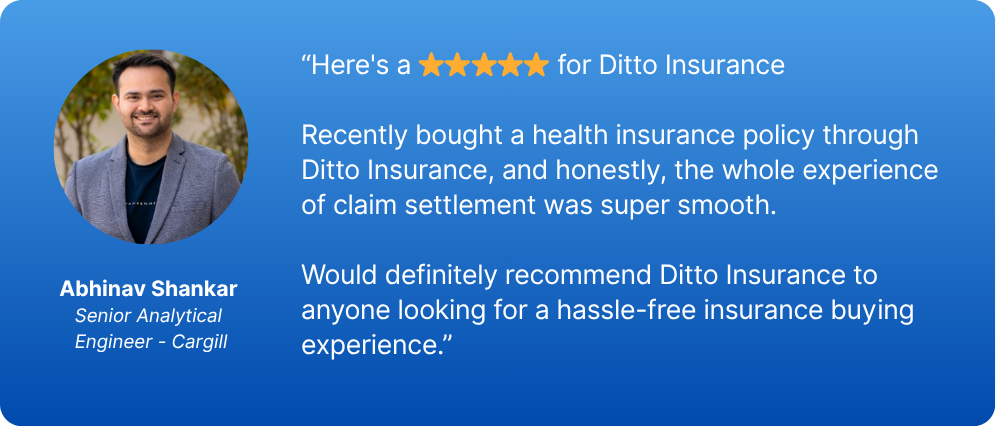
At Ditto, we’ve assisted over 8,00,000 customers with choosing the right insurance policy. Why customers like Abhinav below love us:
Best Health Insurance in India: Top 5 Plans
    • No-Spam & No Salesmen
    • Rated 4.9/5 on Google Reviews by 15,000+ happy customers
    • Backed by Zerodha
    • Dedicated Claim Support Team
    • 100% Free Consultation

You can book a FREE consultation. Slots are running out, so book a call or chat with us on WhatsApp now!

Which Health Insurance is Best in India?

There is no single best health insurance policy for everyone. The right plan depends on your priorities and what you value most, such as insurer reliability, coverage features, or long-term affordability. That’s why we compare plans using a transparent, data-driven framework that looks at insurer strength, product features, and pricing.

HDFC Ergo Optima Secure+ is the most balanced choice, while Care Supreme and Aditya Birla Activ One MAX offer strong coverage at competitive prices. Niva Bupa ReAssure 2.0 Platinum+ stands out for its innovative, feature-rich design. SBI Super Health Platinum Infinite is also a solid option, though not a partner offering.

Disclaimer

We believe in full transparency around our partnerships. Our current insurer partners are HDFC Ergo, Care, Aditya Birla, and Niva Bupa. But as you can see in this list, the rankings include both partners and non-partners because the methodology is unbiased and applied uniformly across all insurers. To know more about how we rate plans, read our detailed rating framework.

Frequently Asked Questions

Which is the best health insurance plan in India?

 HDFC Ergo Optima Secure+ is the strongest overall pick based on Ditto’s transparent methodology because it balances coverage, insurer reliability, and real-world usefulness better than most of its peers. It has a 96.71% claim settlement ratio, and only 9.28 complaints per 10,000 claims. It also includes practical features such as no room-rent cap, 2x coverage from day 1 through Secure Benefit, Infinite bonus, and unlimited restoration. However, the best plan for you depends on your age, city, budget, and medical history.

What are the top 3 health insurance plans in India?

As per Ditto’s transparent policy rating framework, the top 3 health insurance plans in India are HDFC Ergo Optima Secure (4.6/5), Care Supreme (4.5/5), and Aditya Birla Activ One MAX (4.4/5). HDFC stands out for claims reliability, Care for flexible add-ons and unlimited restoration, and Aditya Birla for lower premiums plus wellness-linked discounts. If you are buying your first plan, these 3 are a practical starting point because they combine strong policy features, insurer strength, and better long-term value than many other plans with co-pay or room rent restrictions.

Which health insurance company feels safest for claims?

As per the public disclosure data of health insurers in India, HDFC Ergo looks safest for claims because it combines a 96.71% claim settlement ratio with just 9.28 complaints per 10,000 claims, which is far below the industry average of 27.06. That matters because a high CSR alone does not always mean a smooth claim experience. Bajaj General also stands out with a CSR of 96.78% an. When judging claim safety, always check both CSR and complaint volume, along with other operational metrics.

What is claim settlement ratio in health insurance?

The claim settlement ratio, or CSR, is the percentage of claims an insurer settles out of the total claims available to settle in a year. However, IRDAI does not specify a standard formula to calculate CSR. So if an insurer has a CSR of 95%, it means it settled 95 of the 100 claims it received. In health insurance, a CSR above 90% is seen as a good sign, but it should not be your only filter. CSR shows reliability, but not the full claim experience. So you should also check complaints per 10,000 claims, the hospital network, and whether claims are handled in-house or through a third-party administrator.

What does room rent limit or room rent cap mean in health insurance?

The room rent limit is the daily cap your insurer puts on the hospital room cost that it will pay. For example, if your plan allows only ₹5,000 per day but the hospital charges ₹10,000, you pay the gap yourself. This also triggers proportionate deductions on the full bill, including doctor fees and surgery charges. That is why plans with no room rent limit offer better coverage. If you are comparing health insurance policies, this is one of the first policy terms to check before looking at the premium alone.

What is restoration benefit in health insurance?

Restoration benefit, also called recharge or reinstatement, means your insurer refills your sum insured after it gets used up in a policy year. For example, if you have a ₹10 lakh cover and one major hospitalization exhausts it, the insurer restores that amount for later claims, subject to policy rules. Care Supreme and Niva Bupa ReAssure 2.0 Platinum+ offer unlimited automatic restoration, which can be used for both the same and different illnesses. This feature matters most for family floaters, chronic conditions, and years with more than one hospitalization.

What is the waiting period for pre-existing diseases in health insurance?

In health insurance, a waiting period is the time during which certain illnesses are not covered. For pre-existing diseases, IRDAI rules now allow a maximum waiting period of 3 years, though some plans may offer shorter timelines through add-ons. There is also a 30-day initial waiting period for all claims except accidents, and a 1- to 2-year specific disease waiting period for conditions such as hernia or cataract. If you already have diabetes, asthma, or thyroid issues, choosing a plan with shorter PED waiting periods can make a meaningful difference in when your coverage starts.

Should I buy an individual plan or a family floater?

An individual plan gives the insured person a separate sum insured, while a family floater provides a single shared cover for everyone on the policy. A floater is usually cheaper and works well for young families, especially with a base cover of ₹15 lakh to ₹25 lakh. But if one member uses up most of the cover, the rest of the family may be left with less protection that year. For parents aged 60+, a separate individual policy is usually safer because hospitalization risk is higher and claims are more frequent.

Is HDFC Ergo Optima Secure worth the higher premium?

HDFC Ergo Optima Secure can be worth the higher premium if claim reliability and built-in benefits matter more to you than getting the cheapest policy. For a 25-year-old in Delhi, the premium is about ₹14,130 for a ₹15 lakh cover, higher than that of Aditya Birla Activ One MAX at ₹10,149. But HDFC also offers a 96.71% CSR, only 9.28 complaints per 10,000 claims, 2x cover from day 1, and strong overall product design. If you value peace of mind, the premium is justified.

Which health insurance plan is best for families in India?

For families, Care Supreme, Aditya Birla Activ One MAX, and Niva Bupa ReAssure 2.0 Platinum+ are strong options because they offer features that matter in shared coverage, such as restoration, bonus growth, and flexible add-ons. For a family floater with 2 adults aged 31 and 32, premiums in Delhi start at around ₹16,299 for Aditya Birla and go up to ₹22,272 for HDFC Ergo for a ₹15 lakh cover. In most metro cities, a floater sum insured of at least ₹15 lakh to ₹25 lakh is a practical starting point.

Which health insurance plan gives the highest coverage for the premium?

The best value plan is not necessarily the cheapest premium. A plan offering a ₹15 lakh base cover with benefits like unlimited restoration, no room-rent cap, and cumulative bonuses can provide significantly more effective coverage than a lower-priced policy with restrictions. At Ditto, we recommend comparing the total benefits offered rather than focusing only on annual premiums. Additionally, plans such as HDFC Ergo Optima Secure+, and Care Supreme also have features like Infinite Benefit which can keep increasing your cover without any upper cap.

How much health insurance cover do I actually need in India?

The right cover amount depends on your city, age, family size, and healthcare costs. For most working professionals in metro cities, a sum insured of at least ₹15 lakh to ₹25 lakh is a practical starting point because hospitalization expenses continue to rise each year. Families with dependents or a history of medical conditions may need even higher coverage. At Ditto, we generally recommend choosing adequate protection first and then optimizing premiums, rather than purchasing the lowest cover solely to reduce costs.

Is cashless hospitalization available in every hospital?

No. Cashless treatment is only available at hospitals that are part of your insurer's network. Most leading insurers maintain networks with more than 10,000 hospitals across India, but availability can vary by city and hospital. Before purchasing a policy, it is important to verify whether your preferred hospitals are included in the insurer's network. A larger network improves convenience because it reduces the chances of paying upfront and filing for reimbursement later.

What is the difference between cashless and reimbursement claims?

In a cashless claim, the insurer settles eligible hospital expenses directly with a network hospital, reducing out-of-pocket payments. In a reimbursement claim, you first pay the hospital bill yourself and then submit documents to the insurer for repayment. This process can sometimes take up to a month, or sometimes more. Both methods cover eligible expenses under the policy terms, but cashless claims are generally more convenient. At Ditto, we suggest checking both the insurer's hospital network and claims support process before choosing a health insurance plan.

Can I buy health insurance if I already have diabetes or high blood pressure?

Yes. Most insurers offer coverage for people with pre-existing conditions such as diabetes, hypertension, thyroid disorders, or asthma. However, these conditions are usually subject to a pre-existing disease waiting period, which can be up to 3 years under current IRDAI regulations. Some plans may also impose additional underwriting requirements before approval. Disclosing all medical conditions accurately during the application stage is essential because non-disclosure can lead to claim disputes later.

Does health insurance cover Day care treatments?

Yes. Modern health insurance policies cover hundreds of day care procedures that do not require a 24-hour hospital stay because of advances in medical technology. IRDAI also recognizes a 540+ list of day care procedures. Common examples include cataract surgery, chemotherapy, dialysis, and certain minimally invasive procedures. Coverage for such conditions depends on the policy wording and terms. When comparing plans, it is useful to check whether day care treatments are specifically included, especially if you anticipate treatments that can be completed within a few hours.

Should I choose a policy with a deductible or without one?

A deductible is the amount you agree to pay before the insurer starts covering expenses. There are two types: Aggregate deductible (fixed amount paid once every policy year), and Per-claim deductible (fixed amount paid for each claim). Policies with deductibles often have lower premiums and are commonly used in top-up or super top-up plans. However, a standard comprehensive health insurance policy without a deductible usually provides simpler protection for first-time buyers. At Ditto, we generally recommend a strong base policy first and then considering a super top-up if additional coverage is needed at a lower cost.

What is a no claim bonus in health insurance?

A No Claim Bonus (NCB) rewards policyholders for not making claims during a policy year. Instead of reducing the premium, many modern plans increase the sum insured by a fixed percentage every claim-free year. Some policies can grow coverage substantially through cumulative bonuses, which are given irrespective of claims made. This feature helps policyholders build a larger health cover without immediately paying for a higher base sum insured. However, bonus structures differ significantly across insurers and should be reviewed carefully.

Can I switch my health insurance company without losing benefits?

Yes. Health insurance portability allows you to move from one insurer to another while retaining credit for completed waiting periods, subject to regulatory guidelines and underwriting approval. Portability requests are generally made before policy renewal and must be accepted by the new insurer. While continuity benefits are preserved, policy features, premiums, and coverage terms may differ. At Ditto, we recommend reviewing exclusions and claim support standards before switching solely for a lower premium.

What should I check before buying health insurance online?

 Before purchasing a policy online, review the insurer's claim settlement performance, complaint record, waiting periods, room-rent terms, restoration benefits, hospital network, and exclusions. Premium should be only one part of the decision. A cheaper plan may contain restrictions that reduce coverage during hospitalization. At Ditto, we recommend shortlisting plans that balance insurer reliability with comprehensive benefits, then comparing policy wordings carefully before making a final choice. This approach can prevent unpleasant surprises during a claim. It’s always a good idea to take the help of unbiased advisory platforms like Ditto to help you. IRDAI-certified platforms like Ditto not only help you while purchasing a plan but also when you want to make any changes or claims to your policy in the future.

Customer Reviews

4.9

20915 reviews

Last updated on: