




Overview
Imagine you are a doctor. A patient comes to you with symptoms. You examine them, prescribe treatment, and move on to the next case. But months later, the patient claims your diagnosis or treatment caused them harm. Suddenly, you are dealing with a legal notice, lawyer fees, medical records, expert opinions, and the stress of defending your professional judgment.
This risk is not theoretical. A review published in the Indian Journal of Medical Ethics looked at medical negligence cases decided by the National Consumer Disputes Redressal Commission between 2015 and 2019. Negligence was identified in 53% of the cases examined.
That is where professional indemnity insurance comes in. It is a type of business insurance designed for doctors, Chartered Accountants (CAs), lawyers, architects, consultants, and other professionals who are paid for their expertise.
In this article, we will discuss what professional indemnity insurance covers, who actually needs it, how it works for doctors, CAs, and lawyers specifically, what it costs, and how to buy the right one.
What Is Professional Indemnity Insurance?
Professional Indemnity (PI) insurance is a type of liability insurance that protects professionals and firms against civil claims arising from negligence, errors, omissions, or breach of professional duty. It is also sold as professional liability insurance or Errors and Omissions (E&O) insurance.
In simple terms, if you are paid for your advice, skill, or service and a client alleges that a mistake in your work caused them a loss, the policy can help cover the cost of two things. First, the cost of defending the allegation, such as lawyer fees, court costs, and expert fees, and the damages or settlement you are legally liable to pay, subject to the policy wordings.
Three important things you should know about professional indemnity insurance:
- Legal Mandate: It is not legally mandatory for any profession in India. No Indian law forces a doctor, CA, or lawyer to hold PI cover. However, some professional bodies, hospitals, government tenders, or large corporate clients may require it as a contractual condition.
- Policy Structure: Almost every PI policy in India is "claims-made," not "occurrence-based." The policy that pays out is the one active when the claim is made and reported, not the one active when you actually did the work. This makes your retroactive date (first policy start date) and continuous renewal the two most important things.
- Coverage: PI covers financial loss from your professional work, not bodily injury or property damage on your premises. A client slipping on your office floor is a general or public liability matter. The one exception is medical PI, where the professional error itself (say, a wrong diagnosis) can cause bodily injury, which is why doctors' cover is built as its own product.
All PI products sold in India are general insurance policies regulated by the IRDAI, offered by insurers such as HDFC ERGO, ICICI Lombard, and New India Assurance.
Did You Know?
Who Needs Professional Indemnity Insurance?
Anyone who is paid to give advice, design something, or provide a specialist service, and who could legally be liable if that work costs a client money, is a candidate for a professional indemnity insurance policy.
In practice, the Indian insurance sector underwrites policies for:
- Doctors and medical establishments, such as physicians, surgeons, anesthetists, gynecologists, radiologists, pathologists, dentists, and hospitals or nursing homes, as institutional cover.
- Chartered accountants, financial accountants, and audit firms.
- Lawyers, advocates, solicitors, counsels, notaries, and law firms.
- Architects, engineers, and interior designers.
- Management and IT or software consultants (software failures, coding errors, faulty tech advice, often paired with a cyber-liability add-on).
- Company secretaries, insolvency professionals, valuers, real estate agents, and advertising or design agencies.
The important question to ask is, “If a client claims my advice, treatment, report, or service cost them money, can I afford the legal defense and possible settlement on my own?”
For most independent professionals and small firms, that answer is usually no. And that is the real case for professional indemnity cover, even when no regulator is forcing you to buy it.
Talk to an expert
today and
find
the right
insurance for you.


Coverage and Common Exclusions in Professional Indemnity Insurance
Common Coverages
Common Exclusions
- Intentional wrongdoing, fraud, or willful breach of duty.
- Criminal acts and known statutory violations.
- Fines and penalties from regulators or courts.
- Bodily injury and property damage (except where inherent to medical PI).
- Contractual liabilities beyond normal professional duty, like fee disputes or penalty clauses.
- Claims you already knew about, or should have foreseen, before the policy started.
- Cyber risks or data breaches, unless you buy a cyber-liability add-on.
- Services rendered under the influence of intoxicants or drugs.
- War, nuclear, and sanctions-related exclusions.
Inclusions and exclusions vary by insurer and plan, so always read the policy wording carefully before making any decision.
Professional Indemnity Insurance for Doctors, CAs, and Lawyers
Professional Indemnity Insurance for Doctors
Doctors professional indemnity insurance, often called medical indemnity, is the most distinct form of this product because a professional error, such as an incorrect diagnosis or a surgical error, can directly cause bodily injury.
That is why it is structured as a separate product category rather than combined with general PI. It covers legal defense, court-awarded compensation, and the cost of contesting a claim in consumer court or civil court.
Professional indemnity insurance for doctors typically excludes services performed under the influence of intoxicants and any criminal act, and it does not cover cosmetic or purely elective procedures unless specifically added.
Professional Indemnity Insurance for CAs and Lawyers
For chartered accountants, PI cover responds to errors in audits, tax filings, or financial advice, such as a missed compliance detail that results in a client incurring a penalty. ICAI runs a group scheme for members through New India Assurance, but this is a facilitated group option, not a statutory requirement to practice.
For lawyers, the same principle applies to wrong advice, missed limitation periods, or drafting errors that cost a client a case or a settlement.
Popular Insurers for Professional Indemnity Insurance and Premium Range
Popular Insurers
Insurers offering professional indemnity insurance in India include:
If you are comparing options, ICICI professional indemnity insurance is a commonly searched choice because of the insurer's digital-first quoting and claims process, while New India Assurance and HDFC ERGO are widely used for group and institutional covers.
Premium Range
Premiums are for medical professional indemnity insurance with a ₹1 crore sum insured and are indicative in nature. Your actual quote will depend on your risk profile, so always compare quotes from more than one insurer before deciding.
Note: Professional indemnity insurance comes with 18% GST.
Two Terms Worth Understanding Before You Buy
- AOA (Any One Accident/Claim) is the maximum the insurer pays for a single claim.
- AOY (Any One Year) is the aggregate maximum for the policy year. Every paid claim reduces the remaining AOY.
For most non-medical professionals in India (engineers, architects, lawyers, CAs, and management consultants), insurers often cap the AOA at 25% of the AOY, so a policy with a ₹1 crore AOY might only pay out ₹25 lakh for any single claim, even if a court awards more.
What Drives the Premium?
Premium is a function of the following things:
- Your profession and risk category (a surgeon carries more risk than a physician, or an audit firm more than a solo bookkeeper)
- Sum insured and the AOA-to-AOY ratio you choose
- Scope and value of services you provide
- Your claims history
- Your experience and qualifications
- Length of your retroactive period (initial start date till now)
- Deductible you pick
- Jurisdiction of cover
How to Buy Professional Indemnity Insurance?
- Map your risk honestly. List the services you offer, your typical deal size, and the worst-case claim you could realistically face.
- Decide your sum insured and AOA: AOY split. Higher-risk work (surgery, litigation, large audits) needs a higher single-claim limit, not just a bigger annual cap.
- Set your retroactive date correctly. If you have prior work exposure, make sure the policy's retroactive date covers it, or you could have a gap in coverage.
- Compare at least three quotes. Look at exclusions, the AOA: AOY ratio, whether defamation and cyber add-ons are available, and claims-handling reputation, not just the premium.
- Renew without a break. Since the cover is claims-made, a lapse can leave earlier work permanently uninsured. Set a renewal reminder well before expiry.
- Plan your exit. If you are retiring, switching insurers, or leaving practice, arrange an Extended Reporting Period (ERP), also called run-off or "tail" cover, before your policy ends.
Why Choose Ditto for Insurance?
At Ditto, we’ve assisted over 8,00,000 customers with choosing the right insurance policy. Why customers like Pallavi below love us:
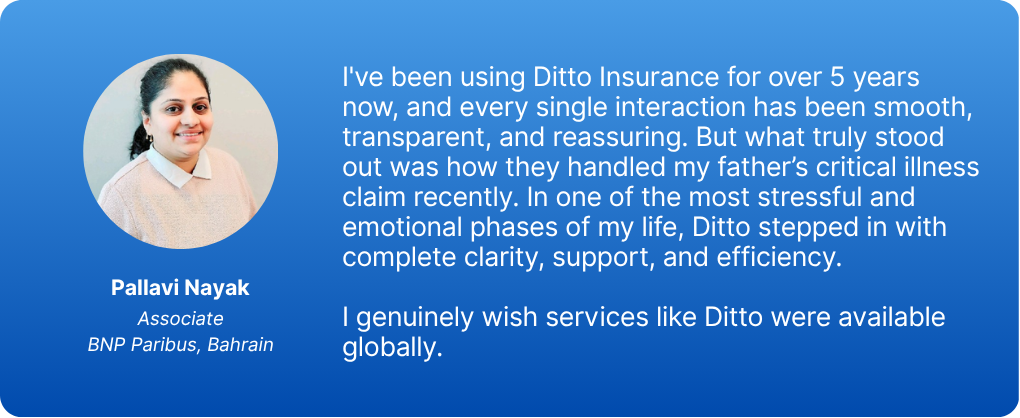
- No-Spam & No Salesmen
- Rated 4.9/5 on Google Reviews by 25,000+ happy customers
- Backed by Zerodha
- Dedicated Claim Support Team
- 100% Free Consultation
Confused about the right insurance? Speak to Ditto’s certified advisors for free, unbiased guidance. Book your call or chat on WhatsApp with us now!
Conclusion
Professional indemnity insurance is not about assuming you will make a mistake. It is about making sure one disputed claim, even a baseless one, cannot drain your savings or shut down your practice while you fight to prove you did nothing wrong.
Before You Buy:
- Confirm whether any hospital, tender, or client contract requires a minimum PI limit for you specifically.
- Choose a sum insured and AOA: AOY split based on your riskiest area of work, not your average one.
- Get quotes from at least three insurers, read the exclusions carefully, and never let the policy lapse between renewals.
If you are self-employed or run a small practice, PI insurance is one of the few covers that protect your income directly. Treat it with the same seriousness you would give your health or term cover.
Ditto's advisory focuses on helping you get the right health and term insurance. These two covers protect your family's finances, no matter what you do for a living. Professional indemnity insurance is a more specialized, profession-specific product, so we would recommend comparing it directly with two or three general insurers or a broker who works in this space.
Frequently Asked Questions
Last updated on: