



Health insurance at work often feels deceptively simple. You join a company, receive a health card, and assume you are covered. But group health insurance is very different from the health insurance you buy for yourself. It is designed, priced, and controlled at the group level, with decisions driven by employers, claims experience, and annual renewals, not individual needs.
By the end of this guide, you will understand how group health insurance works, what it covers, where it falls short, and how it fits into your broader financial planning.
What is Group Health Insurance?
Group health insurance is a health insurance policy issued to a defined group under a single master contract. In India, group health insurance is issued only to groups with a genuine, pre-existing relationship that is not created solely for the purpose of purchasing insurance, as required by the Insurance Regulatory and Development Authority of India. Broadly, such policies are offered to employer–employee groups and to non–employer–employee groups, such as associations or cooperatives, where a common purpose beyond insurance binds members.
What makes it a “group” policy is not the coverage itself, but the way the policy is structured and administered. The employer or organisation does pricing, underwriting, enrollment, renewals, and benefit design at the group level, not for each member. This is why group health insurance is usually cheaper and easier to access than individual health insurance, but it also offers employees less personal control.

Key Features of Group Health Insurance
Ancillary and Related Medical Expenses
Covers ancillary medical expenses, including pre-hospitalization and post-hospitalization costs, ambulance charges, and, in some cases, organ donor hospitalization, subject to the policy wording.
No Mandatory Medical Screening
Does not usually require medical screening at the time of employee enrollment, allowing coverage even for members with severe pre-existing medical conditions.
Cost-Effective Coverage
Provides cost-effective health protection through pooled risk, enabling employers to offer higher coverage at lower premiums than individual policies.
Cashless Hospitalization at Network Hospitals
Enables cashless hospitalization at insurer network hospitals, where eligible medical expenses are settled directly between the insurer and the hospital after approval.
Customizable Benefits and Add-Ons
Allows employers to add benefits such as maternity coverage, outpatient care, mental health treatment, or wellness programs, depending on the plan design.
Portability and Migration
Can be migrated or ported to an individual or family floater health insurance policy when an employee exits the group or when the group policy is modified, subject to regulatory continuity rules and underwriting.
Talk to an expert
today and
find
the right
insurance for you.


How does Group Health Insurance Work?
Group health insurance in India is structured as a business-to-business arrangement rather than a retail one. The employer decides the coverage scope, eligibility rules, premium contribution structure, and enrollment timelines, while the insurer underwrites the risk and issues a single master policy covering all members.
The insurer, which may be a general insurance company or a standalone health insurer, prices the policy based on employee and dependent data, age distribution, locations, and prior claims experience. Claims are managed either by the insurer’s in-house team or by an appointed third-party administrator, which handles cashless approvals, hospital coordination, claim adjudication, and customer service.
Group health insurance procurement typically begins when the employer shares a data pack containing employee census and claims history. Insurers submit quotes, benefits are negotiated, and employees are enrolled and issued health cards.
Most corporate group health insurance policies are indemnity-based, meaning they reimburse actual eligible hospitalization expenses through cashless or reimbursement claims. Benefit-based covers, such as hospital cash, are usually offered only as limited add-ons.
Below, we have listed some of the most popular group health insurance plans in India for easy comparison.
List of Group Health Insurance Policies in India
Benefits of Group Health Insurance for Employees
- Provides health insurance coverage at no cost or at a significantly subsidised cost compared to individual health insurance plans.
- Allows employees to extend coverage to dependents such as spouses, children, and in some cases, parents, under a single policy.
- Often reduces or waives waiting periods, including those for pre-existing medical conditions, depending on the policy wording.
- Offers broader coverage than basic retail plans, typically including hospitalization, day care procedures, and additional benefits chosen by the employer.
- Enables easier access to quality healthcare through cashless treatment at a wide network of hospitals.
- Does not usually require medical check-ups at enrollment, making coverage accessible regardless of medical history.
Benefits of Group Health Insurance for Employers
- Helps employers formalize employee medical support and align with compliance expectations.
- Makes job offers more competitive by providing a visible, high-value health benefit that candidates actively evaluate.
- Improves employee retention by offering continuity of health coverage for employees and their families.
- Offers tax efficiency, as premiums paid for employee health insurance are generally treated as a business expense, thereby reducing overall tax liability.
- Strengthens employer branding by signalling long-term commitment to employee well-being and care.
Note
Coverage under group health insurance varies significantly by employer and insurer, so the inclusions and exclusions below should always be read alongside your specific policy wording. That being said, you’ll find a list of common inclusions and exclusions below:
What is Covered and Not Covered under Group Health Insurance?
Common Benefit Upgrades Chosen by Employers
- Maternity and newborn coverage is widely offered but significantly impacts claims and premiums.
- Outpatient consultations and diagnostics, which require careful caps to avoid excessive utilization.
- Mental health treatment, where coverage depends on policy wording and hospital network capability.
- Dental and vision benefits are often offered through separate benefit programs rather than the core policy.
- Wellness and preventive health check-ups, where coverage depends on a clearly defined benefit structure.
- AYUSH treatment is provided in line with the insurer’s board-approved approach and policy terms.
Why Does Group Health Insurance Not Make Sense As Your Only Coverage?
Job Changes or Career Breaks
Group health insurance ends when your job ends. Even with migration, premiums increase with age, underwriting may apply, and timelines are strict. Relying only on employer cover is risky if income continuity is uncertain.
Planning a Family
Corporate maternity benefits often have caps or conditions and can change at renewal. Pregnancy timing may not align with policy terms, making personal cover important for continuity.
Dependents
Parents’ coverage under group plans is usually costly and comes with co-payments and sub-limits. Claims are harder to manage, so separate planning is often needed.
Chronic Conditions or Medical History
Group policies can change insurers or rules every year. For long-term conditions, a policy you own and renew yourself offers better stability.
Basic Group Plans
Some employers offer minimum-coverage plans with low sums insured and tight limits. These work as benefits, not as a complete safety net. Personal health insurance should be your foundation for continuity and control. Group health insurance works best as an additional layer that boosts coverage while you are employed.
Regulatory Protections under Group Health Insurance
- Employer Obligation: As per directions issued by the Ministry of Home Affairs, employers are required to provide health insurance coverage to employees; however, the employer retains the discretion to decide the scope, limits, and comprehensiveness of the coverage offered.
- Regulatory Limits: Waiting periods for pre-existing diseases under health insurance policies, including group health insurance, cannot exceed 3 years as per regulations issued by the Insurance Regulatory and Development Authority of India. Waiting periods for specific illnesses or procedures are generally capped at 2 years, sometimes going up to 3 years, subject to the terms disclosed in the policy wording.
- Moratorium Protection: After 5 years of continuous health insurance coverage, including coverage through portability or migration, claims cannot be denied on the grounds of non-disclosure or misrepresentation, except in cases of proven fraud. This protection is commonly referred to as the moratorium provision.
- Protection Against Claim-Based Renewal Denial: Insurers are not permitted to deny renewal of an indemnity-based group health insurance policy solely based on claims made during the policy period, except in limited circumstances allowed under regulations.
- Tax Treatment of Premiums: As per Income Tax Department guidance, medical insurance premiums paid or reimbursed by the employer are not taxable in the employee’s hands (not treated as a taxable perquisite). If the employee pays any part of the premium from their own taxable income, they may claim that portion under Section 80D, subject to limits/conditions, and only if they opt for the old tax regime. The employer-paid portion isn’t eligible for the employee’s 80D claim. Employers can generally treat group health insurance premiums as a business expense, subject to the Act's standard allowability conditions.
- Mandatory Migration Rights: Employees covered under an indemnity-based group health insurance policy must be offered a migration option to an individual or family floater policy upon exit from employment or upon modification, withdrawal, or repricing of the group policy, subject to underwriting and continuity rules prescribed by regulations.
- Application of GST: Group health insurance policies continue to attract goods and services tax at the applicable rate, which is commonly 18%, even after the goods and services tax exemption announced for individual life and health insurance policies in 2025.
How to Get a Cashless Claim under Group Health Insurance
- Visit a hospital that is part of the insurer’s network and inform the hospital insurance desk that you wish to use your group health insurance for cashless treatment.
- The hospital submits a pre-authorization request to the insurer or the appointed claims administrator with details of the diagnosis, proposed treatment, and estimated expenses.
- The insurer or claims administrator reviews the request and communicates approval, rejection, or a request for additional medical information from the hospital.
- Once treatment is completed and discharge is planned, the hospital submits a final authorization request along with the discharge summary and final bill.
- After final approval, the insurer settles the eligible medical expenses directly with the hospital, and the employee pays only the non-payable expenses, deductibles, or co-payments, if applicable.
Note: As per regulatory service timelines, a pre-authorization decision is expected within one hour of receiving a complete request, and discharge authorization is expected within three hours. If delays in authorization lead to additional charges being paid to the hospital, such extra amounts are required to be borne by the insurer rather than the employee.
How to Get a Reimbursement Claim under Group Health Insurance
- Pay the hospital bills directly at the time of discharge and collect all original medical documents, including bills, receipts, discharge summary, prescriptions, and diagnostic reports.
- Submit the completed reimbursement claim form along with the required documents to the insurer or the appointed claims administrator, as per the process shared by your employer.
- The insurer reviews the submitted documents to verify eligibility, medical necessity, and policy coverage before processing the claim.
- Once the claim is approved, the insurer pays the eligible claim amount directly to the employee’s registered bank account.
Note: The claims procedure, document requirements, and expected reimbursement timelines are detailed in the Customer Information Sheet provided by the insurer, which also applies to group health insurance policies.
Cost and Pricing of Group Health Insurance
Day 1 Employee Checklist for a Group Health Insurance Policy
- Save your policy number, insurer name, claims administrator helpline, and download your digital health card or certificate of insurance.
- Identify three to five nearby hospitals in the network that offer cashless treatment.
- Check the five common risk areas: room rent rules, co-payments or deductibles, maternity and newborn conditions, pre-existing or specific disease waiting periods, and consumables or non-payable expenses.
- For planned hospitalization, arrange pre-authorization documents such as the cost estimate, diagnosis, and doctor’s notes; for emergencies, inform the insurer or claims administrator as soon as possible and retain all original documents.
- Use group health insurance for parents if they have severe pre-existing conditions and are unable to obtain individual health insur
- ance.
- If you have a personal health insurance policy with waiting periods, use your group policy for smaller or frequent claims while allowing your personal policy to complete waiting and moratorium periods and accumulate bonuses.
- Consider using group coverage for maternity benefits, as personal policies often cost more and have stricter conditions.
Why Choose Ditto for Health Insurance?
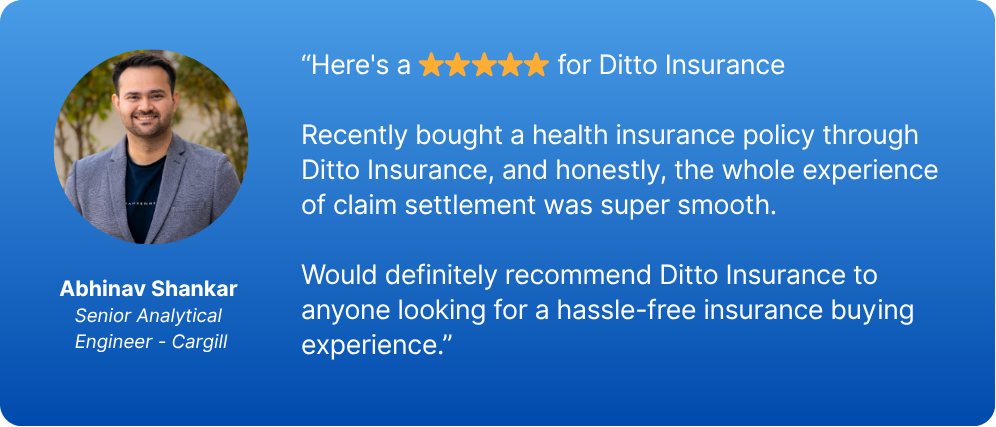
At Ditto, we’ve assisted over 8,00,000 customers with choosing the right insurance policy. Why customers like Abhinav below love us:
- No-Spam & No Salesmen
- Rated 4.9/5 on Google Reviews by 15,000+ happy customers
- Backed by Zerodha
- 100% Free Consultation
You can book a FREE consultation. Slots are running out, so make sure you book a call now or chat with us now!
Conclusion
Group health insurance is an effective way to access affordable healthcare through your employer, offering pooled pricing, simplified enrollment, and cashless hospitalization. However, because coverage, continuity, and benefits are controlled at the group level, it works best as a support layer rather than a lifelong solution. Understanding how your group policy works, its limitations, and how it fits alongside personal health insurance helps you avoid coverage gaps and make better long-term decisions.
Disclosure
Frequently Asked Questions
Why People Trust Ditto
Last updated on: