



Quick Note
Critical illnesses are life-threatening conditions, such as cancer, kidney failure, heart attack, stroke, or organ transplants, that often require long-term treatment and recovery.
While health insurance covers hospitalization bills and associated costs, it doesn't compensate for any income loss or ongoing non-medical expenses, like rent, EMIs, travel, or home care, during recovery.
This is where critical illness (CI) insurance steps in. In this guide, we will walk you through its key benefits, types, and relevant factors to consider when purchasing it.
What is Critical Illness Insurance?
Critical illness insurance is a benefit-based plan that pays a lump-sum benefit if you're diagnosed with a listed serious illness.
Such policies provide you with a financial backup during major medical crises like cancer, heart attacks, stroke, or kidney failure.
Critical illness insurance can be availed in two ways: by buying a standalone policy that offers dedicated protection, or by purchasing a health or term plan with a critical illness rider.
Standalone Critical Illness Policy
This is a dedicated policy offered by general and standalone health insurers that explicitly covers critical illnesses. Upon diagnosis of a listed illness, the insurer pays a lump sum, regardless of the actual medical expenses. It's ideal for:
- Individuals wanting broader coverage and a higher sum insured.
- Those who already have a term or health insurance policy where CI cover cannot be added as a rider.
- People who want independent CI protection without affecting their other policies.
There are two broad types of critical illness insurance plans.
- Single-claim CI Policies: Pay once for a major listed illness, after which the policy terminates.
- Multi-claim or Staged CI Plans: Allow multiple payouts across separate illness categories, such as cancer, cardiac, and others, or through minor-to-major stages of the same condition.
Standalone CI plans offer better flexibility and depth. You aren’t locked into one term or health insurance product, and you can switch CI insurers later without affecting your term or base health coverage. They also allow for significantly higher CI sums compared to CI riders, especially in specialised CI-only plans.
Here are some examples of standalone CI policies:
- HDFC ERGO Critical Illness Policy covers 15 illnesses and provides a sum insured ranging from ₹100,000 to ₹50,00,000.
- ICICI Lombard’s Criti Shield Policy covers up to 92 minor and major critical illnesses and provides a sum insured between ₹5,00,000 to ₹40,00,000.
- Aditya Birla Activ Secure Critical Illness Policy covers up to 64 illnesses and provides a sum insured from ₹1,00,000 to ₹1,00,00,000.
Critical Illness Rider
A critical illness rider is an add-on to your existing health or term life insurance policy that offers critical illness coverage at an additional but nominal premium. A CI rider can be attached to the policy during purchase. Its issuance is rare during renewal, but it may be possible with health insurance. Here’s an overview:
Critical Illness Riders in Health Insurance
- You can attach a critical illness rider to your base health insurance plan.
- It may offer a lump-sum payout or enhanced coverage for treatments, and may also waive the next renewal premium upon diagnosis of a listed illness.
- Coverage (scope and payout) is usually limited compared to standalone plans.
- Health policies are usually lifelong and renewable if you keep paying premiums, and riders often follow the same renewal rules.
Key Benefits of Critical Illness Insurance Plans
Covers Critical Health Conditions
Most critical illness plans or riders follow the IRDAI‑defined standard list, which usually includes around 22 critical illnesses for coverage (refer to page 14 of this circular for the entire list). A few plans also have their own extended lists of illnesses covered. For instance, Axis Max Life Insurance covers a comprehensive list of 64 major and minor health conditions under its CI rider.
Tax Benefits
Conversely, premiums for health insurance with a CI rider are deductible under Section 80D. The same applies to standalone CI plans. However, the next tax regime does not have these deductions.
Affordable Premiums
CI rider premiums with health insurance are also cost-effective, especially for younger folks, but can be higher in the long run. The reason is simple: health insurance premiums increase with age or due to medical inflation.
Standalone CI plan premiums are the highest among the 3, based on what we have seen, and also have a similar scope of price hikes as CI riders under health insurance.
Lumpsum Payout
Upon diagnosis of a covered critical illness (and after satisfying any required survival and waiting periods), the policy pays a fixed lump-sum amount. This payout does not depend on actual treatment costs or bills. You can use this money for treatment, recovery, home care, daily living expenses, loan payments, income loss, or any other financial need.
Provides Easy Access to Claims
Claiming under a critical illness rider is usually simpler because it is based on diagnosis rather than a long list of bills. Once the insurer receives the required medical reports and the illness meets the policy definition, the claim can be processed without having to submit each expense, making access to funds quicker and simpler.
Less Waiting Period
Critical illness plans come with a defined waiting period (for example, 90 days from policy start) and a survival period (such as 30 days after diagnosis). Still, many modern products are designed to keep these periods relatively short. This ensures that after the initial waiting phase, you are quickly eligible for coverage if a covered illness strikes, offering timely financial support.
Provides Financial Security During Crisis
A serious illness often leads to income loss along with high medical expenses, putting pressure on savings and ongoing financial commitments like EMIs and children's education. The lump-sum benefit from a critical illness rider serves as a financial safety net, allowing your family to maintain their lifestyle, pay off debts, and focus on recovery rather than worrying about money.
Popular Health Plans Offering Critical Illness Rider Coverage
Profile: 20-year-old male seeking a ₹15 lakh sum insured base plan and a ₹20 lakh CI cover.
*Subject to premium increases
Standalone Critical Illness Insurance Plans
Profile is the same as that of a health insurance plan.
Inclusions and Exclusions of a Critical Illness Insurance
Critical Illness Insurance Plan vs. Health Insurance Plan
When to Choose Which (or Both)
- If you want broad protection against everyday illnesses and medical emergencies, such as surgery, accidents, and hospital stays, go for a health insurance plan.
- If you want financial protection specifically for major illnesses (especially those with high out-of-pocket costs, prolonged recovery, or loss of income), consider a critical illness plan.
- Many people benefit from having both: health Insurance covers routine and emergency treatments, and critical illness insurance provides a financial safety net if a serious diagnosis hits. This accounts for flexibilities related to rehab, income loss, or non‑medical expenses.
Talk to an expert
today and
find
the right
insurance for you.



Factors to Consider Before Buying Critical Illness Insurance
Age
Your age plays a crucial role in determining the premium and eligibility for a critical illness policy. Younger individuals usually get lower premiums and can secure coverage for a longer duration, while older applicants might face higher costs or restrictions on entry age.
Medical History
Individuals in good health generally find it easier to access critical illness insurance. Those with minor pre-existing conditions (e.g., high cholesterol or mild asthma) may still qualify, though approvals depend on underwriting and may come with loading charges on premiums.
High-risk Cases
Most individuals with higher-risk conditions like diabetes, hypertension, or heart disease are often unlikely to be approved for CI coverage, and should prioritize securing a solid health insurance plan.
Income
Your income level helps determine the sum assured needed to cover medical expenses and financial obligations during illness. The policy's coverage amount should be sufficient to cover treatment costs and maintain your lifestyle in the event of a critical health event.
Number of Dependents
The more dependents you have, the higher the financial protection you may require. Critical illness insurance can act as a financial safety net for your family, helping to cover household expenses and long-term financial commitments when you face health challenges.
Need for Emergency Funds
Consider your existing savings, emergency funds, and other insurance coverage when selecting your critical illness plan. This ensures you choose an appropriate coverage amount that supplements your financial preparedness for unforeseen health crises.
Who Should Buy a Critical Illness Cover?
- Primary Breadwinners: If your family depends on your income, a critical illness can disrupt cash flow. The CI cover payout helps cover expenses while you focus on recovery.
- Self-Employed Individuals or Business Owners: With no paid leave or employer benefits, income can drop instantly if you fall ill. The payout gives you the flexibility to manage treatment and essential business expenses.
- Those With Limited Emergency Savings: If you do not have a substantial emergency corpus, this cover acts as a financial cushion during major illnesses and prevents you from taking high-interest loans or breaking investments.
- Individuals with a Family History of Critical Illness: If illnesses like cancer, heart disease, or diabetes are common in your family, this cover strengthens your financial preparedness.
- People Aged 35 and Above: Health risks rise with age. Adding a CI cover early ensures long-term protection, even though premiums may be higher for older buyers.
- Homemakers: Critical illnesses can limit their ability to manage household responsibilities. The payout can help support caregiving costs and household assistance.
How to Make a Claim for Critical Illness Health Insurance?
Step 1: Notify the Insurance Provider
Step 2: Fill out the Claim Form
Step 3: Collect Supporting Documents
Step 4: Submit Your Claim
The insurer may ask for a second opinion from an independent medical practitioner to verify your documents or reports. If everything looks fine, they will accept the claim and transfer a lump sum payout to your bank account.
What are the Documents Required for a Critical Illness Insurance Claim?
- Photocopies of a valid photo ID proof of the policyholder
- Critical illness policy document
- A duly filled claim form
- Medical certificate from the treating doctor
- Medical and investigation reports, including blood tests, scans, and X-rays
- Bank account details of the policyholder
Can I Get Insurance If I Already Have a Critical Illness?
It usually depends on the condition type you have, its severity, and whether it’s included in the insurer’s specified list of illnesses.
If you are already diagnosed with a CI that is already a part of the list of CIs in the insurer’s covered list, the CI policy application will most likely be rejected.
Suppose you have any other PED, like diabetes, asthma, or hypertension. In that case, the insurer will carefully assess your parameters and then decide whether to issue. If so, there will most likely be loading charges as well.
But in all fairness, we would want you to lower your expectations here and settle for getting a comprehensive health insurance policy primarily.
Can I Claim Both Health Insurance and a Critical Illness Rider for the Same Illness?
Yes. You can receive both benefits together without any conflict. A critical illness rider is benefit-based, so if you have a:
- Health policy (pays hospital bills),
- Standalone CI cover (another lump sum).
All can, in principle, pay for the same illness, subject to each policy's terms (waiting periods, survival periods, definitions). There's no "indemnity cap" like in health insurance, where you can't be reimbursed more than your bill.
Why Talk to Ditto for Your Health Insurance?
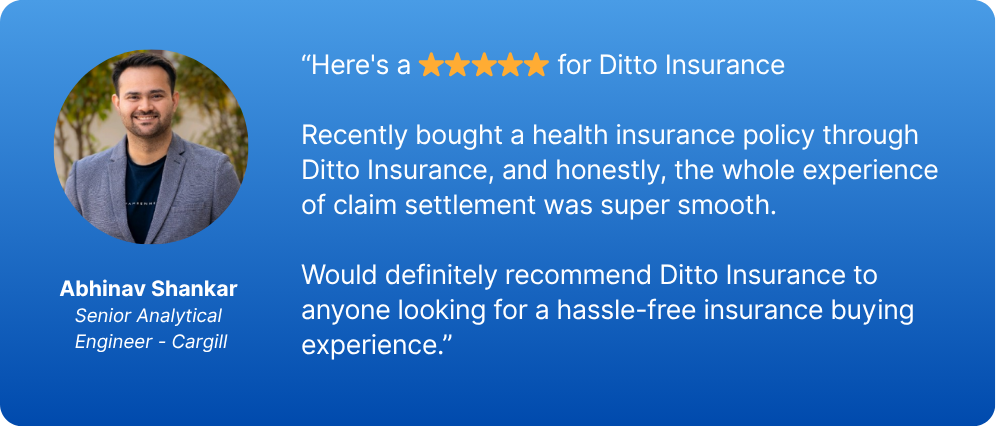
At Ditto, we’ve assisted over 8,00,000 customers with choosing the right insurance policy. Why customers like Abhinav below love us:
- No-Spam & No Salesmen
- Rated 4.9/5 on Google Reviews by 15,000+ happy customers
- Backed by Zerodha
- 100% Free Consultation
You can book a FREE consultation. Slots are running out, so make sure you book a call now!
Conclusion
Adding a critical illness rider to your health or term insurance strengthens your protection by covering both life risks and major health setbacks in one affordable plan. Check the exclusions to understand which illnesses and scenarios are not covered. Be aware of the waiting and survival periods, since claims made too early may not be payable.
Choose a sufficient CI cover, ideally equal to one to two years of your income. Keep in mind that you cannot usually increase your CI cover later, so pick the right amount at the start.
If adding a rider to your plan is not possible, you can also explore a standalone critical illness policy for added comprehensive protection.
Quick Note
For more details on how we approach reviews and partnerships, you can refer to our Editorial Policy & Disclaimers.
And as always, remember that this list is based on publicly available information and is not personalised advice. Please review the policy brochure carefully and speak with a licensed advisor before choosing a plan.
Frequently Asked Questions
Customer Reviews
Last updated on: