

Quick Overview
Choosing between LIC and private insurers for term insurance often feels less like a financial decision and more like a loyalty test. One side promises legacy, government backing, and decades of trust. The other offers lower premiums, digital convenience, and flexible plan design. Somewhere between family advice and online comparisons, buyers are left confused about what actually matters.
In this blog, we break down LIC vs private insurers across pricing, claims, product features, regulatory safeguards, and customer experience, so you can choose based on facts, not fear.
Metrics of LIC India
Insights
LIC vs Private Insurance: Product Offerings
- Primary Focus
LIC’s term plans like Bima Kavach, Digi Term Plan, and New Tech Term Plan are built around pure, uncomplicated life cover. They focus on one core outcome: paying a sum assured on death. You can choose between a level or increasing cover, and in most cases, the payout is a lump sum.
Private insurers take a very different approach. They design term insurance as a flexible income-protection tool, not just a death payout.
- Add-ons or Riders
When it comes to add-ons, LIC keeps things extremely limited. New Tech Term Plan and Bima Kavach offer only an Accidental Death Benefit rider, while Digi Term Plan offers no riders at all.
Important protections such as Waiver of Premium, Critical Illness, Accidental & Total Permanent Disability, terminal illness payouts, or instant claim payout features are missing across LIC’s term portfolio. This makes the plans predictable and straightforward, but also rigid.
However, private insurers provide multiple riders to ensure effective coverage for policyholders.
For instance, HDFC Life Click 2 Protect Supreme offers health management services through the Life Rewards app, multiple payout options, and even a Smart Exit feature that lets policyholders exit the plan at a chosen milestone.
Axis Max Life Smart Term Plan Plus allows cover enhancement through its Smart Cover option, boosting the sum assured to 1.5× for the first 15 years. It also offers women-specific benefits under select variants. Aditya Birla Sun Life Super Term Plan stands out for its wide range of riders, including hospital care and surgical care.
Alongside these modern features, private insurers also routinely offer core riders like Critical Illness, Waiver of Premium, and Accidental Disability, which materially protect families during illness or disability, not just death.
Ditto's Take
LIC vs Private Insurers: Premium Comparison
The profile considered is a non-smoker male, opting for a ₹2 crore sum assured, with policy coverage up to age 70, and without any first-year discounts. Actual premiums may vary based on underwriting outcomes, health disclosures, and insurer-specific pricing factors.
Insights
How Does the Ownership Structure Affect LIC and Private Life Insurers?
Life Insurance Corporation of India is government-owned, while private insurers are shareholder-driven. Ownership does not change regulatory solvency norms, claim-paying obligations, or policyholder protections.
What it does influence is approach: LIC prioritizes stability and scale, while private insurers focus on pricing efficiency, data-driven underwriting, and faster digital experiences. Government backing adds comfort, but not better policy terms or quicker claims.
LIC vs Private Insurance: Claim Handling
LIC
LIC leans on its vast branch and agent network, offering families offline, in-person support during claims. Its claim handling is broadly efficient at scale, with a 98.35% claim settlement ratio and 96.13% of claims settled within 30 days (FY22–25).
LIC also paid an exceptionally high ₹19,017.6 crore in death claims, and its very low complaint volumes indicate stable claim operations, though some servicing steps may feel slower due to scale.
Private Insurers
Private insurers like HDFC Life Click 2 Protect Supreme or Aditya Birla Sun Life Super Term Plan operate a largely digital-first claims process, with online initiation, document uploads, and tracking. As a group, they report a 98.66% average claim settlement ratio and 97.48% claims settled within 30 days, marginally faster on speed metrics.
While absolute payout volumes are much lower than LIC’s, low complaint ratios suggest efficient processes. Across both, claim outcomes depend far more on clean disclosures than on insurer type.
Do LIC and Private Life Insurers Have Different Regulatory Oversights?
No. Both LIC and private life insurers operate under the same regulatory framework laid down by the Insurance Regulatory and Development Authority of India (IRDAI). Government ownership does not place LIC under a separate or more lenient set of rules.
- One key equalizer is the mandatory solvency control level of 150%, which requires every life insurer, public or private, to maintain adequate capital buffers to meet future claims. This directly addresses concerns around an insurer’s ability to pay claims.
- IRDAI has also introduced standardized term insurance products such as Saral Jeevan Bima to reduce complexity, prevent mis-selling, and allow apples-to-apples comparisons across insurers. Policy wordings, benefits, and exclusions are tightly defined under these frameworks.
Why Choose Ditto for Term Insurance?
At Ditto, we’ve assisted over 8,00,000 customers with choosing the right insurance policy. Why customers like Aaron below love us:
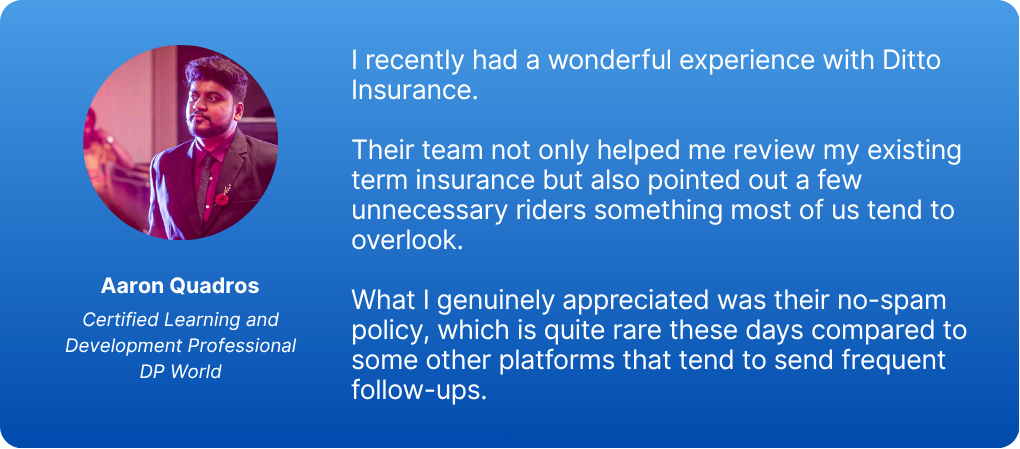
- No-Spam & No Salesmen
- Rated 4.9/5 on Google Reviews by 15,000+ happy customers
- Backed by Zerodha
- 100% Free Consultation
You can book a FREE consultation. Slots are running out, so make sure you book a call now!
Conclusion
There’s no single “better” choice between LIC and private insurers for term insurance, only a better fit. LIC stands out for trust, scale, and simplicity, while private insurers lead on pricing efficiency, flexibility, and modern features. Since term insurance is ultimately about claims, not returns, the right decision depends on your cover needs, budget, and comfort with digital versus offline servicing.
If you’ve already decided to opt for LIC, Bima Kavach tends to work better for higher sum assured amounts, while Digi Term Plan is more suitable for lower sum assured amounts.
If you’re still unsure, it’s usually safer to start with a comprehensive term plan. You can also read this guide to compare the best term insurance plans in India and make an objective choice.
Disclaimer
Frequently Asked Questions
Last updated on: