A medical test for term insurance evaluates your current health and lifestyle risks before a policy is issued. Insurers use these screenings to determine your premium, coverage limits, eligibility, and policy terms. This guide explains which tests are commonly required and how results can affect underwriting outcomes such as standard acceptance, loading charges, or restrictions on riders and cover amount.
At Ditto, we generally recommend insurer-arranged medicals because the tests are usually free, the reports become authoritative underwriting records, and proper medical documentation can reduce the risk of future claim disputes. If a risk factor is identified, premiums may be loaded by 25% to 100% depending on the severity of the condition.
Buying term insurance is one of the smartest ways to protect your family’s finances, but most applications come with a health check. That is because insurers want to assess risk fairly before issuing a large life cover. A medical test required for term insurance helps the insurer understand your current health status and decide whether to offer standard pricing, a loaded premium, or additional conditions.
The good news? Medicals are usually straightforward, and in most cases, the insurer pays for them. The key is to know what to expect and avoid mistakes in your forms or reports.
Why Do Insurers Require a Medical Test for Term Insurance?
To Price the Risk Correctly: Term insurance is a long-term promise, so insurers need to know how likely a claim may be over the policy term.
To Verify your Health Profile: Tests help confirm key markers like blood pressure, blood sugar, heart function, liver health, and kidney function.
To Decide Policy Terms: Your results can affect approval, sum assured, premium, and whether any loading or restrictions are needed.
To Reduce Misrepresentation and Fraud: Medicals help insurers cross-check what was disclosed in the proposal form and reduce the chance of hidden conditions.
To Protect Claim Decisions Later: Clear medical records make underwriting cleaner and help avoid disputes when a claim is raised.
To Keep Underwriting Fair: The insurer wants healthy applicants to be priced appropriately, while higher-risk cases are handled with the right terms.
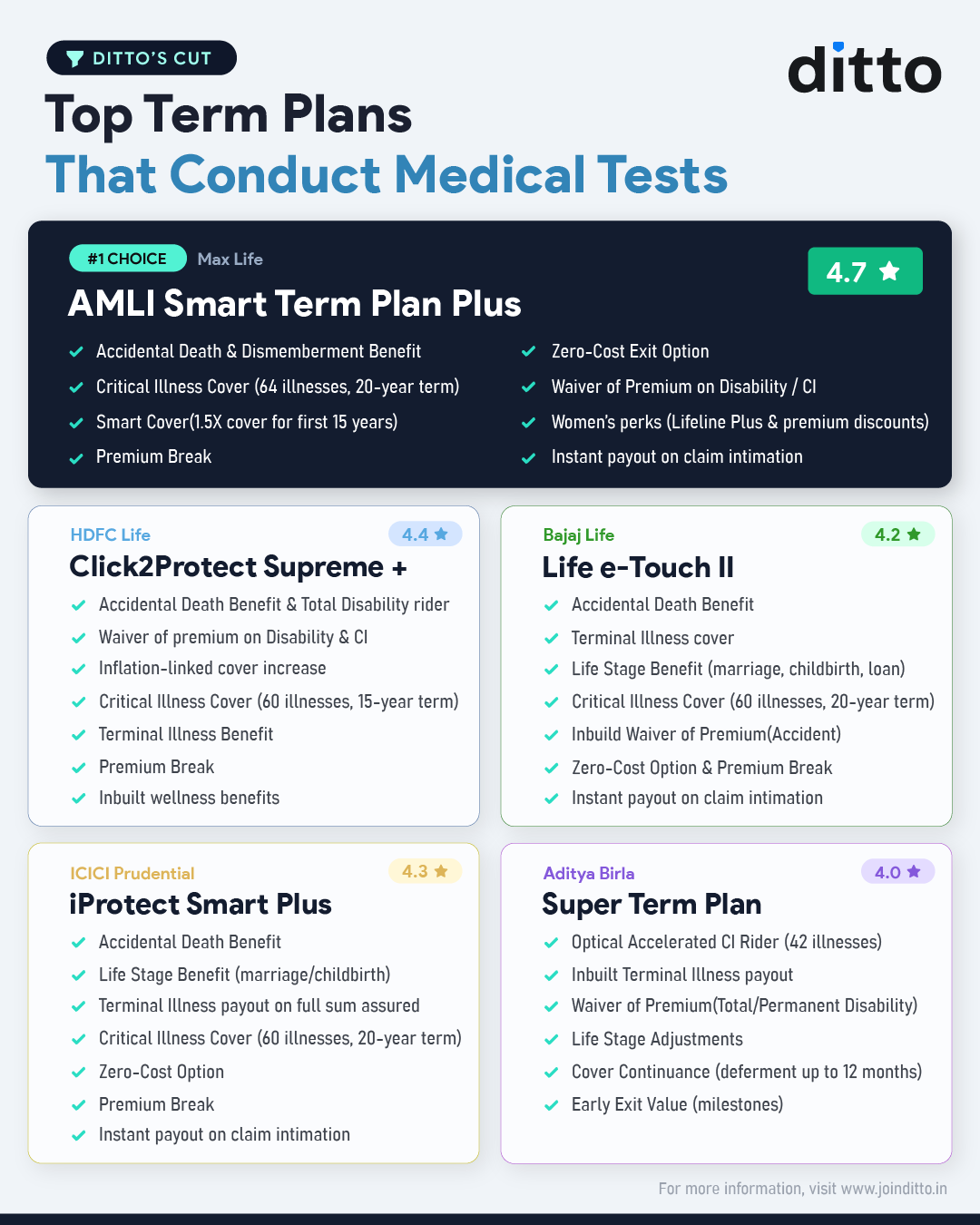
Here are some popular term insurance companies that conduct a medical test for term insurance:
Talk to an expert today and find the right insurance for you.
Complete List of Medical Tests Required for Term Insurance
While the exact list varies by insurer, age, and cover amount, these are the most common tests required for term insurance:
Age / Cover amount
Typical Tests
25–35 years, up to ₹5 crore
Basic tele/video medical exam, common tests include height, weight, BMI, blood pressure, and pulse. Blood tests usually cover fasting blood sugar or HbA1c, lipid profile, liver function, kidney function, and CBC, while urine tests may check for protein, sugar, or infection markers
₹5–15 crore
Everything above, plus Electrocardiogram, and Cardiac Treadmill Test (TMT/CTMT) in many cases
₹15–25 crore
Additional chest X-ray, abdomen ultrasound, 2D echo, pulmonary function test, and other risk-based tests
₹25 crore and above
More intensive underwriting, which may include selective cancer screening or tumour markers, physical consult with the insurer’s doctors, depending on age and profile
Did You Know?
For higher cover amounts or older applicants, insurers may add Electrocardiogram (ECG), TMT/CTMT, chest X-ray, ultrasound, 2D echo, and sometimes pulmonary function tests. Age itself can also act as a trigger, so applicants above 40 or 45 may face additional testing even at lower cover amounts. If you have a history of asthma, Chronic Obstructive Pulmonary Disease (COPD), thyroid concerns, or other flagged conditions, the insurer may ask for specialized tests. These are typical underwriting requirements, though insurers may still deviate based on individual profiles and internal underwriting guidelines.
When Can You Skip the Medical Test for Term Insurance?
Term insurance without medical test may be possible in some cases, especially for younger applicants with clean declarations and a smaller cover. A telemedical or video checkup may also replace an in-person test in some applications.
That said, there is no universal rule. Even if you are healthy, the insurer may still ask for tests if the cover is high, your profile is complex, or the underwriter wants more clarity. In practice, a no-test policy is more of an exception than the norm.
How Do Medical Test Results Affect Your Term Insurance Premium?
Standard Acceptance
If your medicals look clean, the insurer may issue the policy on normal terms with the premium originally quoted. This is the best-case outcome and usually means no extra conditions, no loading, and no change in cover. It also signals that your health profile fits the insurer’s pricing model for the plan you applied for.
Premium Loading
If the insurer spots mild risks such as borderline sugar, high BMI, or controlled BP, the policy may still be approved, but at a higher premium. This is called loading and the commonly seen hike is 25%-100%. The increase is usually based on the level of risk, so the policy is not rejected, just priced differently to reflect the insurer’s exposure.
Policy Conditions
Sometimes the insurer may add restrictive conditions along with or instead of the premium loading charge. These can include a lower sum assured, a shorter policy term, or restrictions on riders such as critical illness or waiver of premium. This usually happens when the health profile is not ideal enough for standard terms, but still acceptable with limits.
Postponement or Decline
If the medicals show a serious issue, the insurer may postpone (usually for 6 months) the application or decline it outright. This is more likely in cases of uncontrolled diabetes, major heart concerns, or recent surgery. It is also why accurate disclosure matters so much. Even a small mismatch in your form, medicine history, or past illness can delay approval or complicate future claims.
Note
Smokers and heavy drinkers pay higher premiums for the same coverage because their mortality risk is higher, meaning that they’re more likely to pass away early. If you want to get an idea about term insurance for smokers, refer to the linked guide.
All lifestyle habits should be disclosed honestly because life insurance policies are governed by Section 45 of the Insurance Act, which includes a 3-year moratorium period. During these first 3 years, the insurer may investigate and question the policy if it can prove that a material misrepresentation affected underwriting or policy issuance. However, once the moratorium period ends, the insurer generally cannot contest the policy on any ground except provable fraud. Wilful fraud or deliberate concealment can still be challenged at any point during the policy term, regardless of how long the policy has been active.
Why Choose Ditto for Term Insurance?
At Ditto, we’ve assisted over 9,00,000 customers with choosing the right insurance policy. Why customers like Vijay below love us:
No-Spam & No Salesmen
Rated 4.9/5 on Google Reviews by 23,000+ happy customers
A medical test for term insurance is part of how insurers price risk fairly. For most applicants, it is simple, free in India, and arranged through a network lab. The test list depends on your age, health, and cover amount, so it helps to know the likely checks before you apply.
If you are healthy and applying for a smaller cover, term insurance without medical test may be possible, but it is not something you should count on. The safest approach is to disclose everything honestly, follow the test instructions properly, and review your medical history before you apply.
Frequently Asked Questions
Is a medical test mandatory for term insurance?
Not always, but most standard term plans do ask for one, especially when the cover is higher or the applicant is older. We recommend treating medicals as the default, not the exception, because underwriting teams often want a clearer risk picture before issuing a large cover. In some cases, young and healthy applicants with smaller sums assured may get a waiver, but term insurance without medical test is never guaranteed. If the insurer does waive it, that is usually a case-by-case underwriting call, not a fixed rule.
What medical tests are done for term insurance?
The usual medical test for term insurance starts with basic checks like height, weight, BMI, blood pressure, and pulse. Blood tests often include fasting sugar or HbA1c, lipid profile, liver function, kidney function, and CBC. Urine tests are also common. For larger covers or older applicants, insurers may add ECG, CTMT, chest X-ray, ultrasound, 2D echo, or pulmonary function tests. The exact list depends on age, cover amount, and health history, so a ₹5 crore proposal can trigger more testing than a small cover.
Who pays for the medical test?
In most cases, the insurer pays for the medical test when it is done in India through its network lab or Third Party Administrator. That is one reason many applicants should not avoid the process. If the tests are done outside India, the cost may fall on the applicant, depending on the insurer. Also note that most medical tests are free for the buyer in India, so there is usually no out-of-pocket cost for the standard underwriting checks. This can make the process easier for people applying for ₹1 crore or higher cover.
Can I use my recent health check-up report?
You can share your recent reports, but the insurer may still insist on its own tests through a network lab. That is common because underwriters want reports that follow their process and timing, not just a generic check-up done elsewhere. We usually tell applicants to upload whatever they already have, then be ready for fresh tests if the insurer asks. The upside is that you generally do not pay for those insurer-arranged tests in India. So a recent report can help, but it does not replace underwriting in every case.
What is telemedical underwriting?
Telemedical underwriting is a phone- or video-based health assessment that can replace or precede an in-person visit in some cases. It helps the insurer ask basic health questions and decide whether full testing is needed. This is more likely for simpler profiles, younger applicants, or smaller covers, but it is not a guarantee of term insurance without medical test. We treat it as a lighter underwriting step, not a full substitute for medicals. It is useful, though, because it can speed up early-stage assessment by a few days.
Will a mild abnormality reject my policy?
Not necessarily. Mild issues like a slightly high BMI, borderline cholesterol, or controlled BP or diabetes often do not cause a straight rejection. Instead, the insurer may apply a loading charge, usually between 25% and 100%, or impose conditions such as no rider benefit, reduced cover, or a shorter term. Ditto’s take is simple: a mild abnormality is usually a pricing or terms issue, not an automatic no. The bigger concern is uncontrolled diabetes, severe heart disease, or recent major surgery, which can lead to postponement or decline.
Do the medical test results come to me first?
Usually, no. The lab or test center sends the report to the insurer first, and the insurer may share it with you later through email or attach it to the policy documents after issuance. That is why it is important to be honest in your proposal form and during the medical test itself. At Ditto, we tell applicants not to assume they will see the report before the underwriting team does. If there is an issue, the insurer may ask for clarifications or further tests before issuing the policy.
Does a higher cover mean more tests?
Yes, in many cases. Higher sums assured usually trigger deeper underwriting, which means more tests and sometimes more scrutiny. A ₹50 lakh to ₹1 crore cover may be simpler for a young, healthy applicant, while a ₹5 crore or higher cover often leads to ECG, TMT, chest X-ray, or other add-on checks. Underwriting is personalised, so two people of the same age can still get very different test requirements based on health history and cover amount.
Do NRIs need medical tests for term insurance?
Yes, in many cases, term insurance for NRIs also includes getting a medical test, especially for higher cover amounts or longer policy terms. If the policy is purchased during an India visit, the insurer usually arranges and pays for the tests through its network labs. However, NRIs applying from abroad may have to bear the testing cost themselves, depending on the insurer. Some insurers are more NRI-friendly than others. For example, insurers like Bajaj Life Insurance may even reimburse or directly support certain overseas medical tests in select cases, subject to underwriting rules and country eligibility.
What happens if I pay the premium online and the insurer later asks for medical tests?
This is completely normal in term insurance. Many insurers first collect the proposal form and initial premium, then begin underwriting and decide whether medical tests are needed. Based on the results, the insurer may issue the policy on standard terms, ask for a loading charge, reduce the sum assured, or restrict certain riders. This is called a counteroffer, and you have the right to accept or reject it. If you reject the revised terms or if the application is declined, the initial premium you paid is usually refunded in full.