



Quick Overview
More than 51 crore individuals have enrolled in PMSBY. On paper, this sounds like a massive success. But in reality, India remains one of the most underinsured countries in the world, with life insurance penetration being 2.7% for FY24-25 according to the IRDAI annual report.
This contrast raises an important question: if millions are already covered under government-backed schemes, why does the protection gap still exist?
In this guide, we’ll break down what actually exists, how these plans work, and how to choose the best government term insurance plan for your needs.
What Is Government Term Insurance?
In India, people often use ‘government term insurance’ to describe different types of cover:
Government Schemes
Government schemes such as PMJJBY are low-cost social security programs that are easy to enroll in, require minimal documentation, and provide small but essential financial support. They’re ideal as a starting point, especially for first-time buyers.
Government Term Insurance Companies in India
These refer to government-backed insurers, such as the Life Insurance Corporation of India (LIC). They offer full-fledged insurance products with higher coverage but operate like regular insurers, with premiums, underwriting, and features similar to those offered by private insurers.
Best Government Term Insurance Plans in India
Did You Know?
Talk to an expert
today and
find
the right
insurance for you.


Eligibility and Benefits of Government Term Insurance
Eligibility
The eligibility of government term insurance varies from scheme to scheme:
- PMJJBY is open to individuals aged 18-50 who have a savings bank account (coverage continues until age 55 with auto-renewal).
- PMSBY is open to individuals aged between 18 and 70 years.
- EDLI is automatically available to salaried employees who contribute to EPF.
- PLI is limited to government employees and certain professionals.
- Standardized plans like Saral Jeevan Bima have the broadest access, with minimal restrictions on income, occupation, or education.
Note: When considering term insurance for government employees, they are covered under separate schemes such as the Central Government Employees Group Insurance Scheme (CGEGIS) and should verify their employer-provided group insurance coverage independently.
Key Benefits of Government Term Insurance
Extremely Low Premium
Tax Benefits
Simple Enrollment
No Medical Exams
Government vs. Private Term Insurance: Which Is Better?
Key Takeaway: Government term insurance plans are cost-effective and widely accessible, but offer lower coverage and fewer features. On the other hand, private term insurance plans offer substantially higher coverage, along with built-in benefits such as health management services, terminal illness cover, premium breaks, life-stage cover increases, etc.
They also provide the flexibility to enhance protection through riders such as
- Waiver of Premium
- Critical Illness
- Accidental Total and Permanent Disability
To learn more about which riders to choose, you can go through our comprehensive guide on term insurance riders.
Why Choose Ditto for Term Insurance?
At Ditto, we’ve assisted over 8,00,000 customers with choosing the right insurance policy. Why customers like Aaron below love us:
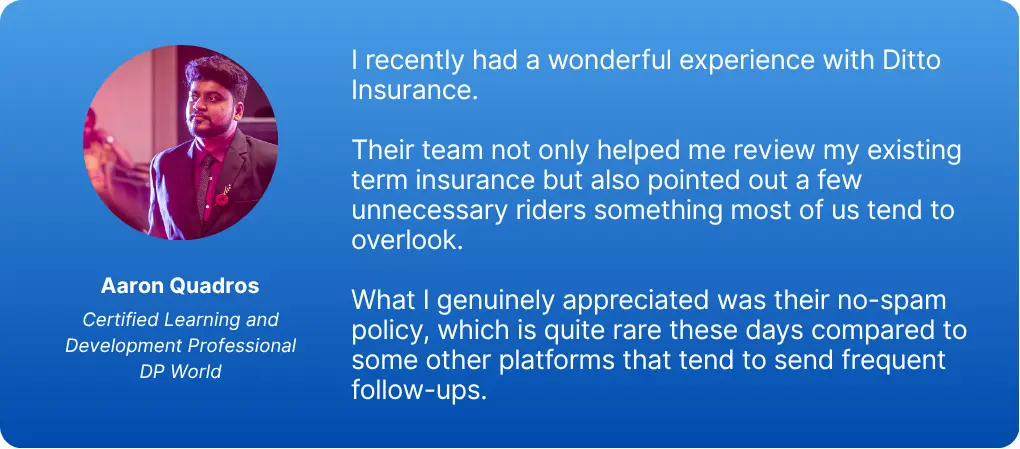
- No-Spam & No Salesmen
- Rated 4.9/5 on Google Reviews by 15,000+ happy customers
- Backed by Zerodha
- Dedicated Claim Support Team
- 100% Free Consultation
You can book a FREE consultation. Slots are running out, so make sure you book a call or chat on WhatsApp now!
Ditto’s Take on Government Term Insurance
Government schemes are excellent starting points that you should consider if you don’t have any life insurance. But here’s the honest truth: they’re not enough on their own. Most families need significantly higher coverage to maintain their lifestyle and meet long-term financial goals.
That’s why a smarter approach is to treat government plans as a base layer, and then build on top with a comprehensive term plan that actually covers your income, liabilities, and future needs.
If you prefer government-owned insurers, LIC’s term plans are worth exploring. You can also refer to our guide on the best term insurance plans in India to find a suitable option.
Frequently Asked Questions
Last updated on: