



Most people understand the value of a salary. What we often overlook is the value of the work that keeps a home running every single day.
According to the Ministry of Statistics and Programme Implementation (MoSPI’s) Time Use Survey 2024, 81.5% of females aged 6 and above participated in unpaid domestic services, compared to just 27.1% of males. And among those who did this work, females spent 289 minutes a day on it, while males spent 88 minutes.
In simple terms, household work may be unpaid, but it is not low-value.
For many Indian families, a housewife manages cooking, cleaning, childcare, elder care, and the everyday responsibilities that would cost real money to replace. So, if something unfortunate happens to her, the family does not just face an emotional loss. They can also need paid help, childcare support, elder care assistance, or a larger financial cushion to keep daily life running smoothly.
That is where term insurance for housewives becomes important. It is not about replacing a salary. It is about protecting the economic value of the work a homemaker does every day.
In this guide, we break down how term insurance for housewives works, who is eligible, how much coverage you can get, and how Ditto can help you find the best term insurance for housewives.
Common Questions Housewives & Their Families Ask
What Is Term Insurance for a Housewife?
Term insurance for a housewife is a pure life insurance policy designed for homemakers. The plan pays a death benefit (sum assured) to the nominees (typically the husband or children) in case of her untimely death.
Even though housewives don’t earn a salary or have an income, term insurance compensates for the invaluable childcare, domestic management, and eldercare they provide.
How It Works: The working spouse is usually the proposer/premium payer, but the wife can be one too. However, the housewife is the life insured. In such cases, term insurance companies typically cap the housewife’s coverage based on a percentage of the husband’s income.
Why It Is Essential: If a homemaker passes away, the family has to incur high costs to outsource basic household chores, childcare, and elderly care. The payout also ensures that children’s education or long-term financial commitments are not derailed by a lack of funds. Housewives can also buy term insurance if the husband doesn’t have a term plan for himself. Eligibility will depend on the husband’s income or surrogate income options, such as rental income and capital gains.
Can a Non-Earning Housewife Buy Term Insurance in India?
Yes, a non-earning housewife can buy term insurance in India. However, as they don’t have any personal income, the working spouse (husband) is generally the proposer/premium-payer, while the housewife remains the life assured.
That said, getting this plan isn’t as simple as buying a standard term insurance policy. Insurers apply stricter eligibility checks, link cover to the husband’s profile, and require mandatory medical tests.
Ditto’s Key Insight: Many families searching for term insurance for housewife India are surprised to learn that insurers assess the earning spouse's financial profile rather than the homemaker's salary. Moreover, term insurance for housewives is generally not issued where the husband’s annual income is below ₹5 lakh.
What Is the Best Term Insurance Plan for a Housewife?
Choosing the best term insurance for housewife depends on factors like the husband's income, existing life cover, underwriting rules, and the insurer's eligibility criteria.
Since housewives typically do not have independent income proof, the final cover amount depends heavily on the husband’s income and existing life cover, and the wife’s education, age, medical history, and insurer-specific rules.
Best Term Insurance Plans for Housewives
- Axis Max Life Smart Term Plan Plus
A housewife can get coverage up to ₹1 crore, subject to the husband’s income or existing life cover, her education, age, pincode, and medical underwriting. If the husband does not have an existing plan, Axis Max can allow up to ₹50 lakh where the husband earns ₹5 lakh+, and the wife is a graduate. For cover above ₹50 lakh and up to ₹1 crore, the husband’s income generally needs to be ₹10 lakh+, and the wife must be a graduate. For a 12th-pass housewife, the cover is usually restricted to ₹50 lakh, with stricter income checks. - HDFC Life Click2Protect Supreme Plus
The cover can go up to ₹1 crore, either based on the husband’s existing cover or his financial eligibility, with a minimum husband income requirement of around ₹5 lakh per year. This makes it suitable for families in which the husband has a stable income but may not already have sufficient life insurance. The plan can also offer useful add-ons such as critical illness cover up to ₹15 lakh, a waiver of premium in the event of the spouse’s accidental death, and a child education income benefit, subject to eligibility and underwriting. - ICICI Life iProtect Smart Plus
ICICI Life iProtect Smart Plus is a more conditional option for housewives because the husband must already have life insurance. The housewife’s cover is linked to the husband’s existing cover and is generally capped at the lower of 50% of the husband’s insurance or ₹1 crore. So, for a ₹1 crore housewife term cover, the husband may need an existing cover of around ₹2 crore. This plan can work well when the husband is already adequately insured, but it should not be positioned as the default best plan for every housewife, as its eligibility criteria are less flexible than those of Axis Max Life or HDFC Life. - Bajaj Life eTouch II
For a ₹50 lakh cover, the husband’s existing life cover may not be mandatory if he earns more than ₹5 lakh per year. However, for cover above ₹50 lakh and up to ₹1 crore, the husband needs both sufficient income and an existing life cover equal to or higher than the proposed housewife cover. For a ₹1 crore cover, Bajaj requires the husband to have at least ₹1 crore existing cover and financial eligibility for a higher combined cover. Its critical illness rider can go up to ₹20 lakh, but only if conditions such as the husband having equivalent or higher CI cover, both spouses being graduates, and the husband’s income being ₹10 lakh+ are met.
Ditto’s Key Insight: Although the plans listed above are broadly similar in terms of features and benefits, eligibility and underwriting requirements can vary significantly from one insurer to another. These insurer-specific guidelines are subject to change, but they can still offer a helpful indication of how the insurance industry generally assesses applications from housewives.
What Are the Eligibility Criteria for a Housewife's Term Plan?
A housewife’s term plan is usually issued based on the husband’s income, existing life cover, and the wife’s basic eligibility. Most insurers require the housewife to be between 18 and 60 years old, married, medically insurable, and at least a 12th-pass or a graduate, depending on the plan.
The husband needs a minimum annual income of ₹5 lakh, and for higher covers such as ₹1 crore, insurers ask for higher income, existing term insurance in the husband’s name, or both.
Ditto’s Key Insight: Final approval also depends on medical history, pincode serviceability, proof of education, and insurer underwriting.
Does a Housewife Need Her Own Income Proof to Buy Term Insurance?
Yes, term insurance for housewife without income proof is possible. A housewife usually does not need proof of income because she may not have independent earnings. Instead, insurers assess the husband’s income proof or his existing life insurance cover to decide whether the proposed sum assured is justified. For example, HDFC Life and Axis Max Life can allow housewife cover based on the husband’s income even if he does not already have a term plan, while ICICI Life generally requires the husband to already have life cover. So the financial underwriting shifts from the housewife’s income to the spouse’s financial eligibility.
How Much Term Cover Can a Housewife Get? (And How Is the Sum Assured Capped?)
A housewife can typically get term cover between ₹50 lakh and ₹1 crore, but the exact cap depends on the insurer, husband’s income, wife’s education, age, and the husband’s existing term cover. In many cases, ₹50 lakh is easier to qualify for, while ₹1 crore usually needs stronger financial backing from the husband. Some insurers cap the wife’s cover at 50% or 100% of the husband’s existing cover, subject to a maximum of ₹1 crore. Any life insurance the wife already holds is usually deducted from her eligible cover limit.
Ditto’s Key Insight: NRI housewives can get up to ₹2 crore in coverage in plans such as Bajaj Life eTouch II.
Talk to an expert
today and
find
the right
insurance for you.


Who Is the Policyholder and Who Pays the Premium in a Housewife's Term Plan?
In a housewife term plan, the housewife is the life assured, meaning the claim is paid if she passes away during the policy term. The proposer or policyholder may be the wife or the husband, depending on the insurer’s rules, but in practice, the husband often provides proof of income and pays the premium. The nominee, usually the husband or children, receives the death benefit. This differs from the husband’s own term plan because the cover is specifically for the wife’s life, even though the financial eligibility is linked to the husband. Moreover, it’s a separate policy altogether.
How Are Premiums Calculated for a Homemaker's Term Plan?
Premiums for a homemaker’s term plan are calculated mainly on the housewife’s age, health condition, smoking or tobacco usage status, policy term, premium payment term, sum assured, and riders selected. The husband’s income or existing term cover affects eligibility and maximum cover, not the base premium rate directly. Medical underwriting is mandatory in most housewife cases, so any pre-existing disease, Body Mass Index (BMI) issue, lifestyle risk, or adverse medical report can increase the premium, reduce the eligible cover, or lead to rejection.
What Documents Are Needed to Buy Term Insurance for a Housewife?
A housewife will usually need basic KYC documents such as PAN, Aadhaar, or address proof, age proof, photograph, education proof, nominee details, and medical declarations. Since the cover is financially justified by the husband, insurers also ask for proof of the husband’s income, such as ITR, Form 16, salary slips, bank statements, or business income documents. If eligibility is based on the husband’s existing life cover, policy documents or proof of existing sum assured may also be required. Some cases may also need marriage proof, especially where spouse-linked benefits or proposer-life assured relationships must be validated.
Should You Buy a Separate Plan for the Housewife or a Joint Husband-Wife Plan?
A separate term plan is usually better if the goal is proper coverage, wider rider options, and independent underwriting for the wife. Joint husband-wife plans can be convenient, but the wife’s cover is often capped as a percentage of the husband’s cover, riders may be limited or unavailable, and the structure can be less flexible if the family later wants to modify or increase one person’s cover. A joint plan can work when convenience matters and the required cover is modest, but for meaningful cover, such as ₹50 lakh to ₹1 crore for the housewife, a separate plan is generally the stronger recommendation.
What Happens to the Housewife’s Policy if the Couple Gets Divorced?
For independent plans, the policy generally remains in force after a divorce, provided the premiums continue to be paid. However, the policyholder may need to update details such as the premium payer, nominee, or beneficiary to reflect the change in circumstances.
For joint life plans, the treatment of the policy after a divorce depends on the insurer's terms and conditions. In some cases, the policy may be split, modified, or otherwise changed, subject to the insurer's provisions.
If a Homemaker With an Existing Term Insurance Plan Returns to the Workforce, Can She Continue Her Current Homemaker Term Plan? Also, Can She Increase Her Life Cover After She Starts Earning?
Yes, a homemaker who has purchased a term insurance plan can continue the policy even after rejoining the workforce. A change in employment status from homemaker to salaried or self-employed does not affect the validity of the existing policy, provided all policy terms and premium payments continue as required. There are generally no issues in maintaining the current term plan after returning to work.
Additionally, she may increase her overall life insurance coverage once she begins earning income that increases her eligibility. This is typically done by purchasing an additional term insurance policy rather than modifying the existing one. While applying for the new policy, she must disclose all existing life insurance policies, including the current homemaker term plan.
The insurer will assess her eligibility based on her current income, occupation, age, health profile, and existing insurance coverage. The amount of additional cover approved will depend on the insurer’s underwriting guidelines and the maximum cover she qualifies for based on her new income. Therefore, rejoining the workforce can provide an opportunity to enhance financial protection through additional term insurance coverage while continuing the existing policy without interruption.
Ditto's Unique Insights on Term Insurance for Housewives
Understanding Housewife Underwriting
Buying term insurance for a housewife is not just about comparing premiums. Since homemakers do not usually have direct proof of income, the real challenge is financial underwriting. Insurers check the husband’s income, existing term cover, the wife’s age, education, medical history, pincode, and sometimes even citizenship or residence status before deciding whether the policy can be issued and how much cover can be offered.
Matching Families With the Right Insurer
This is where Ditto helps. Ditto’s advisors map your family profile to insurers that actually offer term insurance for housewives, rather than recommending a random “popular” plan. For domestic housewife profiles, Axis Max Life Smart Term Plan Plus and HDFC Life Click2Protect Supreme Plus are usually stronger starting points, while Bajaj Life eTouch II and ICICI Life iProtect Smart Plus can work better in specific cases, depending on the husband’s income and existing cover.
For NRI housewife profiles, the shortlist changes, with Axis Max Life Smart Term Plan Plus, Bajaj Life eTouch II, and HDFC Life Click2Protect Supreme Plus becoming more relevant depending on the country of residence, medical requirements, and whether the husband already has adequate life cover.
Choosing the Right Sum Assured
Ditto also helps families avoid underestimating the homemaker’s financial value. Instead of choosing a random cover amount, advisors account for the costs of replacing household management, childcare, and eldercare, meeting children’s education goals, and managing ongoing liabilities such as home loans. This matters because housewife term plans are often capped differently from those for salaried people. In many cases, the cover may be limited to 50% or 100% of the husband’s existing life cover, subject to an insurer-level maximum, and lower cover amounts, such as ₹25 lakh to ₹50 lakh, may be easier to qualify for than ₹1 crore.
Riders also need careful review. Critical illness riders for housewives are usually capped much lower than for earning members, commonly around ₹15 lakh to ₹20 lakh, depending on the insurer and profile. Some riders may also depend on whether the husband has taken equivalent or higher rider cover. Since the total rider premium cannot exceed the base plan premium, adding too many riders may not always be possible, especially because women often have lower base premiums.
Handling Unearned Income Cases
Another important nuance is unearned income. In some cases, a homemaker may have rental income, capital gains, or other non-salary income. Such profiles may not fit standard housewife underwriting, and plans like Bajaj Life Superwoman Term may become relevant depending on how the income is documented. Ditto helps separate these edge cases from regular domestic housewife profiles, so families do not waste time applying to an insurer that is unlikely to approve the case.
Managing Documentation and Medicals
Finally, Ditto helps with the operational side of the purchase: documents, proof of the spouse's income, proof of an existing policy, medical scheduling, and insurer-specific conditions. Since medicals are usually mandatory for housewife term plans, Ditto advisors help the family understand whether physical, tele-med, or video medicals are needed and what could affect approval. This makes the final recommendation more practical: not just the best-looking plan on paper, but the plan most likely to fit the family’s actual eligibility.
Note: Ditto also helps folks avoid the Term Return of Premium (TROP) option and decide if the accidental death benefit rider is worth considering if the housewife is unable to get the desired base cover amount.
Claims Assistance
Buying the policy is only one part of the journey. Ditto also supports families during the claims process by helping them understand the insurer's documentation requirements, coordinating with the insurer where needed, and guiding nominees through each step of the claim.
If you bought your policy through Ditto, you can always reach out to us for claims assistance.
Why Choose Ditto for Term Insurance?
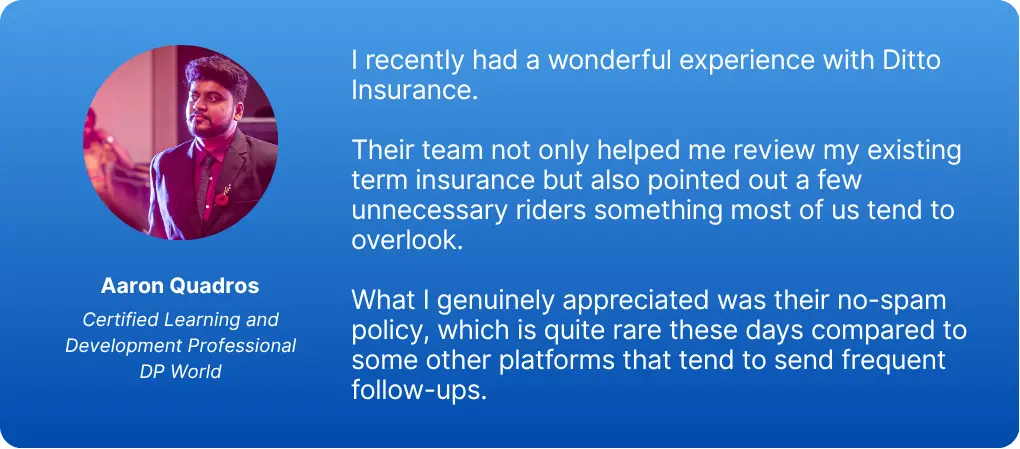
At Ditto, we’ve assisted over 8,00,000 customers with choosing the right insurance policy. Why customers like Aaron below love us:
- No-Spam & No Salesmen
- Rated 4.9/5 on Google Reviews by 24,000+ happy customers
- Backed by Zerodha
- Dedicated Claim Support Team
- 100% Free Consultation
You can book a FREE consultation. Slots are running out, so make sure you book a call or chat on WhatsApp now!
Conclusion
Term insurance for a housewife is ultimately about recognizing and protecting the financial value a homemaker brings to the family. While insurer rules on eligibility, coverage limits, and underwriting can make the process more complex than that of a standard term plan, the right policy can provide meaningful financial security for loved ones if the unexpected happens.
Last updated on: