Accidental death insurance is a policy that pays a lump sum to your nominee if you die due to a covered accident.
In simple terms, accidental death is caused directly and solely by an unforeseen, external, violent event. This includes road accidents, falls, fire, drowning, or similar incidents.
Regular term insurance already covers accidental death. Conversely, an accidental death benefit rider simply provides an additional payout if the death is due to an accident.
Accidents continue to be a growing concern across the country, affecting thousands of families every year. According to data tabled in Parliament, India saw around 4.87 lakh road accidents and over 1.77 lakh fatalities in 2024 alone.
This is where accidental death insurance comes in as an add-on cover designed specifically for accident-related cases.
At the same time, most deaths still occur due to illnesses, which is why regular term insurance plans remain the foundation of financial protection.
So, how do you decide if accidental death insurance is necessary for you or if your regular term plan is enough? In this blog, we’ll break it down simply so you can make an informed decision.
An independent policy covering accidental death and, in most cases, accidental disability as well. Many plans also compensate for permanent total disability, partial disability, or temporary income loss due to an accident. It works separately from your life insurance policy.
Accidental Death Benefit (ADB) Rider
It is an add-on to a term insurance plan. If death occurs due to an accident, the insurer pays the base sum assured plus an additional amount under the rider. Usually affordable and easy to add at the time of purchase, but many riders also require death to occur within a specified time (e.g., within 180 days) from the date of the accident.
Group Accidental Insurance
This type of cover is typically provided by employers as part of employee benefits. It offers financial protection in case of accidental death (and sometimes disability) during the period of employment. While useful, the coverage amount is often limited and ends when you leave the organization.
Accidental Death and Dismemberment (AD&D)
In international markets, AD&D is often sold as a separate policy covering both accidental death and loss of limbs. In India, standalone AD&D policies are not very common. However, similar benefits are available through personal accident policies or riders that combine accidental death and disability coverage. For example, some insurers like Axis Max Life offer AD&D riders.
Plans Offering Accidental Death Cover
1) Pradhan Mantri Suraksha Bima Yojana (PMSBY)
Pradhan Mantri Suraksha Bima Yojana is a government-backed group accidental insurance scheme which provides coverage of ₹2 lakhs for accidental death or full disability and ₹1 lakh for partial disability. The premium is ₹20 per year, and the eligibility is between 18 and 70 years. You need to have a bank account as the premium is auto-debited annually and the coverage is renewed every year.
2) Standalone Personal Accident Insurance Plans
They cover accidental death, permanent total disability, partial disability, and sometimes even temporary income loss. Key features include no medical tests in most cases, and premiums are often based on occupational risks. Some insurers that offer these plans include Care Health, HDFC ERGO, and ICICI Lombard.
3) Term Insurance with Accidental Death Benefit (ADB) Rider
Most major life insurers offer the ADB rider with their term plans, including Axis Max Life (Smart Term Plan Plus), HDFC Life (Click2Protect Supreme Plus), ICICI Prudential (iProtect Smart Plus), Tata AIA (Sampoorn Raksha Promise), and SBI Life (Smart Shield Plus). How it works: If you buy a ₹1 crore base cover + ₹1 crore ADB rider, you’ll get ₹2 crores in case of accidental death and ₹1 crore in case of a natural death.
CTA
Benefits and Drawbacks of Accidental Death Insurance
Pros
Cons
Affordable rider premiums.
Covers only accidental death.
Provides an additional payout (paid over and above the base life sum assured.)
The definition can require the accident to be the sole cause of death, and illness-triggered accidents can be rejected.
Easy underwriting in most cases.
Often requires FIR, post-mortem/inquest, final cause-of-death docs (all of this can delay claim settlement).
No medical tests are usually required.
Many plans exclude intoxication, crime, war, and adventure sports (or price them differently).
Can improve overall protection.
The rider sum assured is capped, and riders can expire way earlier than the base policy.
Who Should Consider Buying Accidental Death Insurance
Not everyone needs accidental death insurance, but it may make sense if:
You travel a lot
You have a high-risk occupation (such as construction work, field-based roles, factory jobs)
You want higher coverage at a lower cost
Note: It’s important to understand that hazardous professions and adventure sport enthusiasts may still face exclusions.
Premium Comparison for Plans Covering Accidental Death
Profile
Standalone Personal Accident Plan
Regular Term Plan with ADB Rider
Health Plan with Personal Accident Rider
25, Male
₹3,719
₹28,824
₹14,574
25, Female
₹3,719
₹26,126
₹14,574
30, Male
₹3,719
₹26,126
₹14,574
30, Female
₹3,719
₹29,525
₹15,531
Note: These plans differ in structure and purpose. The premiums shown are not directly comparable because the coverage types and sum assured vary. Moreover, they are annual and indicative in nature as they can vary by city, payment mode, underwriting, and add-ons.
For a standalone personal accident plan, we’ve considered the example of Aditya Birla’s Activ Secure plan 4 and risk class 1. The sum assured is ₹50 lakhs. The premium stays the same across different ages, but it may vary depending on your risk class, which is based on occupation and lifestyle.
For a regular term plan with an ADB rider, we’ve considered the example of Axis Max Life’s Smart Term Plan Plus with an ADD rider and a waiver of premium rider. The profiles used are of healthy, non-smoking individuals covered till the age of 65 for a sum assured of ₹2 crores (₹1 crore for ADD rider).
For a health plan with a personal accident rider, we’ve considered the example of Niva Bupa’s ReAssure 2.0 Platinum+. We’ve considered healthy, non-smoking profiles, covered for a sum insured of ₹15 lakhs and a personal accident cover of ₹45 lakhs.
Why Choose Ditto for Term Insurance?
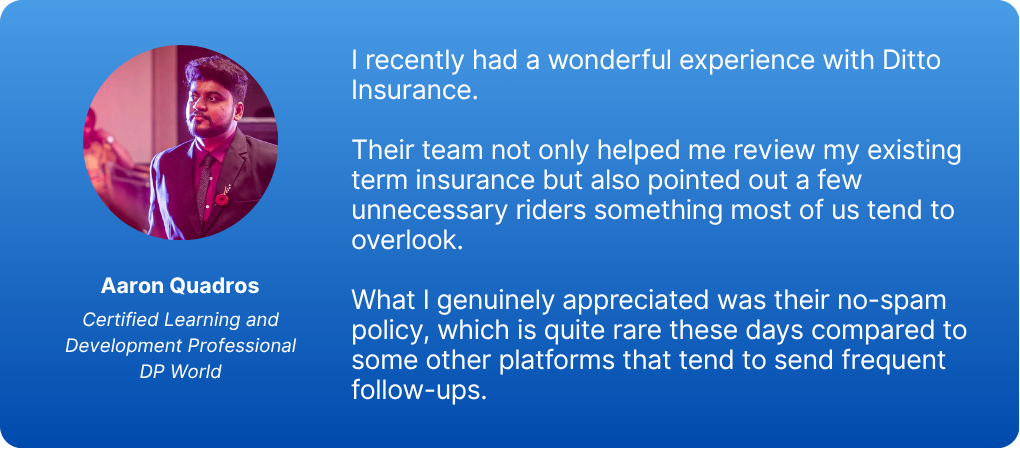
At Ditto, we’ve assisted over 8,00,000 customers with choosing the right insurance policy. Why customers like Aaron below love us:
No-Spam & No Salesmen
Rated 4.9/5 on Google Reviews by 15,000+ happy customers
Backed by Zerodha
100% Free Consultation
You can book a FREE consultation. Slots are running out, so make sure you book a call or chat on WhatsApp now!
Ditto's Take on Accidental Death Insurance
It’s crucial to note that standalone policies do not cover death due to an illness or natural causes, unlike regular term insurance plans. That’s why we don’t recommend relying heavily on an accidental death benefit as your primary protection.
Instead, buy the full cover you actually need through your base term insurance. If you want ₹1.5 crore protection, it’s safer to directly purchase a ₹1.5 crore term plan rather than depending on an accident-specific add-on.
We typically recommend an accidental death benefit rider only if you already have adequate base cover, have higher accident exposure (like frequent travel), the rider cost is minimal, and there are no harsh exclusions in the policy. Used wisely, it works best as supplementary protection and not the main plan. However, please note that the ADB rider cover has more exclusions than the base term cover.
Moreover, buying an accidental death rider with your base term insurance plan is usually the most cost-effective way. This is because the premiums for the base plan and the rider can be locked in for the entire tenure, unlike health insurance and standalone plans. The premiums there can be repriced based on the insurer’s discretion (due to inflation, operational costs, etc.).
Full Disclosure: Aditya Birla, Axis Max Life, Care Health, HDFC ERGO, HDFC Life, ICICI Lombard, ICICI Prudential, and Niva Bupa are partner insurers of Ditto. However, we’ve also included examples of SBI Life in this article even though it’s not a partner insurer. That’s because our recommendations are based on suitability, coverage quality, claims experience, underwriting practices, and overall value.
If you’d like to know more about how we shortlist plans or insurers, you can check out Ditto’s Cut.
Frequently Asked Questions
What is covered in accidental death insurance?
Accidental death insurance covers death that occurs directly and solely due to an unforeseen, external, and violent event such as road accidents, falls, fire, drowning, or workplace mishaps.
What is not covered in accidental death insurance?
It does not cover death due to illness, natural causes, suicide, self-inflicted injuries, substance abuse, or participation in excluded hazardous activities.
If a person has a heart attack while driving and crashes, will accidental death cover pay?
This is often tricky because the illness may be treated as the primary cause. While the term insurance would pay, rider or personal accident coverage can still be denied.
What is an example of an accidental death?
An example would be a person dying in a car crash, a fatal fall from a building, or electrocution due to an unexpected electrical fault. The death needs to be caused purely by an accident and not by any illness or pre-existing health condition.
What is accidental death in insurance?
In insurance terms, accidental death refers to death caused directly, independently, and exclusively by an external, violent, and visible event, typically within a specified time frame from the accident, as defined in the policy wording.
Last updated on:
Need a human touch?
Our advisors are here to help you pick the right plan.
Our advisors are here to help you pick the right plan.