



Overview
Imagine this: your family saves diligently for years, and then one medical emergency wipes it all out. Or worse, you pass away unexpectedly, leaving behind a home loan, kids' school fees, and a spouse with no financial backup.
Both scenarios are real. Both are financially devastating. And both have solutions.
That's exactly where health insurance and term insurance come in.
These two products often get mixed up in people's minds, but they serve very different purposes. One protects you while you're alive. The other protects your family if you're not.
In this article, we explain what term insurance and health insurance are and what to opt for first when choosing between the two.
What is Term Insurance?
Term insurance is the purest form of life cover. You pay a premium every year (typically very affordable if you start young). If you pass away during the policy term, your family receives a large lump sum (sum assured), which is completely tax-free under Section 10(10D).
The entire point of term insurance is income replacement. Since your family depends on your salary for everything: rent, groceries, EMIs, and your child's school fees. If you were to pass away tomorrow, that income stops. Term insurance makes sure your family doesn't have to struggle financially in your absence.
Note: If you survive the policy term, you don't get any payout. Since term insurance is a protection plan. That's also why it's so affordable compared to other life insurance products.
Some term plans offer a return of premium at the end of the policy, but they cost 50-100% more. For most people, return-of-premium variants aren’t worth it. You’re usually better off choosing a cheaper pure term plan and investing the premium difference elsewhere for potentially higher returns.
What is Health Insurance?
Health insurance is your financial support system for unexpected medical expenses. If you fall ill, meet with an accident, or require surgery, your policy helps cover the cost so you don’t have to rely on your savings.
In simple terms, you pay a premium every year, and in return, the insurer covers your hospitalization costs, surgeries, diagnostic tests, and, in some cases, even outpatient care. You can also opt for cashless treatment at a network hospital.
Add-on riders you can consider:
- Reduction in waiting period for pre-existing diseases
- Consumables cover
- Restoration benefit (so your sum insured gets refilled even mid-year)
- Room rent upgrade to any room
One thing health insurance does not do: It does not replace your income if you pass away or become permanently disabled. That's what term insurance is for.
Term Insurance vs Health Insurance: Key Differences
People often search for "life insurance vs term insurance vs health insurance" and end up confused. Let's clear it up.
First, the important clarification: term insurance is a type of life insurance. Life insurance is the umbrella category that includes products such as whole-of-life plans, endowment plans, and ULIPs.
As you can see, they're not competing products. They're complementary. One protects your present. The other protects your family's future.
Talk to an expert
today and
find
the right
insurance for you.


What is Term Insurance Really For?
Term insurance is meant to protect your family’s financial future in your absence. It ensures that if something happens to you, your dependents have the money they need to manage daily expenses, pay off loans, and maintain their lifestyle without financial strain.
At its core, it replaces your income so your family can stay financially secure, even when you’re no longer around.

Get Term Insurance if any of the following apply to you
You Have Financial Dependents
Your income is the backbone of your family's financial life. If it disappears suddenly, so does everything that depends on it: rent, EMIs, school fees, groceries. A term plan with the right cover amount replaces that income, so your family doesn't have to compromise.
You Have a Loan
If you have a home loan of ₹50 lakh or more, that responsibility doesn’t go away if something happens to you. Your family would still have to repay it, which could put them under serious financial pressure. In some cases, they might even have to sell the house or risk defaulting.
You're the Primary or Sole Breadwinner
If your family depends mainly on your income, your absence would have an immediate financial impact. Everyday expenses, bills, and long-term needs can quickly become difficult to manage without that support. Term insurance helps bridge this gap. It provides your family with a financial cushion so they can continue to meet their needs without added stress.
You're in Your 20s or Early 30s
This is the ideal time to buy term insurance. When you’re young and healthy, premiums are much lower, making it more affordable to lock in a high cover for the long term. For example, a 25-year-old non-smoker might pay around ₹10,000 to ₹12,000 per year for a ₹1 crore cover. The same plan at 40 could cost ₹20,000 to ₹25,000 or more.
You Want to Protect Specific Life Goals
You likely have a few important milestones in mind: your child’s education, a future wedding, or supporting your parents in retirement. A term insurance plan can help ensure these goals stay on track, even if life doesn’t go exactly as planned.
What is Health Insurance Really For?
Health insurance is meant to help you cover medical expenses without them becoming a financial burden. It ensures that if you face a health issue, you have support to cover hospital bills, treatments, and related costs.
At its core, it protects your savings, so you can focus on getting better instead of worrying about how to pay for it.
Get Health Insurance if Any of the Following Apply to You
You're Young and Healthy
This is actually the best time to buy. Premiums are lower, there are no pre-existing conditions to worry about, and the waiting period for conditions that develop later will have already been served.
You Rely on Employer-Provided (Corporate) Health Insurance
This is one of the biggest mistakes people make. Corporate plans are tied to your job. The moment you resign, get laid off, or switch companies, that coverage is gone. And if you try to buy an individual plan at 40 with a few pre-existing conditions, the premiums and waiting periods will be much higher. A private health insurance plan running parallel to your corporate cover is always a smart idea.
You're a Freelancer, Self-Employed, or a Gig Worker
You have no employer cover. A single hospitalization without insurance can cost ₹2-5 lakh or more, even for something as "routine" as appendicitis or a fractured leg.
You Have Aging Parents at Home
Parents above 50-60 have a higher chance of hospitalization for diabetes, heart issues, and orthopedic problems. Moreover, medical costs for senior citizens in tier-1 cities can easily run into lakhs. Getting them covered under a family floater or a separate senior-citizen plan is critical.
You Live in a Metro City
Healthcare costs in metro cities are significantly higher than in smaller towns. An ICU stay at a private hospital in Mumbai or Bengaluru can cost ₹15,000-₹30,000 per day. Multiply that by a week-long stay, and you're looking at ₹1-2 lakh, just for the room.
Term Insurance vs Health Insurance: What to Buy First?
At Ditto, we strongly believe that everyone needs both. But if your budget is tight and you have to prioritize, here's our practical recommendation:
Health Insurance First
Medical emergencies are far more common than sudden death, especially when you're young. Even if you're 25 or 40 and feel completely healthy, unexpected illnesses, accidents, and emergency surgeries happen. And one uninsured hospitalization can wipe out months of savings.
On top of that, health insurance has waiting periods. Many plans make you wait 2-3 years before they cover pre-existing conditions. The earlier you buy, the earlier you can get coverage for your pre-existing diseases.
Our recommendation: Start with a comprehensive individual health plan with a minimum cover of ₹15-25 lakh. If you're in a metro, aim higher. You can check out our guide on how much health insurance coverage you actually need.
Term Insurance Next
Once your health is covered, term insurance becomes the next essential. Especially if:
- You have financial dependents (spouse, children, parents)
- You've taken on any major loans
- You're the primary income earner in your household
- You want peace of mind that your family's goals are protected
Term insurance is relatively affordable, especially when you're young. And locking it in early means lower premiums for the entire policy duration.
Not sure how much cover you need? Use Ditto's term insurance cover calculator to get a personalized estimate.
Why Choose Ditto for Term Insurance?
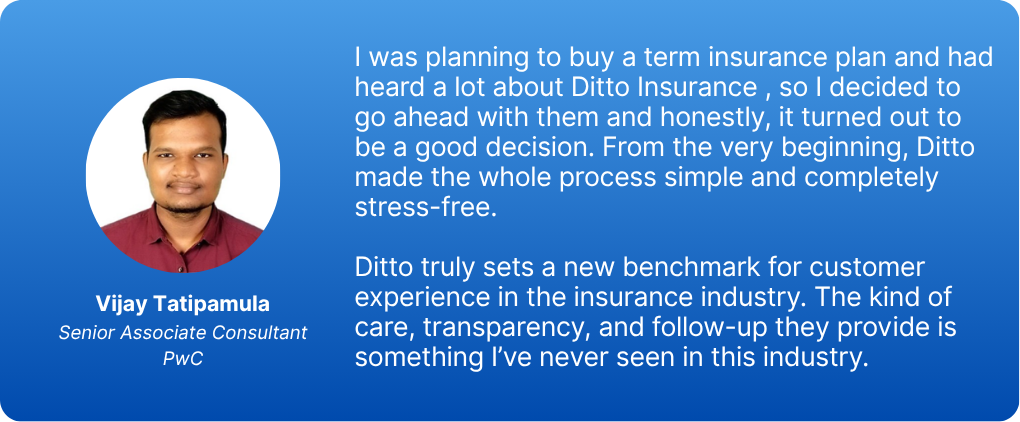
At Ditto, we’ve assisted over 8,00,000 customers with choosing the right insurance policy. Why customers like Vijay below love us:
- No-Spam & No Salesmen
- Rated 4.9/5 on Google Reviews by 15,000+ happy customers
- Backed by Zerodha
- Dedicated Claim Support Team
- 100% Free Consultation
You can book a FREE consultation. Slots are running out, so make sure you book a call now or chat with us on WhatsApp!
Conclusion
The real answer to "term insurance vs health insurance" is: you don't have to choose permanently, you just have to start somewhere.
If you're young and just starting your financial journey, health insurance is your first foundation. It protects your savings from medical expenses that can happen at any age. Once that's in place, term insurance becomes your next must-have, because it protects your family's future if the worst were to happen.
Think of it this way:
- Health insurance protects you while you're alive.
- Term insurance is protection for your family’s financial future and peace of mind.
Neither can replace the other. Together, they cover the two biggest financial risks most Indian families face.
Frequently Asked Questions
Last updated on: