


Overview

Life Insurance Corporation of India (LIC) does not offer any “LIC plan - 5 years double money” policy that guarantees your investments will double in 5 years. Most LIC plans are insurance-cum-savings products designed to provide life cover along with gradual wealth accumulation, rather than aggressive short-term returns.  Since part of the premium pays for life cover, returns are typically lower and require 10 to 20+ years to compound meaningfully.

From a mathematical perspective, doubling money in 5 years requires an annual return of approximately 14.87%, based on the Rule of 72. Doubling money in 5 years generally requires higher-return, market-linked investments such as equity mutual funds. This guide is perfect for people who want to know how to assess return expectations realistically.

Many people searching for LIC investment plans want to know whether it is possible to double their money in 5 years. While LIC offers several savings and insurance products, understanding the difference between policy term, premium payment term, guaranteed benefits, and actual returns is essential before evaluating such claims.

In this article, we separate facts from marketing myths, explain how LIC plans really work, and explore alternatives available to investors seeking short-term growth and capital protection.

Does LIC Have a Plan That Doubles Your Money in 5 Years?

No. LIC does not currently offer any mainstream savings or insurance plan that can realistically be described as a guaranteed "double your money in 5 years" product.

To double an investment in 5 years, you would need an annual return of roughly 14.9%. Here’s an illustrative example of how math works with an investment of ₹1 lakh.
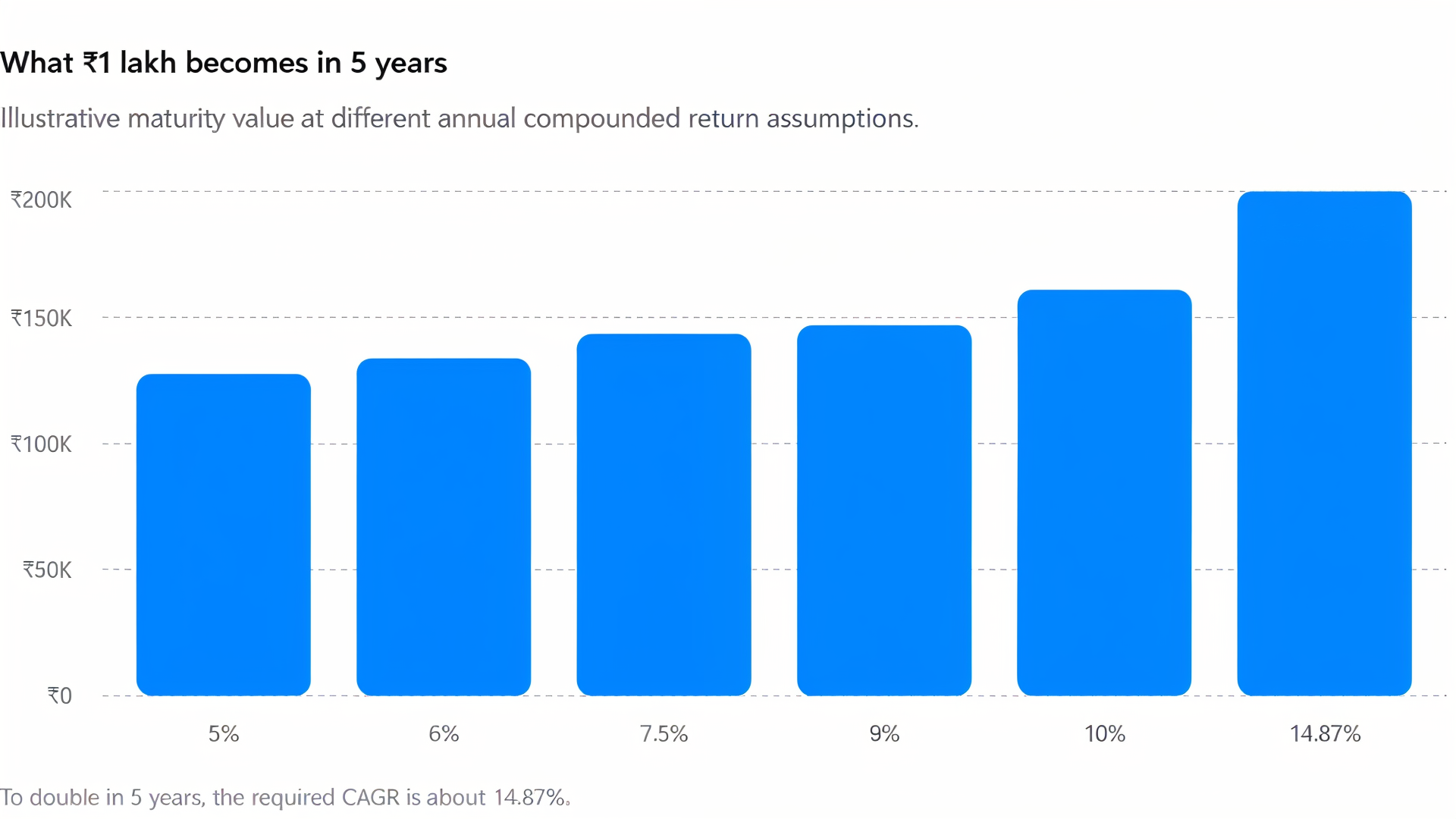
Illustration of How ₹1 lakh Becomes ₹5 lakh in 5 Years

Returns of around 14–15% per year usually require meaningful exposure to equities. Over the past 5 years, some small-cap and mid-cap stocks and indices have delivered returns in this range or higher, as per the National Stock Exchange (NSE) Indices

However, such returns are market-driven and come with volatility and risk. Traditional LIC savings plans focus on capital protection and stability, which is why they are generally not designed to double your money within 5 years.

Note: The commonly used Rule of 72 estimates the return needed to double money. Dividing 72 by 5 years gives roughly 14.4% per annum. A more precise Compounded Annual Growth Rate (CAGR) calculation shows that doubling money in 5 years requires an annual return of about 14.87%.

LIC Plans With Shorter Tenures (5-Year or Near)

LIC does not currently offer any active savings, endowment, money-back, pension, or investment-oriented plan that offers the guarantee to double your money in 5 years.  While some LIC term insurance plans may offer shorter policy durations, they are pure protection products and do not provide maturity benefits or investment returns.

However, certain LIC plans may help accumulate value over time through guaranteed additions, simple reversionary bonuses, final additional bonus, or deferred income benefits. 

Active LIC PlanType of PlanKey Features
Bima JyotiNon-par, non-linked savings plan.Policy term is 15 to 20 years, and the premium paying term is policy term minus 5 years. 
Jeevan LabhPar, non-linked, limited premium savings plan.Policy term and premium paying term options are 16/10, 21/15, and 25/16 years. 
Single Premium Endowment PlanPar, non-linked, single-premium savings plan.One-time premium payment with a policy term of 10 to 25 years. 
New Endowment PlanPar, non-linked regular premium savings plan.Policy term is 12 to 35 years. 

Note: Agent-led sales often frame LIC maturity payouts as “double the premiums paid,” especially for low-awareness customers. This oversimplifies how the policy works and may lead buyers to expect returns that are not guaranteed in practice. 

CTA
Background Image

Key Features of LIC Short-Term Plans

01

Limited Premium Payment

Pay premiums for a shorter period, such as 5 years, while the policy may continue for much longer. However, a short premium term does not mean a short investment tenure.

02

Single Premium Option

Make a one-time investment upfront. Suitable for lump-sum investors, but returns should be compared with other low-risk alternatives.

03

Life Insurance Cover

Provides a death benefit (usually up to 10x annual premiums) along with savings, though pure term insurance usually offers higher coverage at a lower cost.

04

Guaranteed Additions

Fixed additions may accrue as per policy terms. These should not be confused with annual investment returns.

05

Participating Bonuses

Some plans may earn bonuses declared by LIC. Future bonuses are not guaranteed and can vary over time.

06

Policy Loan Facility

Loans may be available against the policy after certain conditions are met, subject to interest charges.

07

Surrender Value

Early exit is possible, but it can significantly reduce overall returns and benefits.

What Returns Can You Realistically Expect?

For traditional LIC savings plans, return expectations should generally be moderate rather than equity-like. 

    • In many endowment, money-back, and similar savings plans, the effective long-term return often falls in the low-to-mid single-digit range, depending on several factors.
    • These factors include policy term, age at entry, premium amount, bonus declarations, guaranteed additions, and whether the policy is held until maturity.
    • More importantly, do not judge returns based only on the sum assured or advertised benefits. 
    • The best way to evaluate a policy is by calculating its actual Internal Rate of Return (IRR) using all premiums paid versus all benefits received over the policy term. 

LIC's traditional plans deliver approximately 4.5% to 6% effective IRR post-tax, depending on policy term, sum assured, and bonuses, if any. Furthermore, if we go by the rule of 72, and let’s assume 5% IRR, the years it will take the money to double is 14.4.

Note: You can upload your benefit illustration into a Large Language Model (LLM) chatbot and ask it to calculate the policy's Internal Rate of Return (IRR). In most cases, this provides a reasonably accurate estimate and can help you evaluate the plan more objectively before investing.

Did You Know?

When you see LIC or other life insurance benefit illustrations showing 4% and 8% returns, these are not guaranteed returns. As per IRDAI rules, insurers have to use these standard assumptions to help customers compare projections such as guaranteed benefits. Actual policy performance can be higher or lower depending on the product and future experience.

LIC Short-Term Plans vs Other Investment Options

OptionTypical Time HorizonReturn NatureRiskBest For
LIC Traditional Savings PlansUsually 10+ yearsGuaranteed benefits with bonuses or fixed payouts, depending on the planLow insurer risk, but liquidity and return risk remainInvestors seeking insurance plus disciplined long-term savings
LIC Limited-Pay Whole-Life PlansLong termGuaranteed income-style or long-duration benefits in select plansLow to moderateThose seeking lifelong cover with structured future income
Bank Fixed Deposits (FDs)1–5 yearsFixed, predetermined interest rate (6-7% commonly)Low, subject to bank strength and deposit insurance limitsCapital preservation and short-term goals
National Savings Certificate (NSC)5 yearsGovernment-backed fixed return (7.7% per annum)LowConservative investors with a 5-year investment horizon
Debt Mutual Funds / Target Maturity Funds3–7 yearsMarket-linked returns based on bond yieldsInterest-rate and credit riskInvestors who are comfortable with moderate debt-market fluctuations

Who Should Consider These LIC Plans?

    • Very Conservative Investors: May find these plans suitable if capital stability, predictable benefits, and the comfort of a well-known insurer matter more than maximizing returns.
    • People Who Struggle to Save Regularly: The long-term commitment and restricted access to funds can help create disciplined savings habits, though this comes at the cost of flexibility.
    • Investors Seeking Insurance Plus Savings: These plans can work as a supplementary savings tool alongside insurance needs, especially for those who prefer an all-in-one product.

However, those expecting their investment to double in 5 years should look elsewhere, as traditional insurance plans are designed for stability rather than high growth.

GoalBetter Direction
Want life coverBuy a pure term plan
Want safe 5-year savingsCompare Fixed Deposits (FD), National Savings Certificate (NSC), and short-duration debt options
Want tax-saving with safetyCompare NSC, tax-saving FD, and ELSS depending on risk appetite
Want higher growthConsider equity mutual funds and National Pension System (NPS), but only for 5+ years, and with volatility
Want pension/incomeLook at annuity products, but compare rates and liquidity limits

Why Choose Ditto for Life Insurance?

At Ditto, we’ve assisted over 8,00,000 customers with choosing the right insurance policy. Why customers like Aaron below love us:

Aaron's Testimony About Ditto's Wonderful Service
    • No-Spam & No Salesmen
    • Rated 4.9/5 on Google Reviews by 22,000+ happy customers
    • Backed by Zerodha
    • Dedicated Claim Support Team
    • 100% Free Consultation

You can book a FREE consultation. Slots are running out, so make sure you book a call or chat on WhatsApp now!

Ditto’s Verdict

Claims that an LIC plan can guarantee your money will double in 5 years do not hold up mathematically. A doubling period of 5 years requires returns of 14.87% per annum, which traditional LIC savings plans are not designed to deliver. In many cases, the "5 years" refers only to the premium payment term, while the policy itself runs much longer.

Certain life insurance products like Unit Linked Insurance Plans (ULIPs) can potentially deliver higher returns because of their market-linked nature, but those outcomes are neither guaranteed nor predictable. Higher equity exposure brings higher risk, and policy charges can meaningfully reduce long-term returns. Always evaluate the actual benefit illustration and expected IRR rather than relying on headline claims. More importantly, separate your life protection needs from your investment goals when assessing any financial product.

Term insurance is generally the most cost-effective way to secure a high life cover, while investment options such as mutual funds, NPS, PPF, and FDs offer transparent return structures that make it easier to build wealth and track performance over time.

Frequently Asked Questions

Does LIC have a plan that doubles your money in 5 years?

No. Life Insurance Corporation of India (LIC) does not offer any plan that guarantees doubling your money in 5 years. This is a marketing myth often circulated by agents and not supported by any official LIC product. LIC’s traditional plans focus on life cover with steady savings through bonuses and guaranteed additions. These are long-term instruments, not short-term high-return products. The insurer clearly does not advertise or design any scheme aimed at 5-year capital doubling under its current product portfolio.

What annual return is needed to double money in 5 years?

To double your invested money in 5 years, you need an annual return of about 14.87% compounded annually. This level of return is very high and difficult to achieve consistently in most regulated financial products. Even equity markets, while capable of such returns in some periods, do not guarantee them. Traditional life insurance plans offered by LIC are not structured for aggressive compounding. LIC life insurance plans focus on capital protection, bonuses, and steady long-term accumulation rather than rapid wealth growth.

What is the Rule of 72, and how does it work?

The Rule of 72 is a simple and easy way to estimate how long your money takes to double. You divide 72 by the expected annual return. For example, at an 8% return, money doubles in about 9 years. If you want to double in 5 years, the approximate required return is about 14.4%. This rule shows why fast-doubling claims are unrealistic for conservative investments. It is a quick mental tool to understand compounding and compare different financial products.

How long does it take to double money at a 5% return?

At a 5% annual return, your money will take about 14.4 years to double, if we go by the Rule of 72. This assumes steady compounding over time without any kind of interruptions. LIC traditional life insurance plans usually deliver returns in the 4.5% to 6% range, depending on bonuses and policy structure. That means doubling typically takes well over a decade. This makes the idea of doubling in 5 years unrealistic for low-risk insurance or fixed-income style investments.

What does 5 years refer to in LIC premium payment terms?

In many LIC life insurance policies, the 5-year period refers only to how long you pay premiums, not how long the policy runs. The policy itself may continue for 15, 20, or even 30 years. Benefits are paid at maturity or during the policy term, depending on the plan. This difference often creates confusion. LIC agents sometimes tend to highlight the short premium payment period, which can mislead buyers into assuming the entire policy benefit is linked to 5 years.

What is the internal rate of return (IRR) on LIC traditional plans?

LIC traditional plans usually deliver an internal rate of return in the range of 4.5% to 6% after tax, depending on policy type, tenure, and bonus performance. Internal rate of return measures the true annual return by considering all premiums paid and total benefits received. This includes maturity value, guaranteed additions, and bonuses. It is a more accurate measure than headline maturity figures. LIC life insurance plans are designed for stability and protection, not high or aggressive investment growth.

How do LIC plans compare with fixed deposits and National Savings Certificate?

Fixed deposits typically offer returns of 4% to 7%, depending on the bank and tenure. The National Saving Certificate offers similar government-backed returns. LIC traditional plans also fall in a comparable range of 4.5% to 6% IRR, but include life insurance cover as an added benefit. However, liquidity is lower in insurance plans compared to fixed deposits. The key difference is that LIC combines protection with savings, while fixed deposits and the National Savings Certificate focus purely on investment returns.

What do IRDAI rules say about return illustrations?

IRDAI requires insurers to show standard illustrations using 4% and 8% assumed returns. These are only reference values, not guarantees. They help customers compare different policies on a uniform basis. Actual returns depend on bonus declarations, policy performance, and company experience. Misinterpreting these illustrations as fixed returns leads to confusion. The regulator clearly states that these figures are indicative and not promises of actual maturity value. Always evaluate a policy using its likely IRR and actual benefit structure rather than illustrative projections alone.

Last updated on: