



Overview
LIC provides an official premium calculator for Jeevan Utsav, but there is no official LIC benefit calculator. Some third-party tools may estimate benefits based on inputs such as entry age, basic sum assured, premium-paying term, payment frequency, and income option.
This guide explains the key details you may need when using the LIC premium calculator or reviewing benefit estimates from other sources, how LIC Jeevan Utsav benefits are calculated, and what to consider when reviewing estimated figures.
What Is the LIC Jeevan Utsav Plan Calculator?
LIC provides an official premium calculator for Jeevan Utsav. It can help estimate the premium based on details such as age, basic sum assured, premium-paying term, payment mode, and other applicable inputs.
However, LIC does not provide an official benefit calculator. Some third-party tools may estimate the policy’s benefits, but their figures should not be treated as an official LIC quotation or benefit illustration.
Note: Ditto does not recommend relying on third-party calculators. For updated premiums and benefit illustrations, customers should contact an LIC agent or visit an LIC branch.
Details You May Need for a Third-Party LIC Jeevan Utsav Calculator
The official LIC premium calculator and some third-party benefit calculators may require details such as:
- Age at Entry: Entry age depends on the selected Premium Paying Term (PPT). For a 5–8-year PPT, the entry age is 8–65 years. For a 16-year PPT, it is 30 days–59 years, with different age limits for the PPTs in between.
- Basic Sum Assured (BSA): The minimum basic sum assured is ₹5 lakh, with no upper limit subject to underwriting.
- Premium Paying Term (PPT): The available premium-paying terms range from 5 to 16 years.
- Premium Payment Mode: Yearly, half-yearly, quarterly, or monthly payments through National Automated Clearing House (NACH).
- Survival Benefit Option: Regular Income or Flexi Income, selected at inception, with the option to change it up to six months before the beginning of the policy year in which the first income benefit becomes due.
- Riders: Optional riders include the accidental death and disability benefit rider, accident benefit rider, new term assurance rider, and premium waiver benefit rider. Rider premiums are charged separately and are subject to applicable limits.
How Guaranteed Additions Are Calculated in LIC Jeevan Utsav?
The official LIC premium calculator does not replace the policy’s benefit illustration. Third-party calculators may estimate guaranteed additions using the policy’s Basic Sum Assured (BSA) and Premium Paying Term (PPT).
LIC Jeevan Utsav provides ₹40 as a guaranteed addition for every ₹1,000 of basic sum assured each year during the PPT, provided the policy is in force and premiums are paid on time.
For example, for a ₹10 lakh BSA: ₹10,00,000 ÷ ₹1,000 × ₹40 = ₹40,000 per year.
With a 10-year PPT, the total guaranteed additions would be ₹4 lakh, while a 16-year PPT would result in ₹6.4 lakh.
These additions are not paid separately during the PPT. Instead, they accrue during the PPT and may form part of the death or surrender value, subject to policy conditions.
Note: Plan 771 does not provide a maturity benefit.
How the Regular and Flexi Income Benefit Payouts Are Calculated

Option I (Regular Income)
Under this option, you receive 10% of the basic sum assured every year once the scheduled income phase begins. For example, with a ₹10 lakh basic sum assured, the annual income would be ₹1 lakh. The income starts from the policy year specified in the brochure for the selected PPT.
Option II (Flexi Income)
Under this option, the same 10% of the basic sum assured is credited each year, but you can leave the benefit in the policy instead of taking it immediately. The accumulated amount earns a guaranteed 5.5% per annum, compounded annually, subject to policy conditions. You can withdraw up to 75% of the accumulated balance in a policy year, subject to the applicable terms.
Worked Example: LIC Jeevan Utsav Payouts at Age 30 and Age 50
Since LIC’s official calculator is a premium calculator rather than a benefit calculator, the following figures illustrate the premiums shown in the LIC brochure.
Note: These premiums are illustrative and based on a ₹5 lakh basic sum assured, excluding applicable taxes (if any). Actual premiums may vary based on age, PPT, selections, underwriting, and other applicable factors. For updated premiums and benefit illustrations, contact an LIC agent or visit an LIC branch. The illustration is derived from the official LIC New Jeevan Utsav Plan brochure.
The Real Return: What Third-Party LIC Jeevan Utsav Calculators May Not Show You
The official LIC premium calculator does not calculate the policy’s effective return, while third-party benefit calculators may provide estimates using inputs such as entry age, basic sum assured, premium-paying term (PPT), income option, and benefit duration.
The 10% income benefit under LIC Jeevan Utsav is not the same as a 10% annual return. It means you become eligible for income equal to 10% of the basic sum assured at the end of each policy year, starting from the policy year specified for the selected PPT. Your actual return depends on the premiums paid, when the income begins, and how long you receive the benefits.
For example, if your basic sum assured is ₹10 lakh, the annual regular income benefit would be ₹1 lakh. However, you would have paid premiums before receiving this income, so ₹1 lakh divided by ₹10 lakh does not represent the actual return.
When assessing these figures, consider the total premiums paid and timing of benefits rather than focusing only on the 10% income figure.
LIC: Performance Metrics
Note: The above metrics reflect LIC's overall performance and are not limited to any particular product. The data is sourced from IRDAI Annual Reports and LIC’s public disclosures. For more data like this, explore the Ditto Data Lab.
Talk to an expert
today and
find
the right
insurance for you.


Common Mistakes When Using LIC Jeevan Utsav Calculators
- Treating 10% as the Actual Return: The 10% income benefit is calculated on the basic sum assured. It is not the policy's investment return. The actual return depends on the premium paid and timing of future benefits.
- Ignoring the Premium-Paying Term: Guaranteed additions accrue at ₹40 per ₹1,000 of basic sum assured only during the PPT. They stop after the PPT and cease if premiums are not paid on time. The PPT also affects when the income benefit begins.
- Comparing Premiums Without Checking the Payment Mode: Premiums can differ depending on whether you pay yearly, half-yearly, quarterly, or monthly.
- Ignoring the Income Option: Regular Income and Flexi Income work differently. Regular Income provides the benefit as income, while Flexi Income allows the benefit to accumulate at 5.5% per annum.
- Not Checking the Surrender Value: If you may need to exit the policy early, check the applicable surrender value before buying. Early surrender can affect the overall value you receive.
- Confusing Plan 771 With Other LIC Plans: LIC Jeevan Utsav is Plan No. 771. It has no maturity benefit. Guaranteed additions accrue only during the PPT and may form part of the death or surrender value, depending on the policy conditions. They are not a separate maturity payout.
- Relying on Third-Party Benefit Calculators: LIC provides an official premium calculator, but not an official benefit calculator. Third-party benefit calculators may provide estimates that should not be treated as official LIC figures.
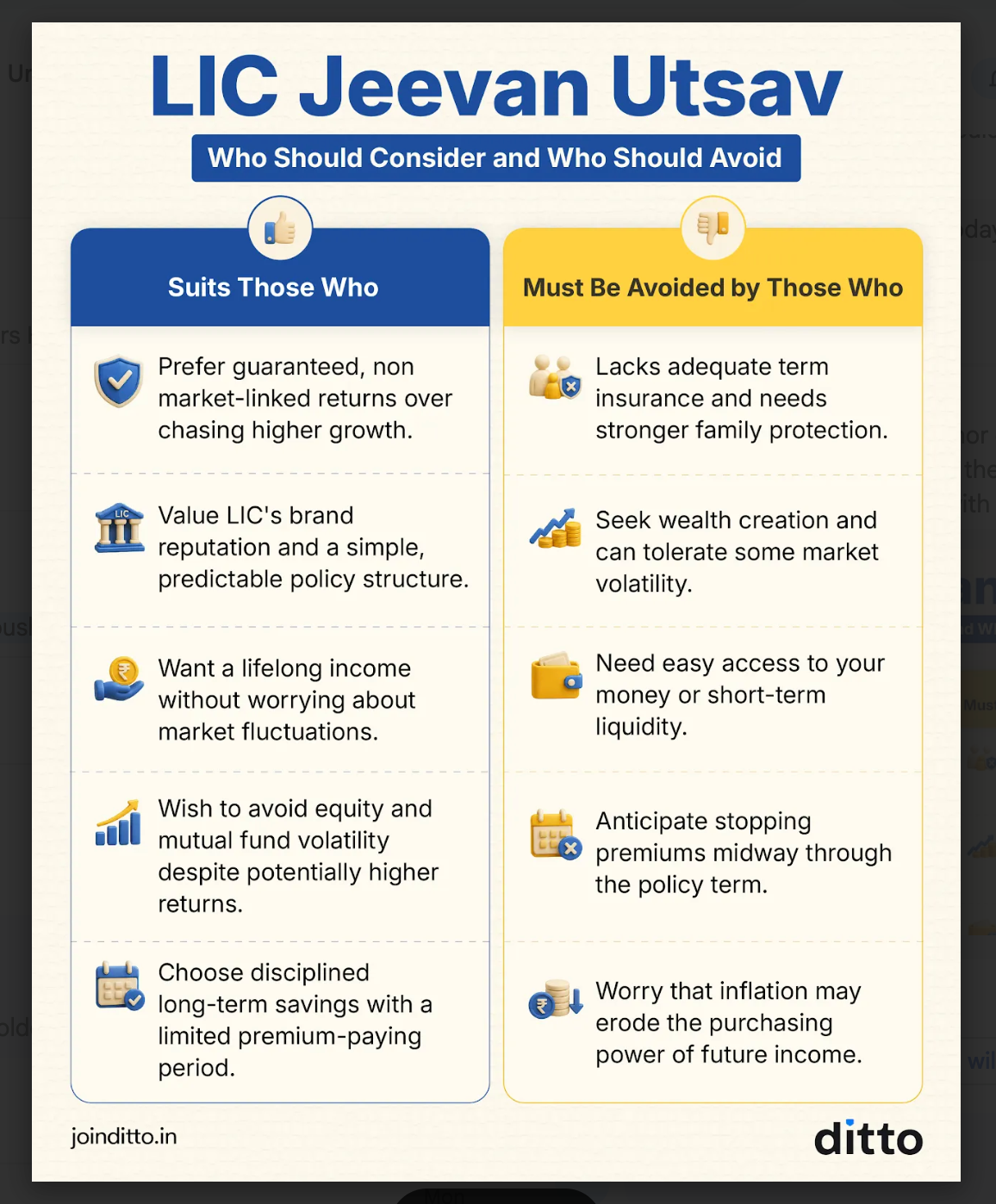
Who Should Consider the LIC Jeevan Utsav Plan?
Consider the following factors before deciding if the plan aligns with your financial needs and goals.
Why Choose Ditto for Life Insurance?
At Ditto, we’ve assisted over 12,00,000 customers with choosing the right insurance policy. Why customers like Vijay below love us:

- No-Spam & No Salesmen
- Rated 4.9/5 on Google Reviews by 30,000+ happy customers
- Backed by Zerodha
- Dedicated Claim Support Team
- 100% Free Consultation
You can book a FREE consultation. Slots are running out, so make sure you book a call now or chat with us on WhatsApp!
Conclusion
LIC Jeevan Utsav is best viewed as a guaranteed lifetime income and legacy planning product, rather than a high-return investment or a replacement for adequate term insurance. LIC provides an official premium calculator but does not provide an official benefit calculator. Any third-party benefit calculator should therefore be treated only as an indicative tool and not as an official source of benefits.
For accurate and updated quotes and benefit illustrations, customers should contact an LIC agent or visit an LIC branch.
Disclaimer: Ditto does not recommend using third-party LIC Jeevan Utsav benefit calculators. Customers should contact LIC agents or visit LIC branches for updated quotes and benefit illustrations.
Frequently Asked Questions
Last updated on: