The premium for LIC Jeevan Tarun (Plan 734) is not fixed and depends on several factors, including your child's entry age, the chosen basic sum assured (minimum ₹2 lakh), premium payment mode, and the selected survival benefit option. Premiums are payable only until the child reaches 20 years of age.
Estimated annual premiums for a ₹2 lakh basic sum assured for Option 1 are:
Child's Entry Age (0–4 years): ₹9,114 to ₹11,505 with premium paying term (16–20 years)
Child's Entry Age (8–12 years): ₹15,464 to ₹22,854 with premium paying term (8-12 years)
These are indicative premiums. The final premium may vary based on the selected survival benefit option (Option 1, 2, 3, or 4) and other policy-specific factors.
There is no fixed LIC Jeevan Tarun policy premium chart, but you can refer to the benefit illustration present in the official brochure.
Planning for your child's future starts with understanding today’s costs. This is where the Jeevan Tarun premium chart by Life Insurance Corporation of India (LIC) comes in, showing how premiums vary based on your child's age, chosen coverage, and policy options.
This guide breaks down the LIC Jeevan Tarun premium chart, explains key LIC Jeevan Tarun policy details, and helps you understand premiums, benefits, and payouts before buying the plan.
Confused about whether LIC Jeevan Tarun premiums justify its benefits? Book a free call or chat on WhatsApp with a Ditto advisor, and let us help you out.
What Is the LIC Jeevan Tarun Premium Chart?
The LIC Jeevan Tarun premium chart is an illustrative premium table published by LIC to help parents estimate policy costs. Instead of providing rates for every possible combination, LIC offers sample annual premiums for a ₹2 lakh basic sum assured under standard conditions.
The premium figures for LIC Jeevan Tarun exclude rider premiums and any additional underwriting charges, making them a useful reference rather than a final premium quote.
Talk to an expert today and find the right insurance for you.
Sample LIC Jeevan Tarun Premiums by Age and Sum Assured
Age
Option 1
Option 2
Option 3
Option 4
0
₹9,114
₹9,310
₹9,516
₹9,722
4
₹11,505
₹11,809
₹12,113
₹12,407
8
₹15,464
₹15,925
₹16,386
₹16,846
12
₹22,854
₹23,628
₹24,392
₹25,166
Note: The premiums shown under each option are annual premiums for a ₹2 lakh basic sum assured and are based on the official policy brochure.
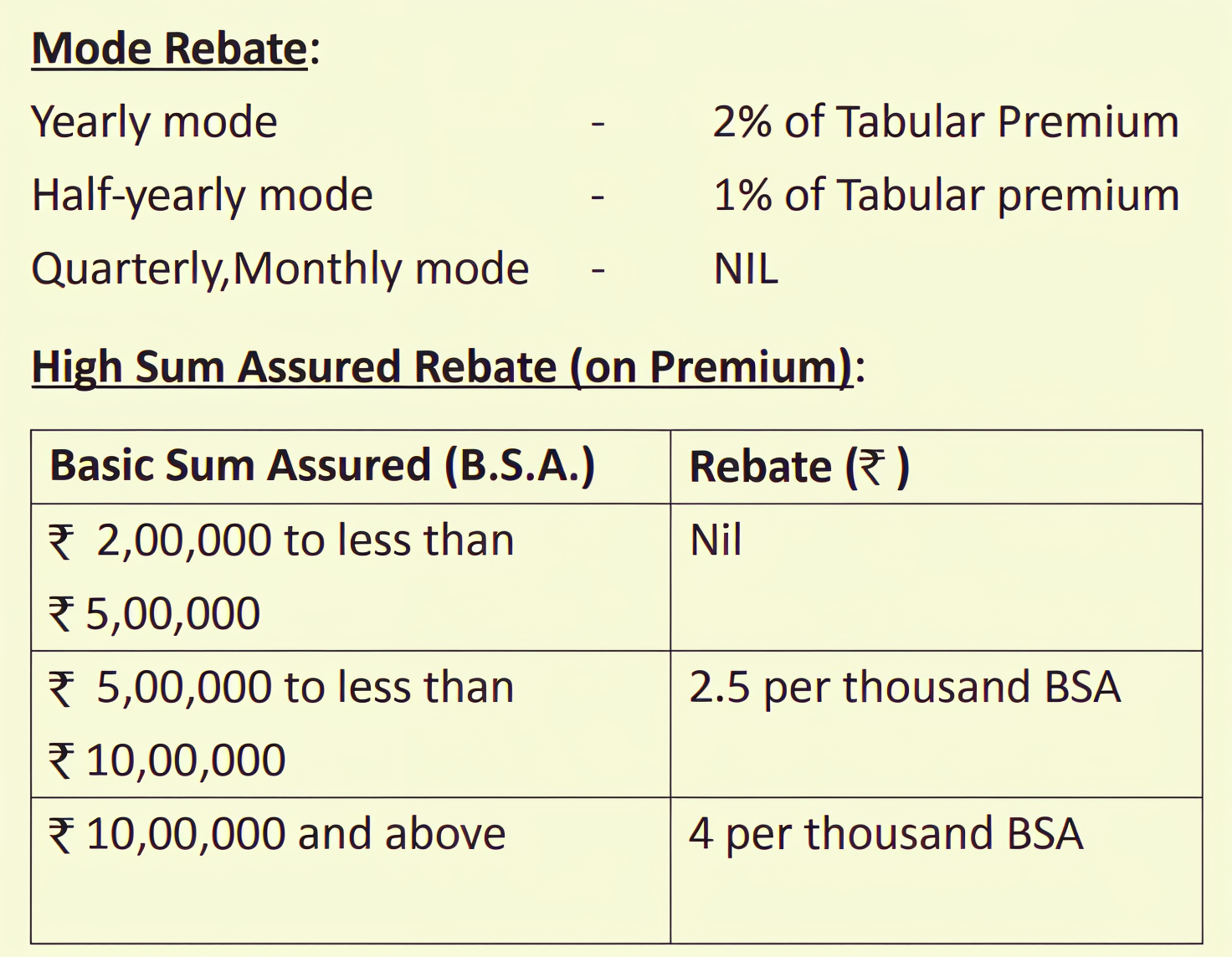
LIC also offers select premium rebates that can help reduce the overall cost of the policy. The snippet below highlights the applicable discounts as specified in the policy brochure.
Factors That Affect LIC Jeevan Tarun Premium
01
Child's Entry Age
Your child's entry age is one of the biggest factors affecting the premium. Since LIC fixes both the policy term and premium paying term based on the child's age, older children have fewer years to pay premiums. As a result, the annual premium is higher for the same sum assured.
02
Basic Sum Assured
Choosing a higher basic sum assured increases the policy's death benefit, maturity benefit, survival benefits, and potential bonus. However, the premium does not always rise proportionately because LIC offers high sum assured rebates.
03
Survival Benefit Option
The selected survival benefit option also affects the premium. Options that pay a larger portion of the benefit earlier generally cost more because LIC releases the money sooner.
04
Premium Waiver Benefit Rider
Adding the Premium Waiver Benefit Rider increases the total premium, subject to LIC's underwriting requirements.
05
Medical and Underwriting Assessment
LIC may charge a higher premium or apply additional underwriting based on the medical history, health condition, or other risk factors of the child or, where applicable, the proposer under the rider.
06
Changing the Payout Option Later
LIC allows policyholders to switch to a higher survival benefit option before payouts begin, subject to its terms. However, this usually requires paying the difference in premiums, along with applicable interest or other charges.
Note: GST on term insurance and other life insurance products was removed in India for individual policies from September 22, 2025. Therefore, premiums paid toward LIC Jeevan Tarun do not include any GST.
LIC Jeevan Tarun Benefits and Plan 734 Features
Death Benefit: If the child dies after the risk cover begins and before policy maturity, LIC pays the higher of 125% of the basic sum assured or 7 times the annualized premium, subject to a minimum of 105% of total premiums paid. Any vested simple reversionary bonus and final additional bonus, if declared, are also payable.
Survival Benefit: LIC Jeevan Tarun provides annual money-back payouts starting at the child's 20th birthday. Depending on the selected option, the policy pays 0%, 5%, 10%, or 15% of the basic sum assured each year for five years.
Maturity Benefit: If the child survives until 25 years of age and the policy remains active, LIC pays the remaining basic sum assured along with declared bonuses. The final maturity amount depends on the chosen survival benefit option. You can use the LIC Jeevan Tarun maturity calculator for rough estimates of benefits.
Premium Waiver Benefit Rider: Parents can add the Premium Waiver Benefit Rider to protect the policy. If the proposer dies during the premium paying term, future premiums are waived while the policy continues with full benefits until maturity, subject to LIC's rider terms and eligibility conditions.
To know more about the plan in detail, refer to our guide on LIC Jeevan Tarun.
Why Choose Ditto for Life Insurance?
At Ditto, we’ve assisted over 8,00,000 customers with choosing the right insurance policy. Why customers like Aaron below love us:
No-Spam & No Salesmen
Rated 4.9/5 on Google Reviews by 30,000+ happy customers
Backed by Zerodha
Dedicated Claim Support Team
100% Free Consultation
You can book a FREE consultation. Slots are running out, so make sure you book a call or chat on WhatsApp now!
Conclusion
The LIC Jeevan Tarun premium chart is a helpful starting point for estimating policy costs, but it should not be treated as the final premium. Your actual premium will depend on factors such as your child's entry age, basic sum assured, selected survival benefit option, payment mode, riders, and LIC's underwriting assessment.
Since LIC Jeevan Tarun is available only through offline channels, obtain your final premium quote from an authorized LIC agent or branch. If you use any online LIC Jeevan Tarun calculator for premiums, treat the estimate as a reference and confirm the final premium with LIC before purchasing the policy.
Frequently Asked Questions
What is the current premium for LIC Jeevan Tarun for a 5-year-old child?
The premium for a 5-year-old depends on the basic sum assured, selected survival benefit option, payment mode, and any riders. LIC publishes only illustrative premium tables rather than a complete rate chart. For a 5-year-old child, the illustrative annual premium under Option 1 for a ₹2 lakh cover can range from ₹11,505 to ₹15,464.
What are the four Survival Benefit options under LIC Jeevan Tarun and how do they differ?
LIC Jeevan Tarun plan offers four survival benefit options. Option 1 pays no survival benefit during the policy term, with the entire amount payable at maturity. Options 2, 3, and 4 provide annual payouts of 5%, 10%, and 15% of the basic sum assured, respectively, starting at the child's 20th birthday, with the remaining amount paid at maturity. Higher annual payouts reduce the maturity benefit at age 25, while lower or no payouts leave a larger amount payable at maturity.
Is LIC Jeevan Tarun Plan 734 different from the older Plan 934?
Yes. Plan 734 is the current version of LIC Jeevan Tarun, while Plan 934 was an earlier variant that is no longer available for new purchases. Existing Plan 934 policies continue under their original terms, but new buyers can only purchase the latest version. LIC Jeevan Tarun Plan 934 was withdrawn in 2024.
What death benefit does LIC Jeevan Tarun pay if the child assured dies during the policy term?
If the child dies after the risk cover begins and before policy maturity, LIC pays the applicable death benefit along with any vested simple reversionary bonuses and the final additional bonus, if declared. The policy terms also prescribe minimum death benefit conditions linked to the basic sum assured and premiums paid.
What is LIC's claim settlement ratio compared to private life insurers?
LIC has consistently maintained one of the highest claim settlement ratios among Indian life insurers, making it a trusted choice for many families. During FY 2024–26, LIC recorded an average claim settlement ratio of 98.16%. However, several private insurers, such as HDFC Life and Axis Max Life, reported claim settlement ratios over 99% in the same period, outperforming LIC. These statistics are derived from IRDAI Annual Reports, LIC's public disclosures, and Ditto's term insurance data lab.
Is LIC Jeevan Tarun a good child investment plan compared to term insurance and mutual funds?
LIC Jeevan Tarun combines savings, life insurance, and guaranteed policy benefits in one plan. However, if your primary goal is long-term wealth creation, many investors prefer combining a term insurance policy for the parents with mutual funds, which may offer greater flexibility and potentially higher returns, subject to market risks.
Can I take a loan against my LIC Jeevan Tarun policy?
Yes. LIC Jeevan Tarun offers a loan facility after completing one policy year, subject to LIC's prevailing loan rules and conditions. The maximum loan amount depends on the policy's available surrender value, and interest is charged at the rate applicable when the loan is granted.
What returns can you realistically expect from LIC Jeevan Tarun?
Based on the guaranteed benefits alone, LIC Jeevan Tarun offers a relatively modest return, with the Internal Rate of Return (IRR) generally around 0% to 1% per year, as the guaranteed payouts are only slightly higher than the total premiums paid. Higher returns depend on non-guaranteed bonuses declared by LIC. If future bonuses are similar to those shown in LIC's 8% benefit illustration, the overall IRR could improve to roughly 4.3% to 4.7% per year.
Should you buy LIC Jeevan Tarun or consider other investment options first?
Before investing in any child savings plan, ensure your financial foundation is in place with adequate term insurance for the earning member and health insurance for the family. Once these essentials are covered, compare LIC Jeevan Tarun with alternatives such as PPF, Sukanya Samriddhi Yojana (if eligible), and mutual funds. Depending on your financial goals and risk appetite, these options may offer greater flexibility or potentially better long-term returns. If you still need life cover, consider comparing the best term insurance plans before making your decision.
Does LIC Jeevan Tarun offer tax benefits on premiums and maturity proceeds?
Yes. LIC Jeevan Tarun may offer tax benefits, provided the policy satisfies the applicable provisions of the Income-tax Act. Premiums qualify for a deduction under Section 123 (previously Section 80C) up to the overall ₹1.5 lakh annual limit under the old tax regime. For policies issued on or after April 1, 2012, the annual premium should generally not exceed 10% of the sum assured to qualify. The maturity benefit is generally tax-exempt under Section 11, read with Schedule II (previously Section 10(10D)), subject to the prescribed conditions being met.