



Overview
The Ministry of Road Transport and Highways recorded 1,77,177 road accident deaths in India in 2024, which accounts for nearly 20 deaths every hour. Add in accidents at home or at work, and a standard life cover payout can start to feel thin for a family that suddenly loses its breadwinner.
This is the gap the LIC’s accident benefit rider fills. In this article, we cover what the rider is, its features, eligibility, sum assured and premium rates, payout structure, and exclusions.
What Is the LIC Accident Benefit Rider?
LIC's Accident Benefit Rider (UIN: 512B203V03) is a non-linked individual rider attached to eligible LIC plans, such as the LIC New Endowment Plan, Bima Lakshmi, or Bima Kavach.
If the life assured dies within 180 days of the accident, LIC pays the Accident Benefit Sum Assured (ABSA) to the nominee. The insurer defines an accident as a sudden, unforeseen, and involuntary event caused by external, violent, and visible means.
Note: The current version of the rider took effect on October 1, 2024, replacing the older version.

Key Features of LIC Accident Benefit Rider
Flexible Addition
Can be added at policy inception or later, provided both the base policy and rider have at least 5 years of outstanding Premium Payment Term (PPT).
Extended Coverage
Protection continues until age 70 or the end of the base plan's PPT, whichever is earlier.
Pure Protection Rider
Offers no maturity or surrender value, as it is solely a risk protection cover.
Premium Payment
Rider premium is collected along with the base policy premium for added convenience.
Police Duty Option
Available at a higher premium (to compensate for the higher occupational risk) of ₹1 per ₹1,000 of sum assured, for eligible non-administrative police duty in a police organization other than a paramilitary force.
Eligibility Criteria & Age Limits
Entry Age
Maximum Maturity Age (Cover Ceasing Age)
Rider Term
Premium Payment Mode
Sum Assured, Premium Rates, & Payout Structure
- Minimum Accident Benefit Sum Assured (ABSA): ₹20,000, in multiples of ₹5,000.
- Maximum ABSA: Subject to the limit specified under the eligible base plan and LIC’s aggregate cap of ₹1 crore across most policies. The aggregate cap can extend to ₹2 crore if you hold LIC’s Jeevan Shiromani with a minimum sum assured of ₹1 crore.
- Premium Rate: ₹0.50 per ₹1,000 ABSA a year (₹1.00 with the police duty extension).
- Payout: A lump sum equal to the ABSA, paid only if accidental death occurs within 180 days of the accident.
For example, for an ABSA of ₹1 crore, your annual premium will be ₹5,000 (or ₹10,000 with the police duty extension), and for an ABSA of ₹2 crore, it will be ₹10,000 (or ₹20,000 with the police duty extension).
Exclusions Under the LIC Accident Benefit Rider
LIC will not pay the ABSA if death is caused by intentional self-injury, attempted suicide, insanity, immorality, or intoxication. In addition, the benefit is excluded if death results from war, riots, or civil commotion, or if it occurs while the insured is hunting, mountaineering, racing, or participating in other adventurous sports. Furthermore, the ABSA does not apply if death results from a criminal act or arises during armed forces or police duty, unless the police duty extension was opted for.
Note: Active police-duty accidents are normally excluded from the standard rate. To remove this exclusion, you must explicitly opt in for the police duty cover and pay the higher premium.
Should You Buy the LIC Accident Benefit Rider?
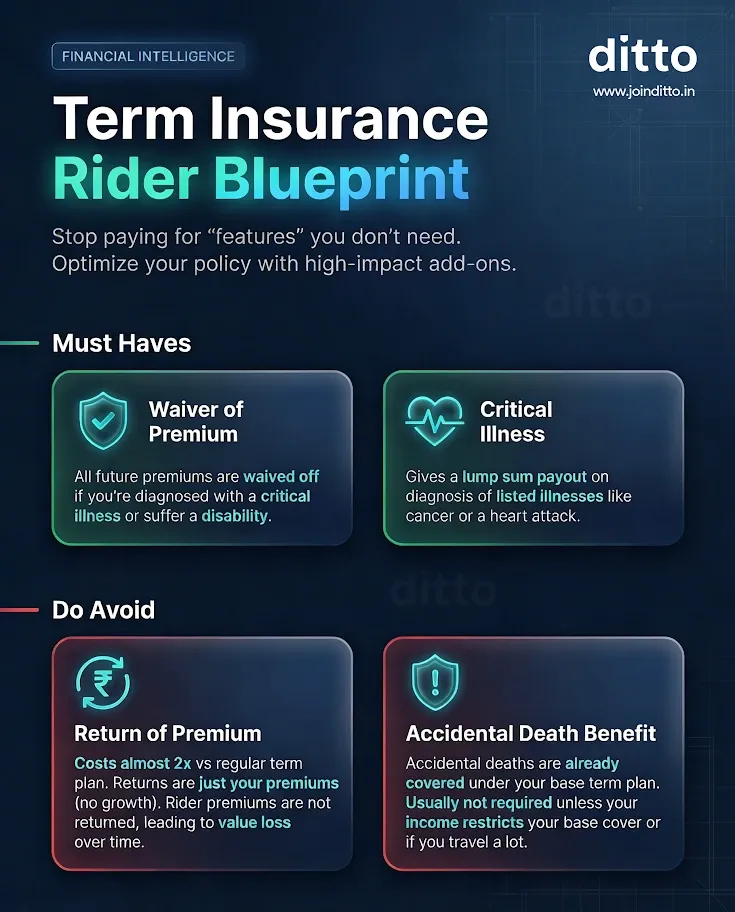
At Ditto, we don't recommend opting for this rider. The reason is simple. A standard term insurance policy already pays the full sum assured, regardless of whether death occurs due to illness or accident.
So, instead of paying extra for a rider that only covers accidental death, it's usually better to increase your base sum assured. That way, your family gets a higher payout no matter what causes your death. In most cases, a higher base cover offers broader and better value than an accidental death rider.
However, the rider can be considered a low-cost supplementary benefit for buyers with higher accident exposure, who cannot increase the base cover economically, or who have restrictions on base cover due to income or age.
If you’re confused about which riders to opt for, you can use the following infographic for reference:
Why Choose Ditto for Life Insurance?
At Ditto, we’ve assisted over 8,00,000 customers with choosing the right insurance policy. Why customers like Aaron below love us:

- No-Spam & No Salesmen
- Rated 4.9/5 on Google Reviews by 25,000+ happy customers
- Backed by Zerodha
- Dedicated Claim Support Team
- 100% Free Consultation
You can book a FREE consultation. Slots are running out, so make sure you book a call or chat on WhatsApp now!
Conclusion
The LIC accident benefit rider is inexpensive, but its coverage is narrow. It pays only when an accident independently causes death within 180 days and provides no benefit for disability, survival, or surrender. Because of these limitations, it works best as a supplement rather than a substitute for comprehensive life insurance.
For most families, adequate term insurance should remain the priority because it covers death regardless of the cause. If you prefer the insurer, you can choose their LIC term insurance plans.
Frequently Asked Questions
Last updated on: