




Overview
Choosing a ULIP isn't just about comparing projected returns. The product's charges, lock-in period, fund choices, and long-term flexibility can significantly impact how much wealth you ultimately build. Some plans also include additional benefits available only if you stay invested until maturity, making it important to understand the fine print before you invest.
In this review, we'll cover Bajaj Life Magnum Fortune Plus III's features, benefits, charges, fund options, and payouts. We'll also compare it with buying term insurance and investing in mutual funds separately to help you decide which option suits your financial goals.
What Is Bajaj Life Magnum Fortune Plus III?
Bajaj Life Magnum Fortune Plus III (UIN: 116L207V02) is a ULIP that lets you invest your premiums in market-linked funds while providing life insurance coverage throughout the policy term.
After deducting applicable charges, the remaining premium is allocated to the funds you choose, and your maturity benefit depends on the fund value at the end of the policy term. The plan also offers features such as loyalty additions, a maturity booster, a family benefit, and a Return of Mortality Charges (ROMC) at maturity, subject to policy terms.
Premium Bands in Bajaj Life Magnum Fortune Plus III: Prime, Prestige, and Priority
Note: From the 6th policy year, the premium allocation charge becomes 0% across all three bands. However, for half-yearly, quarterly, and monthly premium modes, Priority Band policyholders continue to pay a 2% allocation charge during policy years 1 to 5, meaning the waiver in years 4 and 5 is available only under the yearly premium mode.
Loyalty Additions and Return of Mortality Charge Explained
- Loyalty Additions: From the end of the 10th policy year, Bajaj Life allocates additional units to your regular premium fund every year until maturity. The addition is 0.50% of the average regular premium fund value of the last three policy years if your annual premium is below ₹1 lakh, and 0.70% if it is ₹1 lakh or more. Loyalty additions are not available if the policy is surrendered, discontinued, or made paid-up, and they do not apply to top-up premiums.
- Return of Mortality Charges (ROMC): At maturity, Bajaj Life refunds the total mortality charges deducted during the policy term (excluding any extra mortality loading) by adding the amount to your fund value. This benefit is available only if the policy remains in force until maturity and all due premiums have been paid.
- Other Maturity Benefits: The plan also offers a maturity booster of 0.25% to 1% of the average regular premium fund value of the last three policy years for eligible existing customers or those opting for auto-pay. Additionally, a family benefit of 0.5% or 1% is available if an eligible family member already holds a Bajaj Life policy. Both benefits are payable only at maturity.
- Death Benefit: If the policy is in force and all due premiums have been paid, the nominee receives the higher of the sum assured or the fund value for both the base policy and any top-up premiums, if applicable. The total death benefit is subject to a minimum of 105% of the total premiums received, including top-up premiums, up to the date of death. Partial withdrawals from the regular-premium fund during the two years preceding death reduce the sum assured used in this calculation.
Talk to an expert
today and
find
the right
insurance for you.


Fund Options and How to Track Bajaj Magnum Fortune Plus III NAV
Bajaj Life Magnum Fortune Plus III offers 29+ equity, debt, index, balanced, and liquid funds, allowing policyholders to choose investments based on their risk appetite and financial goals. You can invest through one of three portfolio strategies:
- Investor Selectable Portfolio Strategy: Choose and allocate your investments across one or more funds yourself, with unlimited free fund switches.
- Target Asset Allocation Strategy: Invest in two funds with a fixed asset allocation that is automatically rebalanced every quarter.
- Automatic Transfer Portfolio Strategy: Invest initially in a Bond Fund or Liquid Fund, with money transferred monthly to higher-risk funds of your choice.
You can track the Bajaj Magnum Fortune Plus III Net Asset Value (NAV) through Bajaj Life's Fund Performance and NAV History Portal, which provides the latest NAV, historical returns, and fund performance details. Since ULIP fund values are market-linked, the NAV changes daily and should be viewed as an indicator of current fund value rather than future returns.
Note: Bajaj Life Magnum Fortune Plus III does not offer a loan facility against the policy.
Charges You Pay Under Bajaj Life Magnum Fortune Plus III
- Premium Allocation Charge: 2% to 4% of the premium, depending on your premium band. Top-up premiums attract a 2% allocation charge.
- Policy Administration Charge: 2.1% of the annualized premium per annum or ₹500 per month, whichever is lower, deducted monthly.
- Fund Management Charge (FMC): Ranges from 0.95% per annum for debt and liquid funds to 1.35% per annum for most equity and index funds.
- Mortality Charge: Deducted monthly based on your age and life cover. The total mortality charges are refunded at maturity through the Return of Mortality Charges (ROMC), provided all policy conditions are met.
- Discontinuance/Surrender Charge: Applicable if the policy is discontinued during the first four policy years. It becomes nil from the fifth policy year onwards.
- Miscellaneous Charge: ₹100 per transaction for specific policy alterations, such as changing premium allocation.
Note: For a detailed list of charges, refer to the sales brochure (pages 13–15).
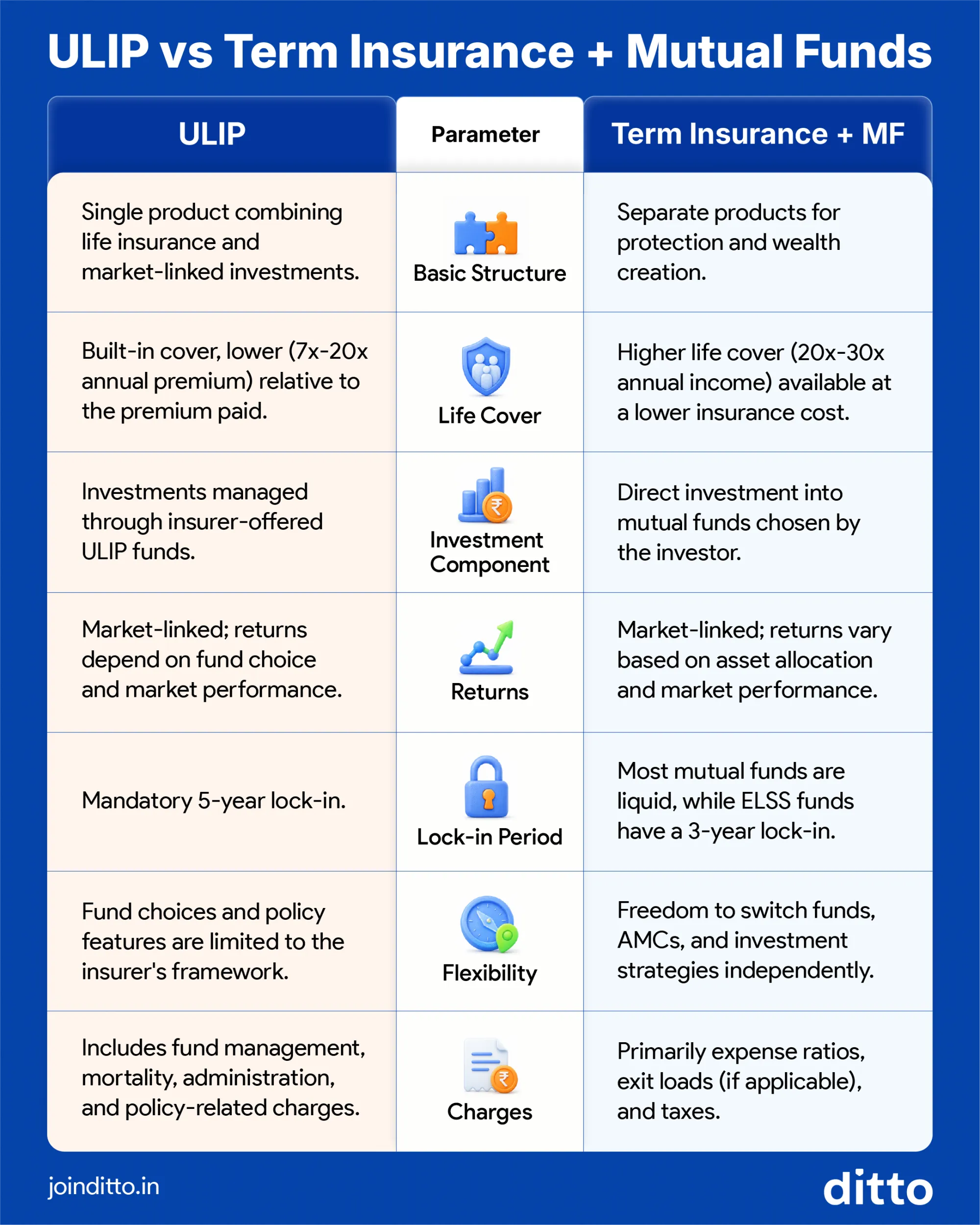
Bajaj Life Magnum Fortune Plus III vs. Term Insurance Plus Mutual Funds
Bajaj Life: Performance Metrics
Note: The figures shown above represent Bajaj Life's overall insurer-level performance, based on Bajaj Life’s public disclosures and IRDAI annual reports. For more such data, explore the Ditto Data Lab.
Pros and Cons of Bajaj Life Magnum Fortune Plus III
Who Should Buy Bajaj Life Magnum Fortune Plus III?
Bajaj Life Magnum Fortune Plus III may be suitable for investors who want to combine life insurance and market-linked investments in a single product and are comfortable staying invested for the long term.
It is particularly suited to those with a 15-year or longer investment horizon, who can pay premiums regularly, and who value features such as multiple fund options, portfolio strategies, and maturity-linked benefits.
However, this plan may not be suitable for everyone. If your priority is maximizing life insurance coverage, a standalone term insurance plan is likely to provide significantly higher cover at a lower cost.
Similarly, if you want greater investment flexibility, lower charges, or access to your money before the five-year lock-in ends, investing in mutual funds alongside a term plan may be a better option. Those who are unsure about continuing the policy until maturity should also note that several key benefits are forfeited on early exit.
Why Choose Ditto for Life Insurance?
At Ditto, we’ve assisted over 12,00,000 customers choose the right insurance policy. Why customers like Vijay love us:

- 100% Free Consultation
- No Spam. No Sales Pressure.
- Rated 4.9/5 on Google Reviews by 30,000+ Happy Customers
- Backed by Zerodha
- Dedicated Claim Support Team
- Compare Plans and Premiums with a Trusted Insurance Advisor
Confused about the right insurance? Speak to Ditto’s certified advisors for free, unbiased guidance. Book your call now or chat with us on WhatsApp. Slots fill up fast!
Ditto's Take
Bajaj Life Magnum Fortune Plus III can be a suitable choice if you specifically want a ULIP that combines life insurance with market-linked investments. However, for most people, we recommend keeping insurance and investments separate. A term insurance plan offers significantly higher life cover at a lower premium, while mutual funds provide greater flexibility and transparency for long-term wealth creation.
If you prefer Bajaj Life Insurance as your insurer, consider exploring its eTouch II or iSecure II term insurance plans for comprehensive life cover. You can then invest the premium savings in mutual funds to build wealth more efficiently.
Frequently Asked Questions
Last updated on: