



Quick Overview
Buying health insurance for the first time can be confusing. There are dozens of policies, insurers, and an overwhelming amount of fine print. And the worst time to discover your policy has a loophole is at hospital discharge, when you're already stressed and exhausted.
In this health insurance buying guide, we’ll walk you through the main things to check before you buy a policy.
How Much Health Insurance Cover Do You Actually Need?
For most people, the right cover depends on your city, hospital preference, age, medical history, and who you want to insure. A ₹15–25 lakh base cover works for many buyers for three reasons:
- The rate of medical inflation in India has reached up to 12.9% in 2025-26.
- Black swan events, like bone marrow transplants (for cancer), may turn your financial situation upside down.
- Difficulty in increasing your sum insured in the future due to insurer scrutiny and rejection, especially if you’re diagnosed with a serious medical condition.
Keep in mind that premiums increase with age and medical inflation, so it’s better to choose adequate coverage early. You can also refer to our guide on how much health insurance do I need to learn more about the ideal coverage.
Key Policy Features to Check Before Buying
- Pre- and Post-Hospitalization Care: Most treatments involve expenses well before and after the actual admission. Look for coverage for at least 60 to 90 days pre-hospitalization and around 180 days post-hospitalization.
- Daycare Treatments: Many modern procedures, such as chemotherapy, dialysis, and cataract surgery, don't require 24-hour admission. Check that your policy covers these treatments without any sub-limits.
- AYUSH: Check whether the health insurance policy covers AYUSH (Ayurveda, Yoga, Unani, Siddha, Homeopathy) treatments at government-recognized or NABH/QCI-accredited hospitals. It’s also an IRDAI mandate to have 100% AYUSH coverage in modern plans.
- Domiciliary and Home Care: Some treatments may need to be given at home when the patient cannot be moved to a hospital safely or when hospital beds are unavailable. Check whether the policy covers domiciliary and home care treatment, along with the conditions, limits, and approved treatment types under this benefit.
- Consumables, Modern Treatments, and Ambulance Cover: Check whether the policy covers consumables such as gloves and PPE, as these can add to your bill. Ensure modern treatments, such as robotic surgeries and advanced procedures, are included without strict limits. Also, review ambulance cover (road and air), including any caps or conditions.
- Health Checkups: Some health insurance plans offer free annual or periodic preventive health checkups, even if you do not make a claim. Check how often this benefit is available, whether it applies to all insured members, and whether there are any conditions for use.
- No Room Rent Restrictions: Some policies cap room eligibility by category or as a percentage of the sum insured (say, single AC room only or 1% of sum insured). If you're admitted to a higher-category room, the insurer proportionately reduces the entire hospital bill.
- No Co-Payment: A co-pay means you pay a certain percentage of every claim whenever you’re hospitalized. That sounds modest until you're staring at a ₹5 lakh bill. Avoid co-payment unless it's mandatory due to age or health conditions.
- No Disease-Wise Sub-Limits: Some policies offer a ₹10 lakh cover but cap payouts at ₹50,000 to ₹1 lakh for specific conditions like cataracts or joint replacements, to name a few. This quietly renders a large cover almost useless for the most common hospitalizations.
- Bonus and Restoration Benefits: A good policy should offer at least 100% no-claim bonus, an extra cover added each year you don't make a claim. Most modern plans offer this facility irrespective of claims. They should also provide 100% restoration, a feature that comes into play if your sum insured runs out mid-year.
- Riders and Add-ons: Many plans offer optional add-ons to enhance coverage, such as outpatient department (OPD) cover, or maternity benefits. Review these carefully to understand if they add real value based on your needs.
- Cashless vs. Reimbursement: Check the insurer’s cashless hospital network, as this determines whether you can avoid paying upfront during hospitalization or need to go through reimbursement later.
Common Exclusions and Waiting Periods You Must Know
How to Compare Plans and Choose the Right Health Insurance
You can compare health insurance plans easily by focusing on comprehensive coverage, affordability, and valuable benefits. It depends on the type of plan you want (individual, family floater, senior citizen, or super top-up). The process also involves analyzing the insurer based on their claims performance, complaints received, business scale, and network hospital range.
To learn more about additional factors, refer to our guide on how to choose health insurance.
Ideal Metrics to Compare Insurers
At Ditto, we consider 3-year average performance metrics because it gives us a comprehensive view of how an insurer performs.
Why Choose Ditto for Health Insurance?
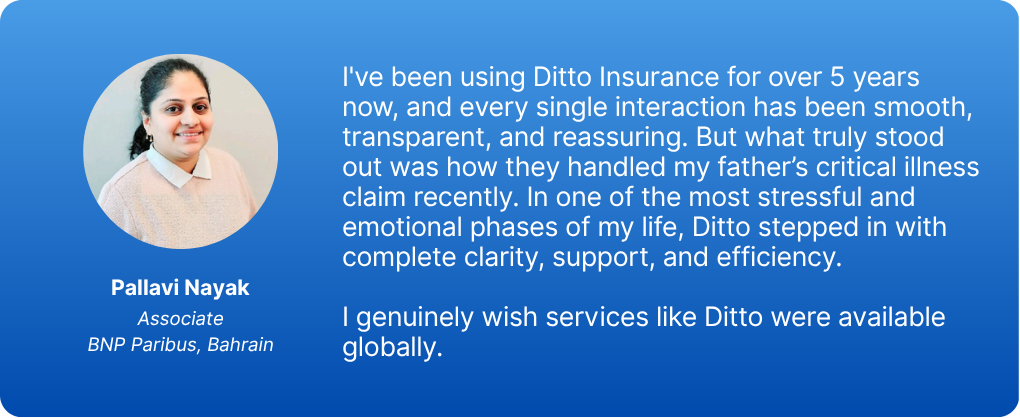
At Ditto, we’ve assisted over 8,00,000 customers with choosing the right insurance policy. Why customers like Pallavi below love us:
- No-Spam & No Salesmen
- Rated 4.9/5 on Google Reviews by 15,000+ happy customers
- Backed by Zerodha
- Dedicated Claim Support Team
- 100% Free Consultation
Confused about the right insurance? Speak to Ditto’s certified advisors for free, unbiased guidance. Book your call or chat on WhatsApp with us now!
Conclusion
There are several things to keep in mind before buying health insurance. However, the primary ones include analyzing the insurer metrics, comparing plans based on their features, and checking exclusions and limitations. A good policy bought after thorough research is worth far more than the best policy bought in a hurry that you don’t know anything about.
It is always better to buy health insurance early because, as you grow older and develop health conditions, insurers may apply stricter underwriting standards. In some cases, this can also lead to exclusions, higher premiums, or even policy rejection. If confused, you can always refer to this health insurance checklist for further guidance.
Frequently Asked Questions
Last updated on: