

Overview

Preventive Health Checkup Tests for Health Insurance are designed to catch health issues before they turn serious. Most standard packages cover a basic set of tests, including a complete blood count (CBC), lipid profile, blood sugar, liver and kidney function tests, thyroid test, and urinalysis. Many plans also extend to ECGs, X-rays, and gender-specific screenings such as Pap smears or PSA tests. 

Many health insurance plans offer this as a complimentary wellness benefit, often linked to your policy's claim-free years and sum insured, and some insurers even arrange doorstep sample collection. 

That said, the specific tests covered and how often you can use them without paying out of pocket vary by your insurer and plan tier.

To get the exact details, check your policy document or your insurer's app to confirm what you're eligible for and where you can get tested.

Most of us are quick to service our car every few months, but somehow keep putting off our own health checkup until "sometime next year." Part of the reason is simple. When nothing hurts and nothing feels off, a checkup doesn't feel urgent. 

But several common health issues, like rising blood sugar or increasing cholesterol, tend to build up slowly over the years without giving any real indication until they've reached a stage where treatment becomes complicated and expensive.

This is exactly why insurers began including preventive health checkup tests for health insurance. It gives you a reason to get tested regularly, so small changes in your health are caught early, while they're still easy to manage.

This guide covers what these tests actually include, how a preventive checkup differs from a diagnostic test, which tests matter at each age, which plans offer this benefit, and exactly how the claims process works.

What Is a Preventive Health Checkup?

A preventive health checkup in health insurance is a set of routine medical tests done while you have no symptoms, meant to catch things like high blood sugar or an early thyroid imbalance before they turn into a real problem. It is a yearly benefit built into many health insurance plans, and unlike most other insurance features, you use it while you are still healthy, not after something goes wrong.

It is worth knowing about one more term that often gets confused with this. A Pre-Policy Medical Checkup (PPMC) happens before your policy is even issued and exists purely so the insurer can assess your risk before covering you. Not every insurer asks for one. It is entirely up to the insurer to decide whether a PPMC is needed, usually based on your age, the sum insured you have chosen, or your declared medical history. 

Preventive Tests vs. Diagnostic Tests and Why It Matters for Your Claim 

Unlike the preventive checkup, a diagnostic test is ordered because something is already wrong, to investigate a symptom, confirm a suspected condition, or monitor an existing one. Insurers treat the two very differently at claim time.

Preventive tests fall under the annual health checkup benefit. Diagnostic tests are usually only paid for when linked to a hospitalization, either during admission or within the pre- and post-hospitalization window (typically around 30 days before and 60 days after, though this varies by plan).

A standalone diagnostic test at a lab, unconnected to any hospitalization, generally isn't claimable unless your plan includes a separate Outpatient Department (OPD) or diagnostic cover. Most policies also exclude admissions arranged primarily for tests and evaluations that didn't actually require hospitalization.

Ditto’s Take

Use your preventive checkup benefit for routine screening, rely on the pre- or post-hospitalization window when tests are linked to an admission, and only expect outpatient diagnostics to be covered if you've specifically bought an Outpatient Department (OPD) add-on. 

Common Blood and Metabolic Tests Included
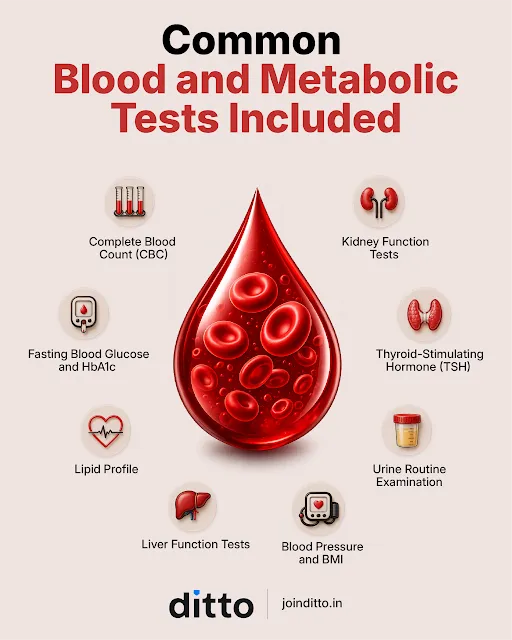
Common Blood and Metabolic tests included

These form the baseline for nearly every packaged checkup sold in India, and they are also the tests most insurers explicitly list in their policy wording when the benefit is offered against a defined list rather than a flat reimbursement amount.

Cardiac, Cancer, and Organ-Specific Screening Tests 

Beyond the basic blood panel, a comprehensive preventive checkup includes tests aimed at specific organs and disease risks, usually recommended once you reach a certain age or have a relevant family history.

General Organ and Cardiac Screening

    • ECG, to check the heart's electrical activity 
    • TMT (Treadmill Test), a stress test for cardiac risk, is typically used for those over 40 or with a family history of heart disease 
    • 2D Echo, an ultrasound of the heart, for those with existing risk factors 
    • X-ray
    • Abdominal Ultrasound, to check the liver, kidneys, and other organs 

Age- and Gender-Specific Screening

    • PSA test for men, typically from age 45 to 50, or earlier with a family history 
    • Mammogram for women, generally from age 40 onward 
    • Colonoscopy, generally from age 45 onward, or earlier with a family history
    • Bone density (DEXA) scan, particularly relevant post menopause and for adults over 60

Most insurance-backed preventive packages stick to the basic blood and metabolic panel. These organ-specific and cancer screening tests are more commonly found in comprehensive packages purchased directly from diagnostic chains or hospitals, though a handful of higher-tier plans do include these benefits.

Age GroupWhat Gets AddedWhy
20sCBC, fasting glucose and HbA1c, lipid profile, annual eye and dental check Establishing a baseline 
30sThyroid function, liver function tests, vitamin B12 and D, BP, and BMI at every visitFirst signs of lifestyle-related conditions often appear 
40s and beyondFull metabolic and organ panel, ECG and TMT, PSA, mammogram, colonoscopy A full-body checkup becomes important, not optional 
60 and above Standard panel every 6 to 12 months, bone density, vision and hearing, cognitive screening Age-related organ decline and medication interactions need closer monitoring 

Treat whatever your insurer's free checkup covers as a baseline, not a substitute for what your doctor actually recommends once you are past your 40s. Insurer panels are built to be broadly useful across a large pool of policyholders, not tailored to your personal risk profile.

CTA
PlanBuilt-In or Add-OnWhat You Get
HDFC ERGO Optima Secure+Built-in (available after the first renewal)        You can pick your own tests up to the applicable sub- limit, and this is settled through reimbursement. Individual plans range from ₹2,000 to ₹8,000, and family floater plans from ₹5,000 to ₹15,000, depending on the sum insured.
Care SupremeAdd-on (available from the 31st day)An annual checkup for a defined list of tests, based on your sum insured, is available only cashless at the insurer's empaneled facilities.
Aditya Birla Activ One MAX Built-in (available from day 1)A full-body checkup once a year, covering tests based on the sum insured, and this only works cashless at partner facilities. 
ReAssure 2.0 Platinum+Built-in (available from day 1)A defined list of tests, booked cashless through the insurer's app at partner facilities. The limit is ₹500 per ₹1 lakh of sum insured, capped at ₹5,000 for individual plans and ₹10,000 for family floater plans.
Star Health Super Star Add-on (available from day 1)Up to 1% of the sum insured, capped at ₹25,000 a year, can be booked cashless via the insurer's app. The same limit can also be used toward vaccination expenses.
ICICI Lombard ElevateAdd-on (available from day 1)0.5% of sum insured or ₹5,000, whichever is lower, usable once every policy year, cashless through the insurer's network providers. 
SBI Super Health Platinum InfiniteBuilt-in (available from day 1)A fixed amount up to ₹10,000, settled through reimbursement, with all tests required to be completed on the same day.

How to Claim These Tests Under Health Insurance

How you actually claim your preventive checkup depends entirely on how your insurer has structured the benefit. It generally comes down to two models, and which one your plan uses changes how much effort is involved.

Cashless Claim

This is where the insurer has a tie-up with specific network hospitals or diagnostic centers, and you book the checkup directly, often through the insurer's own app, without paying anything upfront. 

Reimbursement Claim

This is where you get the tests done at a lab or hospital of your choice, pay for them yourself, and then submit the bills and reports to the insurer for repayment up to your policy's limit. 

Why Choose Ditto for Health Insurance?

At Ditto, we’ve assisted over 8,00,000 customers with choosing the right insurance policy. Why customers like Pallavi below love us:
Preventive Health Checkup Tests for Health Insurance
    • No-Spam & No Salesmen
    • Rated 4.9/5 on Google Reviews by 25,000+ happy customers
    • Backed by Zerodha
    • Dedicated Claim Support Team
    • 100% Free Consultation

Confused about the right insurance? Speak to Ditto’s certified advisors for free, unbiased guidance. Book your call now or chat with our advisors on WhatsApp.

Conclusion

Most people either ignore this benefit entirely or assume it works the same way across every plan, and both mistakes cost you. Some insurers offer a fixed reimbursement amount and let you choose your own tests. Others lock you into a specific list that only works with cash at a network lab. Not knowing which one applies to you is why this benefit goes unused year after year. 

If your plan already includes this, use it every year regardless of how you feel, since you're paying for it through your premium either way. Most checkup benefits lapse if unused in the policy year, so skipping it does not carry the value forward, it just forfeits it. If it's structured as an add-on, weigh the extra cost against a private checkup, in most cases, the rider still works out cheaper.

As your next step, check your policy document to see exactly how your plan structures this, fixed amount or defined list, cashless or reimbursement, and match the tests you actually get against what makes sense for your age, not just what the insurer defaults to.

Frequently Asked Questions

Are preventive health checkup packages worth it for health insurance holders?

Yes, in most cases, though the value depends on how your plan offers it. If it is built in, you are already paying for it through your base premium, so using it costs nothing extra. If it is an add-on, the small extra cost is usually still cheaper than getting tests done independently, helping you catch problems like high blood sugar early.

How often should a preventive health checkup be done for insurance purposes?

Most plans allow one preventive checkup per policy year, which lines up well with general medical advice for adults under 40. People in their 40s and above, or anyone with a family history of a chronic condition, often benefit from checking key markers like blood pressure and blood sugar more frequently than once a year, even if the insurer only reimburses one checkup annually.

Which preventive health tests are most important for someone with a family history of diabetes?

Fasting blood glucose and HbA1c should be the priority, since HbA1c reflects average blood sugar over the past few months rather than a single day. A lipid profile and kidney function tests are also worth adding, since diabetes risk often goes hand in hand with cholesterol and kidney-related complications.

Are cancer screening tests included in a standard preventive health checkup?

Not usually. Most insurer-backed checkup benefits stick to a core panel of blood and metabolic tests. Cancer screenings such as a mammogram, pap smear, or PSA test are more commonly found in comprehensive packages bought directly from diagnostic chains or hospitals, though a few higher-tier plans do extend coverage to include some of these.

Can I claim a preventive health checkup separately from a hospitalization claim?

Yes. A preventive health checkup is treated as a distinct wellness benefit and is claimed on its own, completely separate from any hospitalization claim. Using it does not draw down your sum insured or affect your No Claim Bonus.

Do preventive health checkup tests need a doctor's prescription for insurance?

Generally no. Since these tests are done while you have no symptoms, most insurers do not require a doctor's prescription to claim them. A prescription is necessary only when a test is performed for diagnostic purposes, tied to an actual symptom or condition.

Are preventive health checkup packages covered under health insurance for senior citizens?

Yes, and this benefit is often more relevant for seniors, since age-related screening needs are higher. Some plans even allow more frequent checkups or a wider test panel for senior citizens, though it is worth confirming this directly against the specific plan's policy wording.

How much does a preventive health checkup rider cost compared to paying out-of-pocket?

A standalone full-body checkup in the open market typically costs ₹1,000 to ₹5,000, depending on the tests included. Compare that with the annual rider cost. Care Supreme adds roughly ₹400 to ₹1,500 a year, while ICICI Lombard Elevate charges about ₹1,250 a year, making the rider far cheaper than paying for an out-of-pocket checkup every year.

Why do insurers offer a preventive health checkup benefit in their policies?

Insurers offer preventive health checkup benefits because early detection protects you and reduces claims for everyone. Regular checkups catch risks like high blood sugar or cholesterol before they lead to costly conditions such as heart disease or kidney damage. They also give your doctor real data instead of just symptoms, leading to better advice and fewer emergency hospital visits.

Does a preventive health checkup qualify for tax benefits?

Under Section 80D of the old tax regime, preventive health checkup expenses are deductible up to ₹5,000, and this sits within your overall 80D limit rather than on top of it. This deduction applies to checkups you pay for yourself. If your insurer covers the checkup on a cashless basis or reimburses it, there is usually no out-of-pocket cost left to claim.

Last updated on: