



Overview
You've probably had this thought at least once. "I feel fine. Why would I need a checkup?" And then a friend's parent gets a diabetes diagnosis out of nowhere, or a colleague finds out their cholesterol has been increasing for years without a single symptom.
Health problems rarely announce themselves early. That's exactly why insurers started adding preventive checkups into health insurance plans, so you catch things while they're still easy to fix, not after they've become a huge hospital bill. But how does this benefit work inside a health insurance policy, and is it actually worth using?
This guide covers what a preventive health checkup in health insurance means, the plans that offer it, its advantages, the Section 80D tax deduction, and which tests it typically includes.
What Is Preventive Health Checkup in Health Insurance?
A preventive health checkup in health insurance is a routine screening that helps catch health risks early, before symptoms become serious. Insurers usually offer this benefit in two ways: as a built-in feature in the base policy or as a paid add-on.
Depending on the plan, you may be able to use it cashless at network facilities or pay upfront and claim reimbursement later.
Common Tests and Diagnostics Covered Under Preventive Health Checkup
- Blood Vitals: Complete Blood Count (CBC), Fasting Blood Sugar, and HbA1C.
- Organ Functions: Kidney Function Test (KFT) and Liver Function Test (LFT).
- Metabolic & Heart Screenings: Lipid profile (cholesterol), Blood Pressure (BP), and ECG.
- General Tests: Urine routine analysis and chest X-rays.
Some high-end plans may also cover advanced screenings such as mammograms or Pap smears.
Best Health Insurance Plans That Cover Preventive Checkups
Note: In the above table, SI refers to the sum insured.
At Ditto, we follow a policy and insurer rating framework for every plan we recommend. We rate them across three dimensions:
- Features (45%): Room rent rules, co-pays, waiting periods, restoration, consumables cover, and more
- Insurer Reliability (45%): Claim settlement ratio, complaint volume, hospital network, and servicing model
- Premium Affordability (10%): How reasonably priced the plan is for a standard profile
From the plans that meet our benchmark, we've shortlisted those that also offer meaningful health check-up benefits, whether as an in-built feature or a worthwhile add-on.
Other Plans Worth Looking at for Health Checkup Benefits
Talk to an expert
today and
find
the right
insurance for you.



Benefits of Preventive Health Checkup in Health Insurance
Catches Health Risks Early
A preventive health checkup can help spot early signs of diabetes, high blood pressure, high cholesterol, kidney issues, or liver abnormalities before symptoms become obvious. This gives you time to act early with lifestyle changes, medication, or further tests before the condition becomes harder and costlier to manage.
Reduces Long-Term Medical Costs
A routine checkup does not guarantee savings, but it can help you avoid larger medical bills later. For example, treating borderline sugar or cholesterol early is usually far cheaper than dealing with complications like heart disease, kidney damage, or emergency hospitalization.
Improves Doctor Consultations
A checkup report gives your doctor actual data to work with, rather than relying solely on symptoms. Tests like CBC, fasting blood sugar, lipid profile, KFT, LFT, routine urine test, ECG, and chest X-ray can help your doctor identify risks and recommend next steps more accurately.
Section 80D Tax Benefit for Preventive Health Checkup
80D Limit: The health checkup deduction of ₹5,000 per financial year falls within your total Section 80D limit, not on top of it.
Note: The senior-citizen threshold applies if even one person in a block is 60 years or older during a financial year.
So if you're under 60 with a ₹22,000 premium, only ₹3,000 more is left for checkups before you hit ₹25,000. If you and your parents are all senior citizens, the combined deduction can reach ₹1,00,000. This benefit applies only if you file under the old tax regime.
From 1 April 2026, this will move to Section 126 of the Income Tax Act, 2025.
80D Proof: Unlike your premium, which needs a non-cash payment mode, checkup expenses can be paid in cash and still qualify. Keep your bill or report as proof.
Salaried employees submit it with their investment declaration, and self-employed taxpayers can retain it for their records.
Why Is a Preventive Health Checkup Important as Part of Your Health Insurance?
For You: If your family has a history of diabetes, a free annual checkup means tracking your sugar levels every year at no extra cost, easing anxiety. It also builds a verified medical timeline, so years later an insurer can't easily claim you hid a pre-existing condition.
For Insurers: Preventive checkups are a relatively low-cost benefit that can help reduce long-term claim liability, strengthen customer trust, and support better risk management. Since IRDAI has increasingly encouraged wellness-oriented health insurance products, offering preventive care also helps insurers align with the regulator’s broader push toward proactive health management. There is also a risk-monitoring angle: periodic health data can help insurers identify deteriorating health indicators early and take a closer look during renewal or underwriting.
Worth Knowing
Is Preventive Health Checkup Covered by Insurance Enough?
For young, healthy adults, the basic blood and urine work most plans offer is usually enough. But as you age, your screening needs grow. Older adults often need more in-depth tests, such as advanced cardiac screenings or cancer marker tests, that standard checkups typically skip. Treat the free annual checkup as a baseline, not a substitute for what your doctor recommends past your 40s.
Why Choose Ditto for Health Insurance?
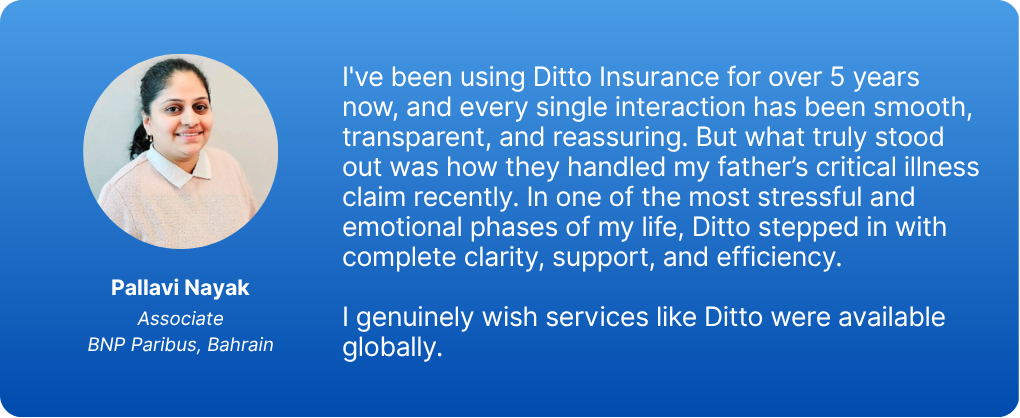
At Ditto, we’ve assisted over 8,00,000 customers with choosing the right insurance policy. Why customers like Pallavi below love us:
- No-Spam & No Salesmen
- Rated 4.9/5 on Google Reviews by 25,000+ happy customers
- Backed by Zerodha
- Dedicated Claim Support Team
- 100% Free Consultation
Confused about the right insurance? Speak to Ditto’s certified advisors for free, unbiased guidance. Book your call or chat on WhatsApp with us now!
Ditto's Take
A preventive health checkup in health insurance is easy to ignore until you need it. If it's included in your plan, you should use it every year, since it costs nothing and could catch something early. If it's an add-on, the math usually favors adding it: a rider typically costs less than one private lab checkup.
As your next step, check your policy document or app to see whether this is built in or a rider. If you don't have it, consider adding it at renewal, and keep every checkup bill handy because it's valid proof for your Section 80D claim, regardless of how you paid.
Frequently Asked Questions
Last updated on: