



Overview
Life Insurance Corporation of India (LIC) has introduced three new insurance plans, giving customers more options to plan for health expenses, retirement income, and financial protection. Among them, LIC Health Shield (UIN: 512N369V01) focuses on fixed payouts for eligible hospital stays, surgeries, and specified medical conditions.
But how useful is this plan when hospital bills can vary widely?
In this LIC health insurance plan review, we break down its key features, sample premiums, limitations, and eligibility criteria to help you understand whether it suits your healthcare needs.
Key Features and Riders of LIC Health Shield Plan
1) Initial Daily Benefit
The minimum Initial Daily Benefit is ₹2,500 per insured person, while the maximum is ₹10,000 per life, subject to the policy’s limits and eligibility conditions.
The spouse’s benefit cannot exceed the principal insured’s benefit. Parents’ and children’s benefits cannot exceed the spouse’s benefit, or the principal insured’s if there is no spouse. All covered parents must have equal benefits, as must all covered children.
2) Hospital Cash Benefit (HCB)
If an accident or illness first occurs or manifests on or after the cover start date and during the cover period, resulting in hospitalization for more than 24 consecutive hours, the insured becomes eligible for the daily hospital cash benefit, subject to policy terms.
- General or Special Ward: The Applicable Daily Benefit is paid for each 24-hour period or eligible additional stay exceeding four continuous hours, after the initial 24 hours.
- Intensive Care Unit (ICU): Twice the Applicable Daily Benefit is paid for each 24-hour period or eligible additional stay exceeding four continuous hours in the ICU, after the initial 24 hours.
- Combined ICU and Non-ICU Stay: If ICU and non-ICU stays occur within the same 24-hour period, the ICU benefit applies if the ICU stay lasts at least four continuous hours.
3) Major Surgical Benefit (MSB)
If an insured undergoes a medically necessary surgery listed in the policy annexure due to an eligible accident or illness during the cover period, LIC pays the specified percentage of the Major Surgical Benefit sum assured, regardless of actual treatment costs. The sum assured equals 100 times the Applicable Daily Benefit. The feature also offers additional benefits.
- Ambulance Benefit: If a Major Surgical Benefit claim is payable and the insured incurs emergency ambulance expenses, LIC pays an additional lump sum of ₹1,000 towards ambulance costs.
- One-Year Premium Waiver: If a Category 1 or Category 2 surgery qualifies for MSB, base policy premiums for all insured members are waived for one year from the next applicable premium due date. Rider premiums remain payable. This benefit applies only once per policy year.
- Major Surgical Benefit Restoration: If the MSB sum assured is exhausted during a policy year, a subsequent eligible surgery may be covered if it arises from a different cause, falls under a different category, and involves a different surgical procedure, subject to policy terms.
4) Day Care Procedure Benefit (DCPB)
If an insured undergoes a medically necessary day care procedure listed in the policy annexure due to an eligible accident or illness during the cover period, LIC pays a lump sum equal to five times the Applicable Daily Benefit, regardless of actual treatment costs.
5) Other Surgical Benefit (OSB)
If an insured undergoes a medically necessary surgery not covered under MSB or DCPB due to an eligible accident or illness, LIC pays 2.5 times the Applicable Daily Benefit for each eligible 24-hour hospitalization period or qualifying additional stay.
6) Medical Management Benefit (MMB)
If an insured requires inpatient hospitalization for dengue, malaria, pneumonia, pulmonary tuberculosis, or viral hepatitis A that first occurs during the cover period, LIC pays a lump sum equal to 2.5 times the Applicable Daily Benefit, regardless of actual treatment costs.
7) No Claim Benefit
For every three consecutive claim-free policy years, LIC increases the insured’s Applicable Daily Benefit by 10% of the Initial Daily Benefit. This increase takes effect at the end of the third claim-free year, with no maximum limit on the total benefit accumulated throughout the policy term. Although there is no stated accumulation cap, the 15-year policy term limits the practical increase to 40% of the Initial Daily Benefit.
8) Health Check-Up Benefit
Under an active policy, each insured becomes eligible for a health check-up benefit after the first three policy years. The benefit is available once every three years thereafter, subject to policy conditions. LIC reimburses actual health check-up expenses up to half of the Applicable Daily Benefit.
9) Auto Health Cover (AHC) Benefit
If the original principal insured dies, LIC waives all future base policy premiums for the surviving insured members from the policy anniversary that falls on or after the date of death. The policy continues with a new successive principal insured and the remaining covered members, subject to policy terms.
10) Extended Hospitalization Benefit
If an insured person undergoes continuous inpatient hospitalization for more than 30 days due to an eligible accident or illness, the policy pays a lump sum equal to 10 times the Applicable Daily Benefit, regardless of actual expenses.
This benefit is paid in addition to other eligible policy benefits for the same hospitalization. It is payable once per policy year and has a lifetime limit of 10 payments per insured person, subject to policy terms.
Note: The plan carries certain limitations and conditions with the benefits offered. You can explore pages 15 to 22 of the official brochure for more information.
Talk to an expert
today and
find
the right
insurance for you.


Riders Offered
1) New Term Assurance Rider
New Term Assurance Rider provides a lump sum payment if the life assured dies during the rider term, subject to the rider's conditions. The rider requires an additional premium because LIC Health Shield’s base policy has no lump sum death benefit. Its cover is capped, so it cannot replace adequate standalone term insurance.
The rider sum assured cannot exceed the Major Surgical Benefit sum assured. Both the policy and the rider must have at least five years remaining, and the life assured must be under 60 at the relevant policy anniversary.
2) Accident Benefit Rider
If this rider is selected, the Accident Benefit sum assured is payable in the event of the life assured’s accidental death, subject to policy terms. The original policyholder and/or insured spouse can add this rider to an in-force policy during the base policy's cover period.
At least five years of premium payment must remain for both, and the life assured must be under 65 at the relevant policy anniversary. Coverage lasts for the remaining premium-paying term or until 70 minus the entry age, whichever is shorter.
Eligibility Criteria for LIC Health Shield Plan
Sample Premiums by Age
The illustration below is taken from the official policy brochure. It shows sample annual premiums for an Initial Daily Benefit of ₹5,000 across different ages and standard lives covered under a single policy purchased offline. There is no LIC health insurance premium chart available for the plan.
Note: Actual premiums can vary based on age, the number of insured members, selected benefits, and underwriting.
The following illustration shows how claims work and how payouts are calculated.
Suppose a 45-year-old policyholder is diagnosed with lumbar spinal stenosis (narrowing of the spinal canal) and needs decompression surgery, also called a laminectomy or foraminotomy.
Under LIC Health Shield, this procedure falls under Category 4, which pays 20% of the Major Surgical Benefit sum assured.
Let's assume:
- Applicable Daily Benefit: ₹5,000
- Major Surgical Benefit Sum Assured: ₹5 lakh (100 × ₹5,000)
- Hospitalization: 4 complete days in a non-ICU room
- Total Hospital Bill: ₹8 lakh (hypothetical)
Here's How LIC's Payout Would Work:
So, even with an ₹8 lakh hospital bill, LIC would pay only ₹1.2 lakh under these two benefits. The remaining ₹6.8 lakh would need to come from another health insurance policy or the policyholder's own pocket.
LIC: Performance Metrics
Note: The figures in the table are based on LIC's overall insurer-level performance and are not attributed to LIC health insurance plans. The data is sourced from LIC's public disclosures and IRDAI annual reports. To know more about such statistics, visit Ditto Data Lab.
Disclaimer: IRDAI permits life insurers to offer health insurance products on a benefit basis. LIC New Cancer Cover pays predefined benefits upon meeting specified policy conditions rather than reimbursing actual medical expenses. This allows LIC to offer the plan as a life insurer.
Pros & Cons of LIC Health Shield Plan

Pros of LIC Health Shield
Predictable Premiums and Useful Daily Benefits
Premium rates remain guaranteed for the 15-year term. The Initial Daily Benefit can reach ₹10,000, with double benefits for eligible ICU stays.
Broad Surgical Coverage
The plan covers 263 major surgeries and 243 day-care procedures. It also offers MSB restoration and a one-year base premium waiver after eligible Category 1 or 2 surgeries.
Additional Support for Serious Conditions
Quick Cash can provide an advance for eligible major surgeries. Other fixed benefits cover specified medical conditions and eligible hospital stays.
Family Protection Under One Policy
Family members can be covered under a single contract. The Auto Health Cover benefit waives future base premiums for surviving members after the original principal insured’s death.
Benefits Can Grow Over Time
The No Claim Benefit increases the Applicable Daily Benefit after every three consecutive claim-free years.
Discounts
Offers rebates for higher Daily Benefit amounts and online purchases, subject to policy terms.
Cons of LIC Health Shield
- Not a Comprehensive Hospitalization Plan: This is a fixed-benefit policy, not an indemnity plan. It does not provide a large general-purpose sum insured to reimburse hospital bills. LIC Health Shield does not meet every family’s healthcare needs. Compare it with other LIC health insurance plans for family before choosing coverage.
- Important Hospital Expenses Are Excluded: Pre- and post-hospitalization expenses are not covered. Treatment must take place in India, and maternity is excluded except for ectopic pregnancy.
- Payouts Depend on Defined Benefits: Most payments are calculated as fixed multiples of the Applicable Daily Benefit. Surgery payouts depend on the listed procedure and its assigned category, so benefits may not match actual expenses.
- Waiting Periods Can Delay Claims: A 90-day waiting period applies to general sickness, while many specified procedures have a 24-month waiting period. Pre-existing conditions are covered only if disclosed and accepted by LIC, subject to policy terms.
- Some Additional Benefits Are Limited: The health check-up benefit is capped at half the Applicable Daily Benefit and payable once in 3 years. The ambulance benefit is only ₹1,000 when an eligible Major Surgical Benefit claim is payable. Quick Cash is not equivalent to a full cashless hospital settlement.
- Coverage Has a Fixed Duration: The policy term is 15 years. Don't treat it as lifelong, renewable hospitalization cover, especially when planning for healthcare costs in retirement.
Why Choose Ditto for Health Insurance?
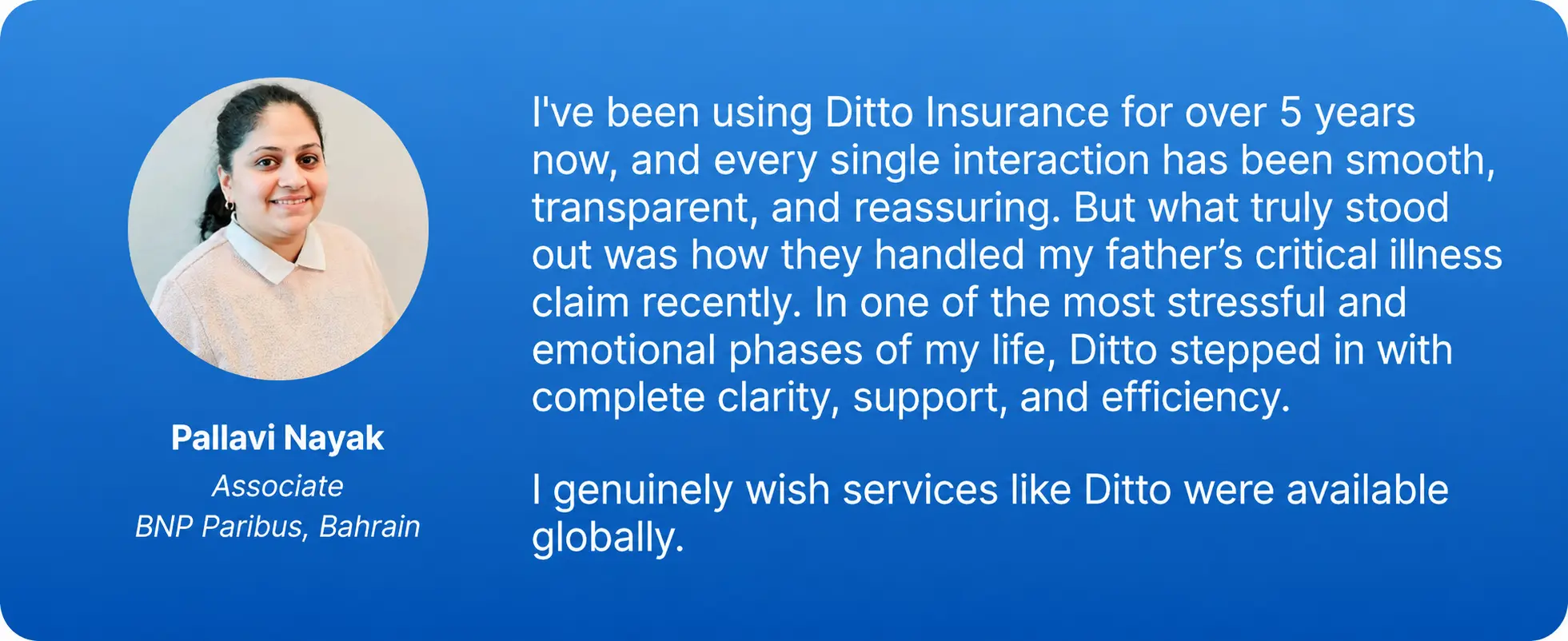
At Ditto, we’ve assisted over 12,00,000 customers choose the right insurance policy. Why customers like Pallavi love us:
- 100% Free Consultation
- No Spam. No Sales Pressure.
- Rated 4.9/5 on Google Reviews by 30,000+ Happy Customers
- Backed by Zerodha
- Dedicated Claim Support Team
- Compare Plans and Premiums with a Trusted Insurance Advisor
Confused about the right insurance? Speak to Ditto’s certified advisors for free, unbiased guidance. Book your call now or chat with us on WhatsApp. Slots fill up fast!
Conclusion
LIC Health Shield is a fixed benefit policy that offers useful cash support during hospitalization and eligible surgeries. Its family continuation benefit and surgical restoration add value, especially for families seeking predictable benefits alongside existing health cover.
However, a ₹5,000 Daily Benefit does not equal ₹10 lakh or ₹15 lakh of regular health insurance. LIC pays predefined amounts based on eligible hospital stays and procedures, not the actual hospital bill. These payouts are also subject to annual limits, lifetime caps, waiting periods, and policy exclusions.
Treat LIC Health Shield as supplementary protection, not a replacement for comprehensive health insurance. Compare the best health insurance plans for adequate hospitalization cover, then consider Health Shield for additional cash benefits during medical emergencies.
Frequently Asked Questions
Last updated on: