



Health insurance doesn’t just protect you against medical expenses; it also helps you save on taxes. Under Section 80D of the Income Tax Act, 1961, deductions are provided for premiums paid on health insurance policies.
Health Insurance Tax Benefit in Old and New Tax Regime: Quick Comparison
Note: Under both tax regimes, insurance payouts (such as hospitalization claim reimbursements or direct claim settlements) are completely tax-free, as they are treated as compensation for actual medical expenses, not income. However, tax-saving deductions on premiums are allowed only under the Old Regime.
Why was the New tax Regime Introduced?
The New Tax Regime was introduced in India to simplify the income tax system, offer lower tax rates, and reduce the paperwork burden associated with claiming multiple deductions and exemptions. Above all, it is devised to encourage consumption and boost economic growth.
Primary Motivations for the New Tax Regime
- Simplification of the Tax System
The old tax regime became increasingly complex due to numerous exemptions and deductions. The new regime simplifies the process by:- Eliminating the need to submit proof for deductions (like rent receipts or medical bills).
- Introducing fewer and broader tax slabs makes calculations easier.
- Lower Tax Rates
The new regime offers lower tax rates compared to the old regime, providing significant relief to taxpayers, especially those with modest or no deductions. - Promoting Consumption Over Savings
By removing most deductions (like Section 80C), the new regime gives individuals more disposable income, encouraging spending rather than locking money into long-term investments. - Fairness and Reduced Litigation
With fewer exemptions, the tax system becomes more transparent and equitable, reducing ambiguity and potential disputes between taxpayers and authorities. - Default Tax Regime
From the Union Budget 2023, the new tax regime became the default option, nudging most taxpayers toward a simpler system unless they actively opt for the old regime.
Deduction Limits under the Health Insurance Policies
Under Section 80D of the Income Tax Act, 1961, individuals can claim tax deductions for premiums paid towards health insurance for themselves, their family, and their parents. The deduction amount depends on who is covered and their age.
Deduction Limits under Section 80D for the Old Regime

Maximum Deduction Possible
- If you are below 60 and your parents are below 60: ₹25,000 (self + family) + ₹25,000 (parents) = ₹50,000
- If you are below 60 and your parents are senior citizens (60+): ₹25,000 (self + family) + ₹50,000 (parents) = ₹75,000
- If you and your parents are all senior citizens (60+): ₹50,000 (self + family) + ₹50,000 (parents) = ₹1,00,000
Did You Know?
Examples: How Much Tax Can You Save with Health Insurance?
Example 1: 35-Year Old Individual with 65-Year Old Parents
- Premium Paid for Self, Spouse & Kids: ₹25,000
- Premium Paid for Parents (Senior Citizens): ₹50,000
- Total Premium: ₹75,000
Deduction Calculation under Section 80D:
- Self & family: ₹25,000 (within ₹25,000 limit)
- Parents: ₹50,000 (within ₹50,000 limit) Total Deduction = ₹75,000
Tax Saved:
If the individual falls under the 20% tax slab,
₹75,000 × 20% = ₹15,000 saved in taxes (plus cess: an additional charge levied by the Central Government, over and above the base tax to fund welfare schemes such as education and healthcare)
Example 2: 45-Year Old Professional with Parents Aged Below 60
- Premium Paid for Self & Family: ₹20,000
- Premium Paid for Parents (Both Below 60): ₹25,000
- Total Premium: ₹45,000
Deduction Calculation under Section 80D:
- Self & family: ₹20,000 (within ₹25,000 limit)
- Parents: ₹25,000 (within ₹25,000 limit) Total Deduction = ₹45,000
Tax Saved:
If the professional falls under the 30% tax slab,
₹45,000 × 30% = ₹13,500 saved (plus cess: an additional charge levied by the Central Government, over and above the base tax to fund welfare schemes such as education and healthcare)
Why Choose Ditto for Health Insurance?
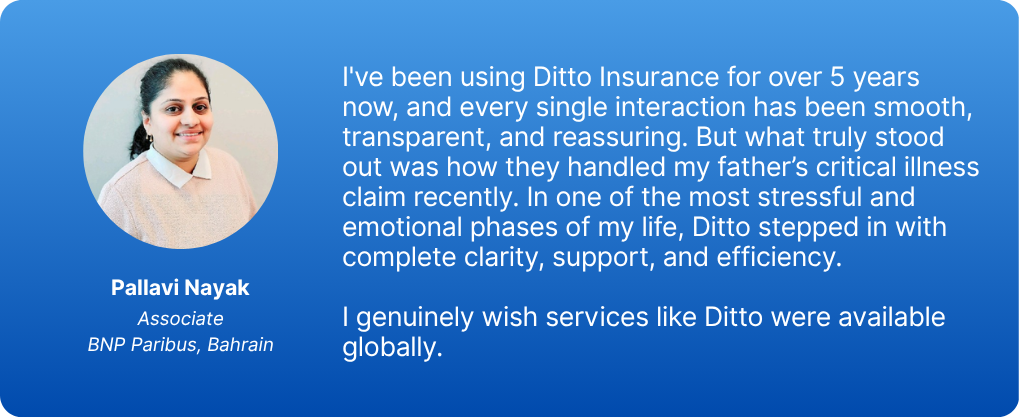
At Ditto, we’ve assisted over 8,00,000 customers with choosing the right insurance policy. Why customers like Pallavi below love us:
- No-Spam & No Salesmen
- Rated 4.9/5 on Google Reviews by 15,000+ happy customers
- Backed by Zerodha
- Dedicated Claim Support Team
- 100% Free Consultation
Confused about the right insurance? Speak to Ditto’s certified advisors for free, unbiased guidance. Book your call or chat on WhatsApp with us now!
Conclusion
While health insurance provides peace of mind against medical expenses, it also offers tax relief under the old tax regime. But it is important to know that the health insurance tax benefit in old and new tax regime differs significantly; deductions under Section 80D are available only in the Old Regime, whereas the New Regime offers no such premium-related benefits. However, claim payouts remain tax-free under both.
That said, tax savings shouldn’t be the primary reason for buying health insurance. The real purpose of health coverage is to cushion yourself and your family against unexpected financial troubles arising from medical emergencies. If maximizing tax savings is a priority, the Old Regime offers more scope—but the bigger priority should always be robust protection.
Frequently Asked Questions
Last updated on: