



Quick Overview
Health Insurance Premiums could be the biggest deciding factor in your insurance journey. Premiums can vary widely across plans and depend on personal factors such as age, pincode, lifestyle habits, BMI, and medical history.
So in this article, we will break down what a premium is, the different types of premiums, why they vary, and how you can find the most suitable premium amount for yourself.
What is Health Insurance Premium?
In health insurance, the premium must be paid for the entire lifetime of the policyholder, unlike term insurance, which usually ends after a specific tenure.
You need to pay this premium because it enables the insurer to continue providing the benefits promised under the policy. They can be paid online via the insurer’s official website/Mobile app, or offline at one of their offices. If you don't pay the premium on time, your policy will lapse, and you may lose your accumulated benefits.
Note
How Health Insurance Premium Is Calculated
Here’s the detailed calculation (on the insurer’s end):
Premium = Expected Medical Claims + Expenses + Profit/Safety Margin – Investment Income Effect
Health insurance premium pricing works in 2 steps:
- Initial Pricing: During the planning stage, insurance risk professionals (also known as actuaries) use actuarial models and past data to decide how much a plan should cost and what premium should be charged. This is the base premium, but it can go up over time due to factors such as rising healthcare costs, inflation, the number of claims experienced by the insurer on aggregate, and the insurer’s operating costs.
- Individual Loading Based on Risk Profile: Insurers consider factors such as location, BMI, medical history, and lifestyle habits (such as smoking and drinking) to decide whether to apply a Loading charge (generally 10-40%, higher for severe cases). The logic is simple: higher risk means higher premiums.

Factors Affecting Health Insurance Premium in India
Age and Number of Members
Younger people usually pay lower premiums because they are less likely to fall sick. In family floater plans, the premium can either be based on the age of the oldest member or on a combination of all members’ ages. The age-based increase can be every year or in age bands as well, depending on the plan.
Inflation
Due to the almost 14% yearly medical inflation, premiums do increase over time. Usually around 14-18% every 2-3 years.
Loading Charges
As discussed above, insurers can ask for a higher premium for applicants with pre-existing conditions, high BMI, and lifestyle habits (like smoking).
Pincode
Premiums are higher in certain areas, such as Delhi-NCR, Mumbai, and parts of Gujarat, because treatment and hospital costs are higher. Smaller towns usually have lower premiums.
Add-ons
Add-ons come in various forms. They can give you consumables coverage, reduce your waiting periods, or cover you for maternity-related expenses, if you pay extra. But more add-on benefits also mean higher premiums.
Cover Amount
The higher the cover amount, the higher the insurer’s risk, and therefore the higher the premium as well.
Sample Health Insurance Premium by Age and Coverage Amount
Note
- The premiums mentioned above are for the HDFC Ergo Optima Secure, Care Supreme, and Aditya Birla (comprehensive plans in India) for a person living in Delhi.
- As you can see, the premium does not increase linearly with the amount of cover. For a 25-year-old, the maximum premium cost is ₹14,130 for a ₹15 lakh cover. However, the minimum amount for a ₹25 lakh cover is only ₹11,214.
- To know the methodology behind why certain plans are recommended, refer to Ditto’s Cut and Framework.
Ways to Reduce Your Health Insurance Premium
- Co-payment: By opting for a co-payment, you agree to always share a set percentage of the bill with the insurer. While the insurer reduces your premiums if you opt for one due to lower risk, it also increases your out-of-pocket expense.
- Aggregate Deductible: This is a safer option than co-payment, as it is a fixed, aggregate amount you pay once per policy year and can be planned for with savings or emergency funds. It is mostly suited for people with employer-provided insurance and policies for the elderly, where premiums are very high.
- Super Top-Ups: They are a great way to boost your cover beyond a certain amount. Because they come with a high aggregate deductible amount, they are cheaper. It is usually only recommended for people who already have a solid base cover.
- Plans with Fewer Benefits or Different Insurers: Sometimes, people are tempted to choose plans that are not comprehensive or new insurers with below-par performance just because their premiums are lower.
- Higher Policy Tenure: Paying a 2- or 3-year premium at once can give you a 10-15% discount and protect you from inflation-related price hikes, leading to solid savings over time.
- Additional Offers: You can also use insurer-provided wellness discounts, such as Activ One Max's health returns program.
Note: If you are considering anything mentioned above, like co-payment or deductible, please plan thoroughly for the possible out-of-pocket expenses that you may incur as a result.
Health Insurance Premium Payment Options
Health insurance premiums can be paid annually or monthly through both online and offline modes. You can also refer to this guide to understand the options available when you miss a premium payment.
Tax Benefits on Health Insurance Premium Under Section 80D
Individuals can claim the deduction for health insurance premiums paid for:
- Self, Spouse, and Dependent Children
- Parents (whether dependent or not)
You can learn more about these health insurance tax benefits in this guide.
Why Choose Ditto for Health Insurance?
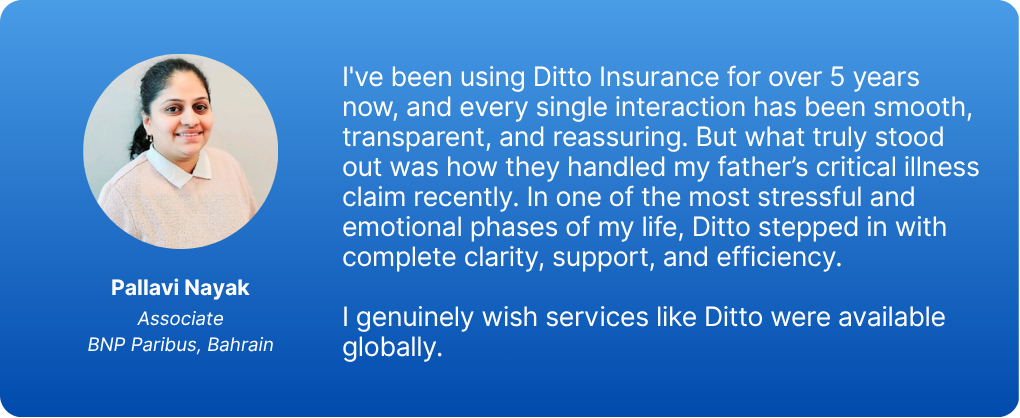
At Ditto, we’ve assisted over 8,00,000 customers with choosing the right insurance policy. Why customers like Pallavi below love us:
- No-Spam & No Salesmen
- Rated 4.9/5 on Google Reviews by 15,000+ happy customers
- Backed by Zerodha
- Dedicated Claim Support Team
- 100% Free Consultation
Confused about the right insurance? Speak to Ditto’s certified advisors for free, unbiased guidance. Book your call now or chat on WhatsApp, slots fill up fast!
Ditto’s Take on Health Insurance Premiums
Before buying a plan, it is important to compare premiums across the best available options and insurers. Also, make sure you read the policy terms carefully so there are no unpleasant surprises later.
It is also reassuring to know that IRDAI has put safeguards in place for senior citizens. Annual premium increases are capped at 10%, and any increase beyond this requires consultation and approval from the regulator. This brings a level of predictability and protection at an age when health insurance is most needed.
When comparing insurers, metrics such as the incurred claims ratio (ICR) can provide useful context. A consistently high ICR indicates higher claim outgo and can influence future premium revisions, although it should never be the sole factor in decision-making.
Remember, paying slightly higher premiums for the peace of mind and surety of getting as much of the claim amount settled should be of utmost priority.
Frequently Asked Questions
Last updated on: