
<img height="1" width="1" style="display:none" src="https://www.facebook.com/tr?id=7698356820180471&ev=PageView&noscript=1" />
Term Insurance

Term Insurance for Self-Employed: A Comprehensive Guide

Subhashish Banerjee

Written by Subhashish Banerjee

Insurance Writer

Gaurav Bhat

Reviewed by Gaurav Bhat

IRDAI-Certified Expert at Ditto

SP0738578124

Certified
Term Insurance for Self-Employed: A Comprehensive Guide

A recent HSBC analysis shows a sharp rise in self-employment in India, jumping from 239 million workers in FY18 to nearly 358 million in FY24. This significant 7% annual growth shows how quickly India is moving toward independent work.

For salaried individuals, employer-backed benefits such as EPF, NPS, and group term and health cover offer some cushioning during unfortunate events. But for the self-employed, there are no employer benefits, and income depends entirely on their own skills, health and reputation. With business loans often tied to them personally, a death or disability can cause the entire income stream to collapse overnight.

This is why term insurance becomes even more important for self-employed people. This guide walks you through the best plans for self-employed individuals, how much coverage to choose, how income proof works, and much more. 

How Does a Term Plan Work for the Self-Employed?

It works similarly to any other pure-protection term plan:

    • You pay fixed premiums regularly (monthly, quarterly, half-yearly or annually) during the policy term.
    • If you pass away during the term, the insurer pays the sum assured to your nominee (family).
    • If you survive the term, there is no payout (unless you opted for a return‑of‑premium variant, where premiums are much higher (50-100%)  than regular term plans). 

Note: You can add optional riders, such as a waiver of premium or a critical illness benefit, to boost protection.

What Are the Leading Term Plans for the Self-Employed?

Before we discuss the list, we assess the plans through our 6-point evaluation framework to ensure strong coverage, clear features, and long-term value.
01
Axis Max Life
Axis Max Life
Smart Term Plan Plus
Founded in 2000 as a joint venture between Max Financial Services and Axis Bank, Axis Max Life offers Smart Term Plan Plus. The term plan is a strong 2026 option with flexible benefit structures, long-term coverage, reliable claims, and solid add-on features.
Axis Max Life
Smart Term Plan Plus
4.6
Overall Rating

Premium Rating
5.0/5

Insurer Rating
4.9/5

Feature Rating
4.1/5

Customer Service Rating
5.0/5

Here are some of the features:

  • Accidental Death Benefit and Terminal Illness Benefit (up to ₹1 crore)
  • Critical Illness Cover (up to 64 illnesses)
  • Regular or Smart Cover (1.5X coverage for first 15 years)
  • Waiver of Premium on Disability or Critical Illness
  • Additional features like Zero-Cost Exit Option and Women's Perks (Lifeline Plus & Discounts)
  • Health Management Services, such as network discounts and teleconsultations
02
HDFC Life
HDFC Life
Click 2 Protect Supreme
Founded in 2000, HDFC Life is now the third-largest private life insurer in India, supported by a strong network of 390 branches. Its Click 2 Protect Supreme plan upgrades the earlier version with smart exit, premium breaks, instant claim payouts, and expanded wellness benefits for added flexibility.
HDFC Life
Click 2 Protect Supreme
4.25
Overall Rating

Premium Rating
1.5/5

Insurer Rating
4.7/5

Feature Rating
4.5/5

Customer Service Rating
5.0/5

Here are some of the features: 

  • Accidental Death Benefit
  • Disability & Critical Illness Premium Waiver
  • Income benefit on Accidental Disability
  • Inflation-linked cover and Critical Illness Cover (60 illnesses)
  • Life Stage Increase Option
  • Terminal illness cover (up to ₹ 2 crores)
  • Smart Exit, instant partial payout on claim intimation, and wellness services through the HDFC app 
03
Bajaj Allianz Life
Bajaj Life
eTouch II
Bajaj Life Insurance, launched in 2001 and fully owned by Bajaj Finserv since 2025, offers eTouch II as a strong term plan with practical riders. It provides a zero-cost option, a premium waiver for total permanent disability, and the flexibility to increase coverage during key life events.
Bajaj Life
eTouch II
4.25
Overall Rating

Premium Rating
5.0/5

Insurer Rating
4.6/5

Feature Rating
3.4/5

Customer Service Rating
5.0/5

Here are some of the features:

  • Accidental Death Benefit
  • Life Stage Benefit (increased coverage after marriage/childbirth)
  • Critical Illness Coverage (60 illnesses)
  • Waiver of Premium on Accidental Total & Permanent Disability
  • Terminal Illness cover and Zero Cost Option
  • Health management services, such as teleconsultations, discounts, and comprehensive health checkups
04
ICICI Prudential
ICICI Prudential
iProtect Smart Plus
ICICI Prudential Life Insurance, a joint venture between ICICI Bank and UK-based Prudential Plc, introduced iProtect Smart Plus as an upgraded version of its popular iProtect Smart plan. It retains core benefits while adding stronger features and enhanced flexibility for better protection.
ICICI Prudential
iProtect Smart Plus
4.1
Overall Rating

Premium Rating
5.0/5

Insurer Rating
4.4/5

Feature Rating
3.3/5

Customer Service Rating
5.0/5

Here are some of the features:

  • Accidental Death Benefit
  • Life Stage Benefit (increased coverage after milestones like marriage/childbirth/home loan)
  • Terminal Illness Payout (Entire base cover) and Critical Illness Cover (60 illnesses)
  • Zero Cost Option
  • Additional features like Premium Break and Instant payout on claim intimation
05
Aditya Birla Sun Life
Super Term Plan
Aditya Birla Sun Life, a joint venture between Aditya Birla Capital and Canada-based Sun Life Financial, has been a leading insurer since 2000. Its Super Term Plan suits buyers seeking life, health, and income protection, along with wellness benefits and fast claim processing.
Aditya Birla Sun Life
Super Term Plan
4.3
Overall Rating

Premium Rating
5.0/5

Insurer Rating
3.9/5

Feature Rating
3.3/5

Customer Service Rating
5.0/5

Here are some of the features: 

  • Accelerated Critical Illness Benefit (42 Illnesses)
  • Waiver of Premium on Accidental Total & Permanent Disability
  • Life Stage Flexibility and Terminal Illness payout 
  • Cover Continuance (premium deferment up to 12 months)
  • Early Exit Value (specific age/tenure bands)

Key Metrics of the 5 Term Plans

Plan NamesCSR (Avg 2022-2025)ASR (Avg 2021-2024)30-day Claim Settlement (Avg 2022-25)Volume of Complaints Per 10,000 Claims (Avg 2022-25)
Axis Max Life Insurance Smart Term Plan Plus99.62%96.20%99.71%5.67
HDFC Life Click 2 Protect Supreme99.55%93.90%98.93%1.33
Bajaj Life eTouch II99.21%93.50%92.45%3.95
ICICI Prudential iProtect Smart Plus98.03%95.10%94.68%11.00
Aditya Birla Sun Life Super Term Plan98.45%94.30%99.39%2.33

Let’s compare the cost of the top plans with a ₹1 crore cover. The annual premiums below are for males (non-smokers of different ages), with coverage up to age 70 and without 1st year discounts.

How Much Do ₹1 Crore Term Insurance Premiums Cost for Top Plans?

Age/PlanAxis Max Life Smart Term Plan PlusHDFC Life Click 2 Protect SupremeICICI Prudential iProtect Smart Plus
25₹10,459₹11,954₹10,480
30₹13,185₹14,576₹12,968
35₹17,223₹20,176₹17,650
40₹19,482₹25,272₹23,866
45₹30,112₹32,803₹31,008

Ditto’s Take: Axis STPP offers strong features at an affordable price for a ₹1 crore cover, earning it a solid overall rating.

What Documents Are Required for the Purchase of a Term Plan? 

Here’s a list of documents you will need to apply for a term plan:

    • ID Proofs such as  PAN Card or  Passport
    • Photograph
    • Address Proof, e.g., Aadhaar Card, Passport, Voter ID, Driving Licence
    • Income Proof – ITR and CA-certified computation of income for the last 2-3 years (depending on the insurer). Only income from “Business/Profession” is considered; capital gains, F&O Income, commission-based, or interest income won’t count towards eligibility.
    • Existing policy details, if any
    • Bank/NEFT Details, e.g., Cancelled cheque or bank statement with account holder name, MICR, IFSC, and account number (depending on the insurer) 
    • Medical history details and reports (if any)

How Much Coverage Should a Self-Employed Person Choose?

Choosing the right coverage is slightly different for self-employed individuals because income varies and documentation is more complicated. 

Insurers usually prefer salaried income because it is stable and easy to verify. They rarely give discounts to self-employed buyers because there is no salary slip, and income fluctuates. Self-employed individuals also face stricter financial underwriting than salaried individuals.

As a rule, try to target coverage that equals:

  • Ten to twenty-five times your annual income
  • Plus outstanding loans/business liabilities
  • Plus future goals like children’s education and weddings, adjusted with inflation

For example, if your income is ₹10L/year, your ideal cover could range from ₹1 Cr to ₹2.5 Cr, depending on your family's needs, lifestyle, and liabilities.

At Ditto, we use the expense and liabilities replacement method to estimate the term cover you require. To get a better understanding, use this online calculator to find the ideal cover for you.

Why Should a Self-Employed Person Purchase a Term Plan?

Protection from Income Fluctuations

Self-employed income often changes with market cycles. A term plan provides stable financial support for your family even when business performance is unpredictable.

Security for Long-Term Goals

The payout helps meet major family goals, such as children’s education or weddings, ensuring these plans stay on track even if the primary earner is no longer around.

Shield for Personal Assets and Debts

It prevents families from liquidating savings or property to manage expenses or repay business loans with personal guarantees.

High Coverage at Low Cost

Term insurance provides protection at an affordable premium, useful during slow business periods. These premiums are locked for the entire duration of the policy.

What Riders Are Most Important for Self-Employed Individuals?

Term riders add valuable protection at a small extra cost. The most useful riders for self-employed people are:

    • Premium Waiver Rider: If you face a disability or a serious illness, this rider waives future premiums while keeping your policy active.
    • Critical Illness Rider: This rider pays a lump sum if you are diagnosed with a major illness. Self-employed people often do not have sufficient emergency funds or a steady income during treatment, so this rider helps maintain cash flow.
    • Disability Cover (Accidental Total & Permanent Disability): This rider pays a benefit if you permanently lose the ability to work. Unlike the base term plan, you cannot choose your payout format. 

The insurer decides whether the benefit is paid as a lump sum or monthly, and you must purchase the rider from the same insurer as your base policy.

For example, HDFC Click2Protect Supreme’s Income Benefit Rider replaces regular earnings to support your family’s ongoing expenses.

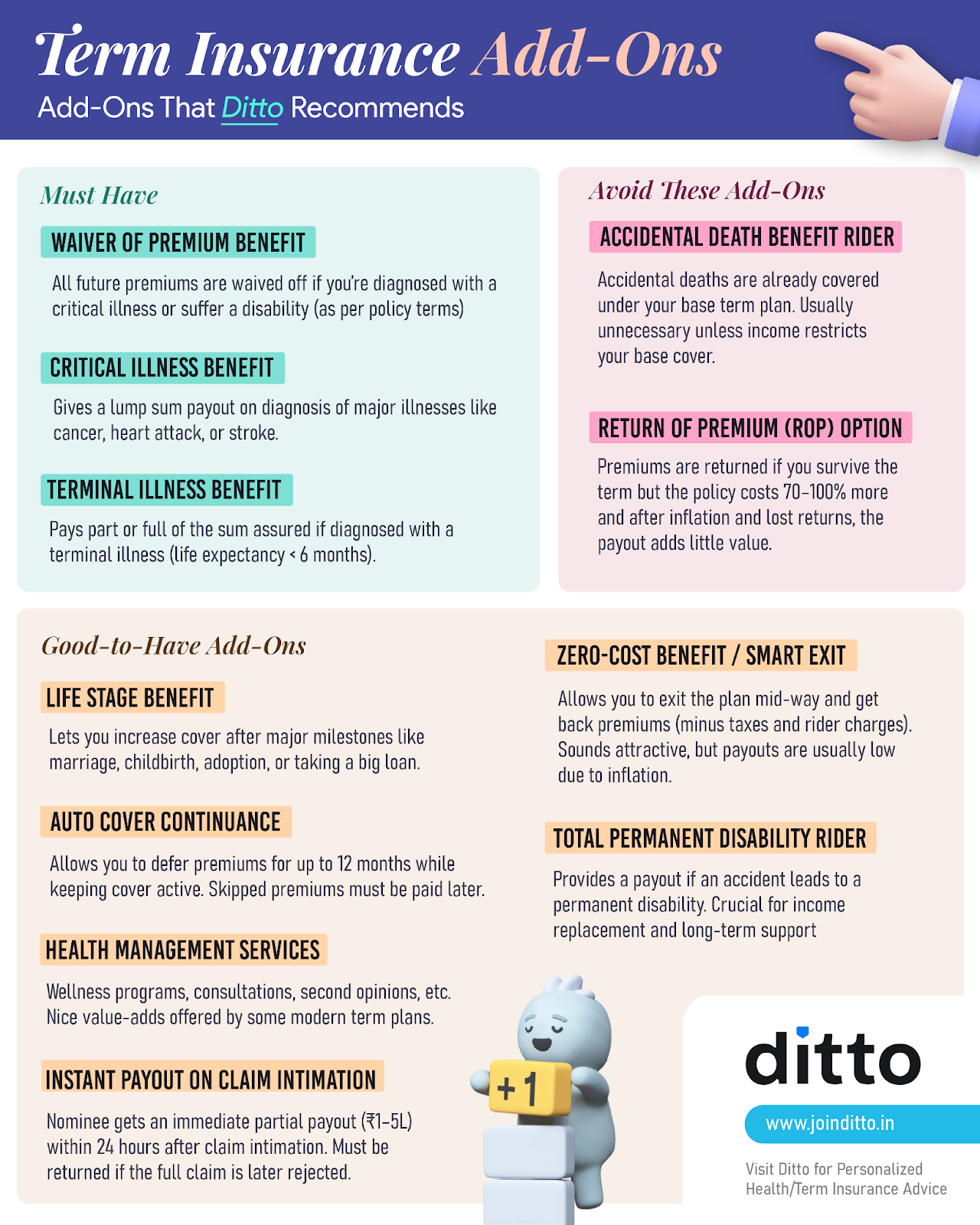
Check out this infographic to understand the essential term plan add-ons you can choose during purchase:
Term Insurance for Self-Employed

Which Premium Paying Term Works Best for Self-Employed?

Self-employed people often try to finish payments early when income is steady or when business is doing well. If you receive bonuses, seasonal profits or large one-time payments, a limited pay option can work better. You can go with any of the following options:

    • Limited Pay: You pay premiums for a shorter duration, like 5, 10, or 15 years, but stay covered for the full term. Many self-employed people prefer this because they want to finish commitments early rather than pay for decades.
    • Regular Pay: If your income is stable most of the year and you do not want high yearly payments, regular pay works fine. You pay a smaller amount every year until the end of the policy term.

At Ditto, we recommend limited pay for self-employed people as it ensures you finish payments during your best earning years and removes the risk of your policy lapsing later in life.

Can a Self-Employed Person Buy a Term Plan Without Income Proof?

Buying a term plan without income proof is possible, but with conditions. Insurers need to ensure that the coverage amount matches your financial profile.

If you do not have ITRs, salary slips, GST reports or bank statements, the insurer may cap the sum assured or ask for alternate documents like business invoices or accountant-certified financials.

Read more about how you can buy term insurance without income proof.

Take Note

Some newer term insurance plans for the self-employed, like Bajaj iSecure II and ICICI iProtect Super, allow you to buy cover even if you do not have standard income proof, such as ITRs, GST returns, or a CA certificate. 

Instead, insurers may check your credit score, average bank balance, spending patterns, investments, or even your car’s IDV to understand your financial stability. This is helpful for freelancers and entrepreneurs who earn well but show low income on paper, because it gives them a fair chance to qualify for strong life cover.

How Long Should Your Term Insurance Cover Last?

Your policy term should last only until your family truly depends on your income and your major loans are cleared. For the self-employed, this period is usually longer than for salaried individuals, because income often continues well past 60 through consulting, practice, or business ownership.

A practical way to choose the term is to match it with your work span and key milestones. Here’s what you should consider:

    • Age 25 to 35: If you’re 30 today, choosing a 35–40-year term means your cover runs till 65–70, matching the longer working life most self-employed people have.
    • Age 36 to 45: If you’re 40, a 20–30-year term (till 60–65) usually aligns with your kid’s education and loan timelines.
    • Age 46 to 55: If you’re 50, a 10–20-year term gives protection till 60–70, based on how long you realistically expect to work and support dependents.

Avoid extremely short terms that leave you uninsured in mid-life, and extremely long ones (till 80–85) that add cost without real dependency. For most self-employed individuals, a cover lasting till 65–70 strikes the right balance.

Insurers check self-employed applicants more carefully because income is harder to verify. You can improve approval chances by following four key steps.

Ditto’s Take on Term Plans for Self-Employed

Maintain Proper Income Proofs

Submit 2 to 3 years of ITRs, CA-certified income computation, and Form 26AS. These documents help establish a stable income.

File Accurate ITRs

Insurers look at declared net income/profit, not gross revenue. Showing very low income reduces the coverage you qualify for, while accurate reporting supports higher eligibility.

Keep Business Documents Ready

Have GST returns, business registration, licenses, and recent bank statements available. This prevents underwriting delays and supports your financial profile.

Seek Expert Guidance

An experienced advisor can help present your case clearly, explain income fluctuations, and coordinate with underwriters to reduce delays or rejection.

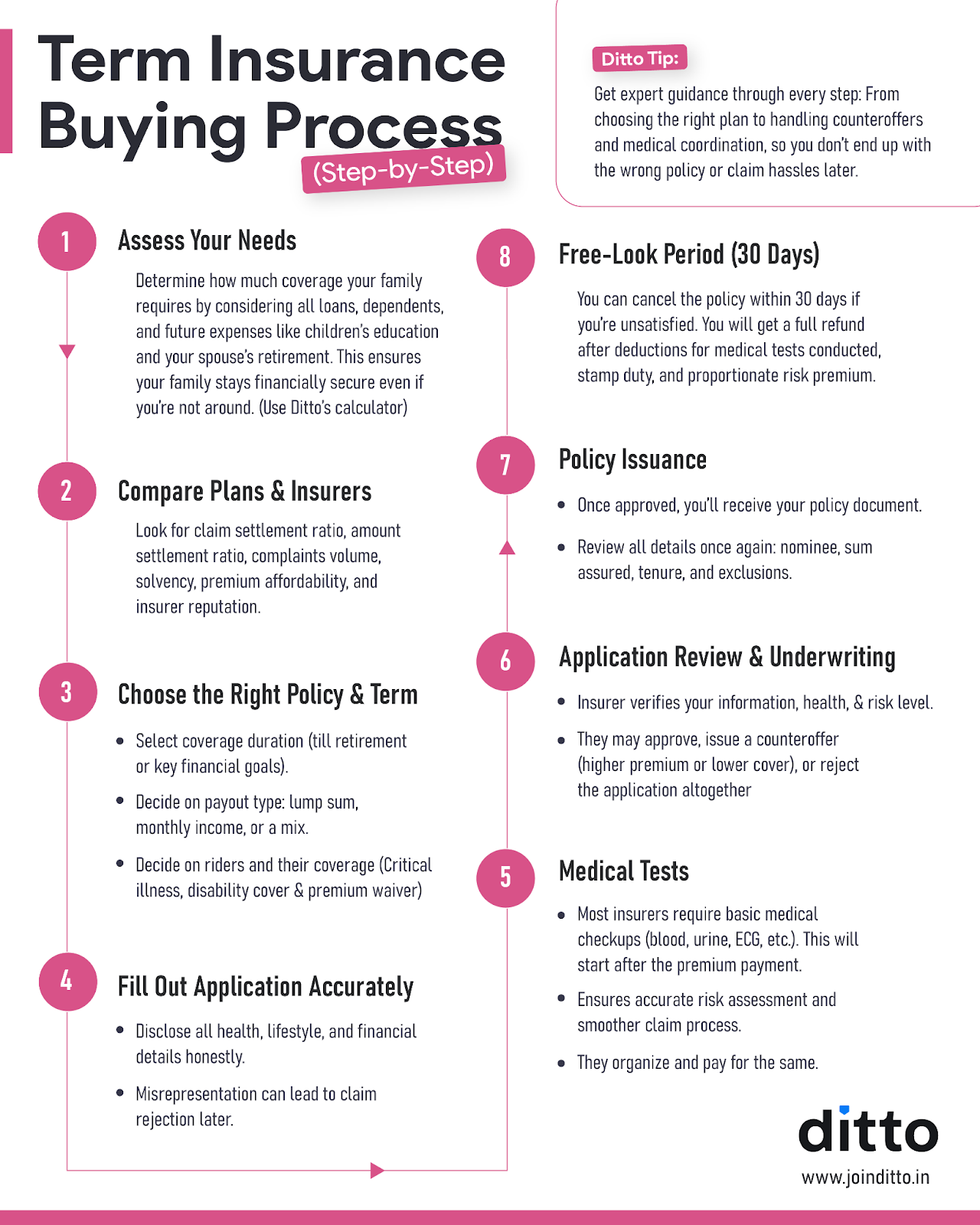
Check out the infographic, which helps you with your term plan purchase process:
Term Insurance for Self-Employed

Why Choose Ditto for Term Insurance?

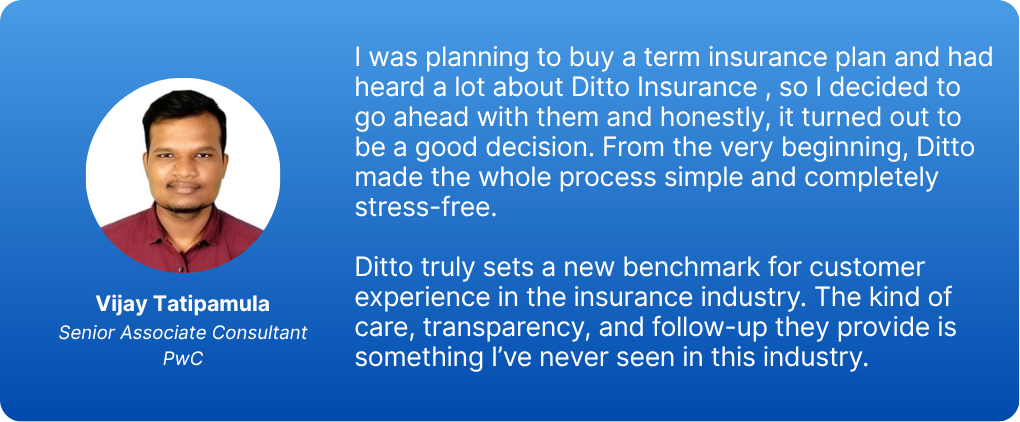
At Ditto, we’ve assisted over 8,00,000 customers with choosing the right insurance policy. Why do customers like Vijay below love us:
Term Insurance for Self-Employed
    • No-Spam & No Salesmen
    • Rated 4.9/5 on Google Reviews by 15,000+ happy customers
    • Backed by Zerodha
    • Dedicated Claim Support Team
    • 100% Free Consultation

You can book a FREE consultation. Slots are running out, so make sure you book a call now!

Final Thoughts

If your income fluctuates, make your premium payments foolproof, and choose annual or half-yearly premium payment modes. Furthermore, you can maintain a separate protection-focused bank account with 1–2 years of premiums and enable auto-debit only from that account. Add calendar reminders and alerts for an extra safety layer.

In case you move from a self-employed to a salaried person or vice versa, you need not worry. Your term insurance cover stays the same. If you plan to start a business and expect your income to fluctuate, it is wiser to lock in a higher cover now while your income proof is stronger and easier to verify.

Quick Note

Our plan rankings here reflect an objective view, combined into a simple 5-point score so you can compare them easily. Partner or not, every insurer on this list is evaluated using the same criteria, which is why you’ll see a mix of both, including partners such as Axis Max Life, HDFC Life, Bajaj Life, and ICICI Prudential, as well as non-partner insurers like Aditya Birla Sun Life.

For more details on how we approach reviews and partnerships, you can refer to our Editorial Policy & Disclaimers.

Frequently Asked Questions

My business is new. Can I still get term insurance?

Yes, but insurers check new businesses more strictly. Without 2–3 years of ITRs, you may get a smaller cover or need plans with easier underwriting. You can increase your cover later once income stabilizes.

Can I get term insurance if most of my income is in cash?

It is possible, but tougher. Insurers prefer income that appears on bank statements or ITRs. Start depositing cash into your bank and file proper ITRs before applying.

What if my income type changes from salaried to self-employed?

Your term insurance cover stays the same. It does not change if you shift jobs or become self-employed. If you expect unstable income later, buy adequate cover now.

My application was rejected due to low-income proof. Can I reapply?

Yes. A financial rejection is temporary. Once you file better ITRs or show stronger income documents, you can apply again.

What are the basic income requirements for term insurance?

Insurers usually want a minimum income of ₹3-5 lakh for applicants. Self-employed individuals must show at least two years of ITRs to prove a stable income.

Can I buy a term plan if I currently don’t have any source of income?

No, you cannot buy a term insurance plan without an active source of income. Term insurance is designed to replace the policyholder’s income, so insurers require proof of earnings.

Last updated on: