


Overview
Think about the last time you visited a doctor. Chances are, you were not admitted to a hospital. You paid consultation fees, had tests done, and picked up medicines. Now imagine doing that three or four times a year. Those bills add up, and most health insurance plans cover none of it.
That is where OPD health insurance steps in. OPD cover is designed to pay for expenses like doctor visits, lab tests, and medicines.
The challenge is that OPD claims are almost a certainty, so insurers price OPD benefits accordingly, and not every plan is worth the extra premium.
This guide explains what OPD cover means, how it's priced, which plans currently offer the best value, and how the claims process works. By the end, you should have a clear sense of whether adding OPD cover makes financial sense for you.
What Is OPD Cover in Health Insurance?
OPD stands for Outpatient Department. In simple terms, it refers to any consultation or treatment where you visit a doctor or diagnostic center without being admitted to a hospital (overnight or for a daycare procedure). So a regular check-up, a blood test, a follow-up scan, or a prescription refill: all of this falls under OPD.
But in India, standard health insurance plans are built almost entirely around hospitalization. They kick in when you are admitted, cover your room, treatment, and surgery, and then provide a defined window for pre- and post-hospitalization expenses.
Imagine a 42-year-old with mild hypertension. They see their doctor every couple of months, get their blood pressure and cholesterol checked twice a year, and refill their prescription monthly. None of that requires hospitalization, so a regular health insurance policy without OPD cover won't reimburse those visits, even though you're paying for them year after year.
OPD cover changes that. It reimburses, or in cashless cases directly settles, the cost of those routine medical interactions. Some plans include OPD as a built-in feature, while others offer it as a rider you buy separately on top of your base plan.
Best OPD Health Insurance Plans in India: Ditto's Pick [2026]
Note: Ditto’s Score reflects our overall rating of the health insurance policy.
OPD insurance plans sound great on paper, but is it actually worth paying extra for? Watch this quick breakdown before we get into the plans, costs, limits, and fine print.
Talk to an expert
today and
find
the right
insurance for you.




How Does Ditto Pick the Best Health Insurance With OPD Cover in India?
At Ditto, we follow a detailed policy and insurer rating framework for every health insurance plan we recommend. We rate plans across three broad dimensions.
- Features (45%): Room rent rules, co-payment, waiting periods, restoration benefits, consumables cover, and other important policy clauses.
- Insurer Reliability (45%): Claim settlement ratio, complaint volume, hospital network, and the insurer’s overall servicing track record.
- Premium Affordability (10%): Whether the plan is reasonably priced for a standard buyer profile.
From the plans that clear our benchmarks on these parameters, we shortlist those with genuinely useful OPD benefits. We look at what the OPD cover actually pays for, along with annual limits, and whether the benefit is cashless or reimbursement-based.
The idea is simple. An OPD benefit should add meaningful value, not just increase the premium for a small or difficult-to-use allowance.
If you'd like to dig into the numbers behind our insurer assessments, Ditto Data Lab is our proprietary repository of insurer disclosures and IRDAI data, compiled and verified by our team.
How Much Does OPD Health Insurance Cost in India?
OPD cover can cost anywhere from a few hundred rupees to several thousand rupees a year, depending on what the benefit actually covers.
The interesting part is that the OPD add-on premium does not always behave like your regular health insurance premium. Your base health insurance premium usually changes with factors such as age, location, family composition, and sum insured. But some OPD add-ons use a fixed pricing structure instead.
OPD Add-On Costs
HDFC ERGO Optima Wellbeing
Optima Wellbeing has one of the simplest pricing structures. The add-on premium does not change based on your age, location, or base sum insured. The main difference is whether you have an individual policy or a family floater.
Note: The family floater price remains the same regardless of the number of members covered.
Care Supreme With Care OPD
Care OPD also has a straightforward pricing structure and does not change based on age, sum insured, or location. But the total cost increases with the number of members covered.
Niva Bupa ReAssure 2.0 Platinum+ Acute Care With Best Care
The Best Care add-on pricing works similarly to Care OPD. It does not change with age, sum insured, or location. Only the number of members and the selected OPD limit affect the premiums.
Insight: The value improves as you move up the Best Care limits. At ₹5,000, the add-on premium itself takes up a large part of the available benefit. At ₹15,000 to ₹20,000, the additional premium rises much more slowly than the OPD limit, making the higher limits offer better value.
Premium Comparison: Best OPD Health Insurance in India
The OPD add-on is only one part of what you actually pay. You still need to account for the underlying health insurance policy and any other add-ons required to make the plans comprehensive.
Note: The premiums above are for a ₹15 lakh base sum insured for healthy individuals residing in Delhi (pincode: 110010). Base policy premiums can vary with age, medical history, location, underwriting, plan configuration, and applicable discounts. The OPD add-on pricing follows the structures explained above.
For people above 60 looking for comprehensive plans from HDFC ERGO, consider Optima Secure, since it has no entry age limit.
Does GST Apply to OPD Health Insurance?
Since September 22, 2025, GST on individual health insurance policies, including family floater policies, has been reduced from 18% to 0%. So retail health insurance policies and attached add-ons such as the ones discussed here no longer attract the earlier 18% GST on the individual health insurance premium, making health insurance a little more affordable for everyone.
Special Mentions: Other Health Insurance Plans With Useful OPD Benefits
The plans below did not make our main OPD shortlist, but they still offer interesting outpatient benefits for specific use cases.
Star Health Super Star With High-End Diagnostics Add-On
Star Health Super Star does not offer a conventional OPD wallet for everyday doctor visits. Instead, it includes unlimited teleconsultations through the Star Health app by default. It also provides a dental check-up and cleaning benefit covering consultation, IOPA X-ray, and scaling for one insured person during the second and third policy years as part of the base policy.
You can separately opt for the High-End Diagnostics cover, which pays up to ₹25,000 per policy year for specified advanced tests such as PET-CT, PET-MRI, CT-guided biopsy, and Digital Subtraction Angiography (DSA).
What Works Well: The combination can be useful if you regularly use teleconsultations or want protection against the cost of specific advanced diagnostic tests.
What to Watch Out For:
- Routine in-person doctor consultations are not covered.
- You must access teleconsultations through Star Health's platform, and the high-end diagnostic cover applies only to the specified tests.
- The dental benefit is also narrow and is available only during the second and third policy years.
TATA AIG MediCare Premier
TATA AIG MediCare Premier has one of the more layered in-built OPD structures. What You Get:
- Depending on your base sum insured, the plan provides between ₹5,000 and ₹20,000 per year for OPD treatment, including consultations and pharmacy expenses.
- It separately offers between ₹10,000 and ₹25,000 for specified dental treatments and up to ₹25,000 or ₹50,000 for listed high-end diagnostic tests.
- Unlimited general physician and specialist teleconsultations are also available through its wellness services.
What Works Well: Instead of putting every outpatient expense inside one small limit, MediCare Premier separates regular OPD treatment, dental expenses, and high-end diagnostics. This can provide substantially more outpatient value at higher sum insured levels.
What to Watch Out For: Regular OPD treatment and dental benefits have a 24-month waiting period. So, while the numbers look generous on paper, you can't fully start using these benefits immediately after purchasing the policy.
Aditya Birla Activ Yuva With OPD Cover
Activ Yuva offers one of the broadest OPD structures here.
What You Get:
- You can select optional OPD cover up to 5 times the base premium.
- It covers physical and virtual doctor consultations, prescribed diagnostics, dental care, physiotherapy and sports therapy, pharmacy expenses, and prescribed vision aids.
- The OPD amount is divided across categories. Doctor consultations can use up to 35%, diagnostics up to 25%, and dental, physiotherapy, pharmacy, and vision aids up to 10% each.
- It also includes wellness services such as mental health support, diet and nutrition consultations, and fitness benefits, all available online without limits.
What Works Well: Few OPD plans cover this many everyday healthcare expenses. Doctor visits, medicines, tests, dental care, physiotherapy, and vision expenses can all sit within the same broader OPD setup.
What to Watch Out For:
- The OPD amount is not a completely flexible wallet because individual categories have their own allocations.
- The benefit is designed primarily for cashless use through the insurer's app. Reimbursement is available only in specified situations where cashless service is unavailable, and a 20% co-payment then applies.
- There is also a 30-day waiting period.
ICICI Lombard Elevate With OPD+ Rider
Elevate keeps comprehensive OPD coverage optional rather than building it into the base policy.
What You Get:
- Its current OPD+ rider provides cashless outpatient coverage through the IL TakeCare app for doctor consultations, diagnostics, pharmacy expenses, mental health services, dental care, vision care, and more, up to the OPD sum insured you select.
- It also includes unlimited teleconsultations and mental health counseling.
What Works Well: The range of expenses covered is unusually broad. Someone who wants a cashless ecosystem covering doctor appointments, medicines, tests, dental, and vision expenses gets substantially more utility than from a basic consultation-only OPD rider.
What to Watch Out For:
- Comprehensive OPD is not part of the base Elevate hospitalization cover, so you need to pay for the optional rider.
- The benefit is also built around cashless usage through ICICI Lombard's network and IL TakeCare app, so it is less flexible if you prefer doctors, pharmacies, or diagnostic centers outside that ecosystem.
ManipalCigna Infinix
ManipalCigna Infinix takes a lighter approach to OPD coverage.
What You Get:
- The base plan includes unlimited teleconsultations with general physicians, which works well for routine medical advice without needing an additional OPD rider.
- Emotional Quotient benefit provides unlimited virtual access to psychologists, mental wellness tools, fitness, yoga, meditation sessions, and other wellness resources.
- NutriBoost benefit provides unlimited e-consultations with nutritionists, along with personalized diet plans, weight-management guidance, and nutrition support.
- For buyers choosing the unlimited base sum insured, there is also an optional High-End Diagnostics cover that provides up to ₹50,000 per policy year for specified tests such as PET-CT, cardiac MRI, and coronary angiography.
What Works Well: Unlimited general practitioner teleconsultations are included without a conventional OPD rider, while the high-end diagnostics option can help buyers worried about expensive advanced tests.
What to Watch Out For: It doesn't include broad in-person doctor consultations, pharmacy, dental, or an everyday diagnostic wallet.
How Does OPD Health Insurance Work Without Hospitalization?
Since OPD claims don't involve a hospital stay, the process looks quite different from a typical hospitalization claim. It generally works in one of two ways.
Cashless OPD Health Insurance: You book an appointment through the insurer's app, visit an empaneled network clinic or diagnostic center, and show your health card or policy details at the counter. The insurer settles the bill directly with the provider, so you walk out without paying for anything covered under the policy.
Reimbursement OPD Health Insurance: You visit any doctor of your choice, pay the bill yourself, and collect the original receipts, prescription, and any diagnostic reports. You then fill out an OPD claim form through the insurer's app or website, upload the documents, and wait for the insurer to verify and transfer the eligible amount to your bank account.
Cashless is more convenient and doesn't tie up your cash flow, but it usually restricts you to a specific network of clinics and hospitals. Reimbursement gives you the freedom to see any doctor you trust, but it means you pay upfront and wait a few days (sometimes longer) for the money back.
Who Should Consider OPD Health Insurance?
OPD cover isn't a blanket "yes" for everyone. It can genuinely pay off in some situations and unnecessarily drain money in others. Here's a straightforward way to think about it.
Families With Young Children
Kids visit pediatricians far more often than adults visit their own doctors, for vaccinations, seasonal infections, and general check-ups. A family floater with a strong OPD benefit can genuinely offset a good amount of that annual spend, making this one of the better cases for the best OPD health insurance in India for family buyers.
People Managing Chronic Conditions
If you're managing diabetes, hypertension, or thyroid issues, you're likely visiting a doctor and running lab tests every couple of months anyway. OPD cover here isn't a luxury. But closer to a predictable, recurring expense that insurance can smooth out.
Senior Citizens
Older adults tend to have more frequent consultations and diagnostic needs, even outside a specific chronic condition. Health insurance with OPD benefits can meaningfully reduce that steady out-of-pocket spending, though it's worth checking that the OPD benefit itself doesn't come with an age-based sub-limit or exclusion.
Think Twice Before Buying OPD Cover If
Employer Cover
Low OPD Spend
High Premium
No Need
Quick Math: A simple gut check works well here. Add up what you actually spent on consultations, tests, and medicines last year. If that number comfortably exceeds the OPD rider's premium, it's probably worth it. If it doesn't, you're likely better off putting that money toward a stronger base hospitalization plan instead.
Does Using OPD Benefits Affect Your No-Claim Bonus?
What Does OPD Health Insurance Cover & How to Claim OPD Expenses?
Doctor Consultation
This is the core of most OPD benefits: fees for visiting a general physician or a specialist, whether in person or via teleconsultation. Coverage usually applies up to a per-visit cap, an annual limit, or both, depending on the plan.
Diagnostic Tests
Blood tests, X-rays, ECGs, ultrasounds, and other routine investigations that a doctor prescribes as part of your treatment are typically covered here. Higher-end tests like MRI, CT scans, and PET-CT are sometimes bundled into a separate "high-end diagnostics" add-on with its own cap, rather than the general OPD limit.
Pharmacy and Medicines
Prescribed medicines bought with a valid doctor's prescription are usually reimbursable or covered on a cashless basis if you buy from a network pharmacy. Most OPD add-ons also offer pharmacy discounts instead of reimbursement. Over-the-counter purchases without a prescription generally aren't covered.
Cashless OPD Claims
1) Book your appointment through the insurer's app or portal.
2) Visit an empaneled network clinic, hospital, or diagnostic center.
3) Show your policy details or health card at the reception.
4) The insurer settles the bill directly with the provider, so you don't pay anything upfront (for the covered portion of the bill).
Reimbursement Claims
1) Visit any doctor or diagnostic center, in or out of network.
2) Pay the bill yourself and collect the original receipts, prescription, and reports.
3) Log in to the insurer's app or website and fill out the OPD claim form.
4) Upload the required documents and submit the claim.
5) The insurer verifies the claim and transfers the eligible amount to your registered bank account, usually within a few working days to a couple of weeks.
Documents Required for an OPD Claim
- Original consultation receipt from the doctor or clinic.
- The doctor's prescription.
- Diagnostic or lab test reports, where applicable.
- Pharmacy bills, along with the corresponding prescription.
- A duly filled and signed OPD claim form.
Pro Tip: Keep every receipt and prescription as soon as you get it, rather than trying to gather them all just before filing a claim. It's a small habit that saves a lot of last-minute scrambling.
OPD Insurance Cover: Built-In Benefit vs. Add-On vs. Standalone Plan
OPD cover in India comes in three broad formats, and each suits a different kind of buyer.
Ditto's Take: A built-in OPD benefit is convenient, but it isn't automatically the better choice. A well-structured OPD rider on a strong base plan often gives you more control over what you're paying for. Standalone OPD plans can work well if your hospitalization cover is already sorted elsewhere, but read the fine print carefully, since some of these products behave more like healthcare subscriptions than traditional insurance.
Section 80D Tax Benefits on Health Insurance With OPD Cover
When you buy an OPD rider as part of your regular health insurance policy (rather than as a standalone healthcare subscription), the premium you pay is treated the same way as your base health insurance premium under Section 80D (renumbered as Section 126 of the Income Tax Act, 2025).
That means the combined premium, your base plan plus the OPD add-on, counts toward your Section 80D deduction limit (old regime):
- Up to ₹25,000 a year for yourself, your spouse, and dependent children (below 60).
- Up to ₹50,000 a year if you, your spouse, or a covered dependent is a senior citizen (60 or above).
- An additional ₹25,000 or ₹50,000 for your parents' premium, depending on whether they're senior citizens.
Where This Gets Complicated: Standalone, subscription-style OPD products, the kind sold as a "healthcare membership" rather than a regulated insurance policy, may not qualify for Section 80D at all, since the deduction is specifically meant for health insurance premiums, not general wellness subscriptions.
If you're buying a standalone OPD product mainly for the tax benefit, it's worth checking directly with the provider (and ideally a tax professional) whether it's structured as an actual insurance policy or a non-insurance subscription.
Pros & Cons of OPD Insurance Cover to Know Before Buying
Pros of OPD Insurance Cover
- Covers a genuinely recurring expense: unlike hospitalization, which is (hopefully) rare, OPD costs show up almost every year.
- Cashless options remove the hassle of paying upfront and waiting for reimbursement.
- Particularly useful for chronic conditions, young children, and senior citizens, where consultations and tests are frequent.
- The combined premium (base plan plus OPD rider) still qualifies for Section 80D (old regime) tax deductions.
- Encourages more regular check-ups and preventive care, since the cost barrier is lower.
Cons of OPD Consultation Cover
- Per-visit and annual caps are often lower than what a specialist consultation actually costs in a metro city.
- Cashless networks can be limited to specific cities or a narrow list of empaneled clinics.
- A 30-day (or, in some cases, 2-year) waiting period applies before you can start claiming.
- For healthy adults with low OPD usage, the rider premium can easily exceed what you'd ever realistically claim back.
- Some plans blur the line between OPD claims and your main policy's claims history, which can complicate no-claim bonus and restoration calculations.
Weighing these against each other, rather than looking at OPD cover in isolation, is really the whole exercise. It's genuinely valuable for the right buyer and unnecessary for the wrong one.
Why Choose Ditto for Health Insurance?
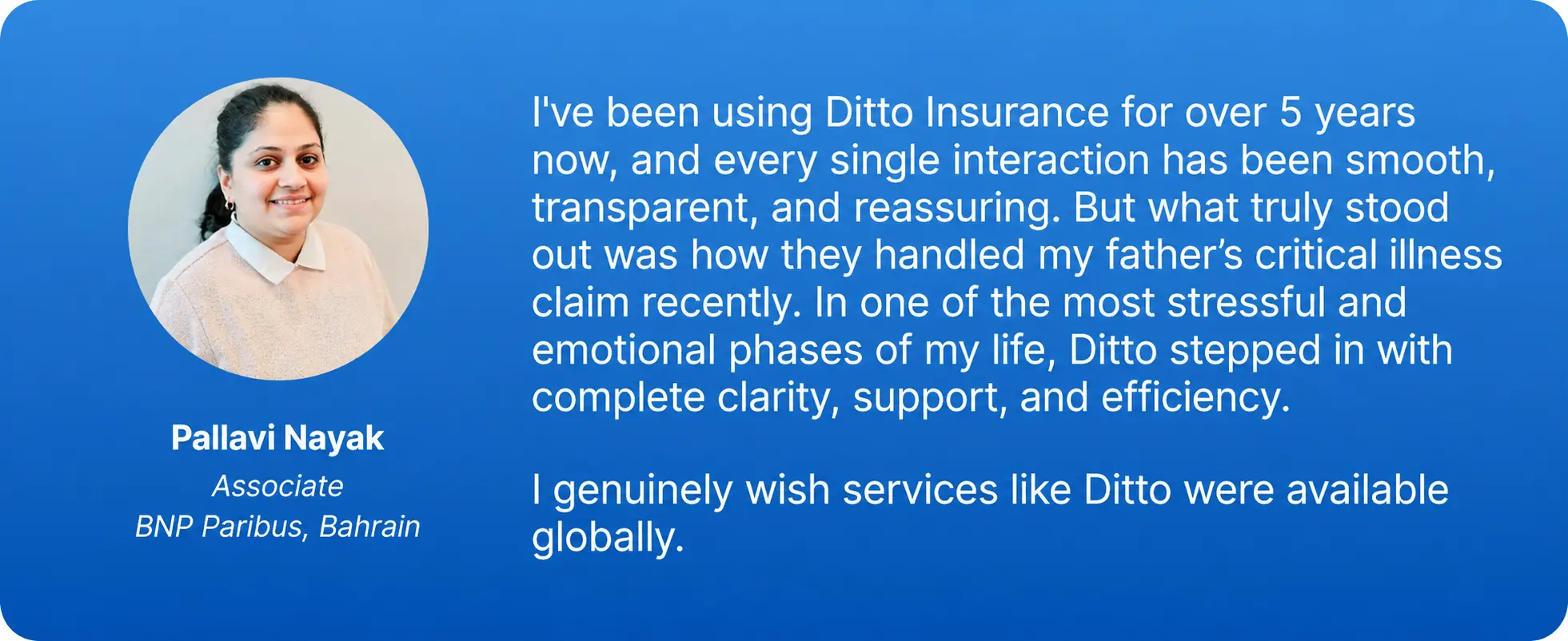
At Ditto, we’ve assisted over 12,00,000 customers choose the right insurance policy. Why customers like Pallavi love us:
- 100% Free Consultation
- No Spam. No Sales Pressure.
- Rated 4.9/5 on Google Reviews by 30,000+ Happy Customers
- Backed by Zerodha
- Dedicated Claim Support Team
- Compare Plans and Premiums with a Trusted Insurance Advisor
Confused about the right insurance? Speak to Ditto’s certified advisors for free, unbiased guidance. Book your call now or chat with us on WhatsApp. Slots fill up fast!
Ditto's Take on OPD Health Insurance
OPD cover earns its premium for a specific set of buyers: families with young children, people managing chronic conditions, senior citizens, and anyone whose actual annual outpatient spending already exceeds what the rider costs. For everyone else, the math often just doesn't work out in your favor.
Here's how we'd suggest moving forward:
1) Sort your base plan first. A solid hospitalization policy with no unreasonable room rent caps, good restoration, and a reliable insurer is your real financial safety net. That decision matters far more than any OPD perk.
2) Do the math before adding OPD. Add up what you actually spent on consultations, tests, and medicines last year. Compare that honestly against the OPD rider's premium and its annual cap.
3) Check the fine print on caps and networks. A ₹500 per-visit cap or a cashless network limited to one city can quietly make an OPD rider far less useful than it first appears.
4) Don't let OPD benefits drive your insurer choice. Even a generous OPD rider isn't worth much if the base insurer has a weak claim settlement track record. Get the fundamentals right first, then layer OPD cover on top if it makes sense.
Disclaimer
Frequently Asked Questions
Customer Reviews
Last updated on: