



Quick Overview
IRDAI is preparing two significant moves to improve transparency and accountability in the health insurance sector. In collaboration with the Confederation of Indian Industry (CII), the regulatory body aims to address long-standing issues like claim delays, billing disputes, and low insurance penetration. The introduction of low-cost health insurance plans and performance scorecards for insurers and hospitals could also directly affect policyholders. But to understand why this matters, we need to look at the current state of the industry.
Why Is IRDAI Doing This Now?
India's health insurance market collected premiums exceeding ₹1.2 lakh crore in FY 2024–25. That sounds impressive. But insurance penetration in India stands at just 3.7% of gross domestic product (GDP), well below the global average of 7.4%. That, in simple terms, means that the industry is growing but a large portion of the population remains either uninsured or underinsured.
At the same time, the system is under financial strain. In FY24, insurers reported an Incurred Claims Ratio (ICR) of 89% for private insurers and 65% for standalone health insurers (SAHI). This means that insurers paid out a larger chunk in claims than they earned in premiums.
The ICR crosses the danger line when it exceeds 100%, indicating that an insurer is paying out more in claims than it earns in premiums. And public sector general insurers were already in that zone in FY24, with an ICR of 103%, indicating that claims outgo had exceeded premium income.
Complaints have also been rising. Health insurance grievances surged by 14.5% in FY26, driven largely by claim rejections. And while the claim settlement ratio performance looks good, they don’t fully capture the gap between claims filed and claims actually paid..
IRDAI itself has described this situation as an "unstable equilibrium," meaning the industry is financially stressed, complaint-heavy, and structurally under-penetrated.
Hospitals add another layer to this problem. Unlike insurers, hospitals are not directly regulated by IRDAI. Yet their billing practices have long been flagged as a major contributor to cost inflation. With medical inflation in India running above 12.9% annually, hospital charges form a significant part of the burden.
Read More: IRDAI Says No Link Between Medical Inflation and Premium Hikes
What the Scorecard System Would Actually Do?
The proposed insurer and hospital scorecard system will evaluate the insurers and hospitals on specific, measurable parameters. With this, the IRDAI aims to:
- Reward insurers for ensuring faster claim settlement, adherence to turnaround timelines, and accurate documentation.
- Negatively impact scores for insurers if policyholders are affected by delays, billing discrepancies, and documentation gaps.
- Link hospital payments to the same performance metrics, like efficiency in claims processing and billing discipline.
- Allow the best-performing hospitals to receive higher reimbursement rates, while poor performers face downgrades.
For policyholders, the benefit is more direct: Instead of relying on brand perception or word-of-mouth, they would have access to structured, regulator-backed data on how hospitals and insurers actually perform at the time of a claim.
The IRDAI Basic Health Cover: Who Is It For?
The second initiative focuses on affordability.
The proposed no-frills health insurance product is aimed squarely at the large uninsured population. In short, this standard health insurance policy is for people who want basic coverage but find current products either too expensive or too feature-heavy to understand.
To support this, IRDAI has set up ten working groups on March 19 to revisit product design, pricing, and distribution of health insurance products.
The idea is not entirely new. IRDAI already introduced the Arogya Sanjeevani policy in 2020 as a standard health product to reduce confusion. However, the new proposal goes further by prioritising affordability and simplicity over feature-heavy designs.
Alongside this, the IRDAI is pushing a broader reorientation from pure hospitalization-driven models toward preventive healthcare and wellness. Practically speaking, this means one can expect more plans in the coming years that prioritize cashless health insurance in India. The perks may include annual health checks, chronic disease management, and early diagnosis, rather than only paying out when something goes seriously wrong.
What If You Already Have a Health Plan?
If you hold a comprehensive health insurance policy today, these proposals don't change anything immediately. Your existing coverage, sum insured, and claim process remain the same.
But once live, the scorecard system would be a genuinely useful tool the next time you compare plans or shortlist hospitals. Instead of relying on word-of-mouth or marketing claims, you'd have a regulator-endorsed data point on how a hospital actually handles insured patients.
The push for basic products could also eventually prompt insurers to restructure some of their existing offerings. If the IRDAI is creating a clearly defined floor for what a "basic" plan looks like, it may indirectly push other products to differentiate and justify higher premiums more clearly and transparently.
Why Choose Ditto for Insurance?
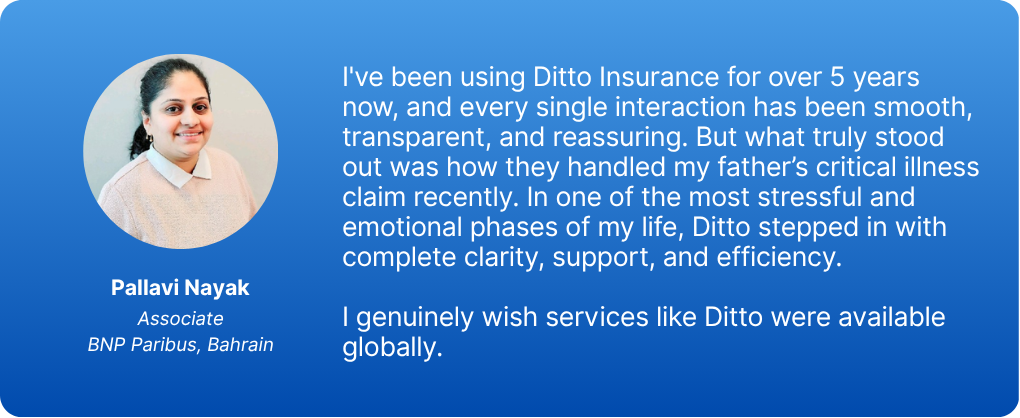
At Ditto, we’ve assisted over 8,00,000 customers with choosing the right insurance policy. Why customers like Pallavi below love us:
- No-Spam & No Salesmen
- Rated 4.9/5 on Google Reviews by 15,000+ happy customers
- Backed by Zerodha
- Dedicated Claim Support Team
- 100% Free Consultation
Confused about the right insurance? Speak to Ditto’s certified advisors for free, unbiased guidance. Book your call or chat on WhatsApp with us now!
The Final Takeaway
IRDAI's proposals are not just standalone fixes for claim delays or low insurance penetration. They fit into the regulator’s broader Bima Trinity vision, which includes Bima Vistaar, Bima Vaahak, and Bima Sugam. In that larger framework, the basic health cover is likely meant to widen access, while the scorecards could create the transparency needed for a more credible insurance marketplace.
And that context matters because it shows IRDAI’s vision to reshape how insurance is distributed, compared, and experienced in India.
The success of these reforms will also depend on whether the wider Bima Trinity rollout finally gains traction. If that happens, the scorecards and basic cover could become meaningful building blocks of a more transparent and accessible health insurance market.
Frequently Asked Questions
Last updated on: