

Overview

A level term life insurance plan is a type of pure life cover where both the premium and the sum assured remain fixed throughout the policy term. Since the payout does not change over time, it is considered one of the simplest and most affordable forms of life insurance.

For example, if you buy a ₹1 crore policy for 30 years, your nominee will receive ₹1 crore whether the claim happens in year 2 or year 28.

There is no maturity payout unless you choose a return-of-premium (ROP) option.

For instance, under the HDFC Life Click 2 Protect Supreme, a 35-year-old non-smoker pays roughly ₹17,397 annually for a ₹1 crore cover till age 65.

This guide compares level, increasing, and decreasing term insurance plans.

Term insurance is meant to protect your family's financial future if you are no longer around. Yet many buyers are unsure which structure to pick, especially when comparing level term, increasing term, and decreasing term plans. Level term life insurance is the most straightforward of the three and remains the most widely purchased type in India.

This guide will help you figure out if this term insurance type suits your needs.

How Level Term Life Insurance Works?

    • In a level benefit term life insurance plan, the sum assured remains constant throughout the policy term.
    • The insurer evaluates your age, health, income, occupation, and lifestyle at the time of purchase. 
    • Based on this assessment, they calculate a premium that generally remains fixed throughout the policy tenure, whether that is 20, 30, or 40 years.
    • For example, in a 30-year level term life insurance plan, the premium you pay from the second year onward remains the same even in the 29th year.
    • If you pass away during the policy term, your nominee receives the full sum assured. If you outlive the policy term, the cover ends unless you have chosen a return-of-premium option.
    • One important thing to remember is that inflation gradually reduces the real value of a fixed cover. A ₹1 crore cover today may have the purchasing power of only ₹50–60 lakh after 20 years, which is why choosing an adequate sum assured from the beginning matters a lot.

Background Image

Key Features & Benefits of Level Premium Term Life Insurance Policies

01

Fixed Sum Assured

Your cover does not change, not upward, not downward, for the entire policy term. Whether a claim is made in year 3 or year 25, your nominee receives the exact amount you chose at inception. This predictability is what makes level term the most reliable form of life cover for long-term family protection.

02

Predictable Premiums

Premiums remain fixed throughout the policy term and do not increase due to age, health conditions developed later, or changes in lifestyle after policy issuance. You know exactly what you pay every single year, making it easy to budget and plan your finances around it.

03

Upfront Medical Underwriting

Through term insurance underwriting, the insurer reviews your health declarations, medical test results, and lifestyle habits once before issuing the policy. Once it is issued, they cannot revisit your health or revise your premium, no matter what changes. Your rate is locked in for the entire duration of the policy.

04

Simple Claim Process

Because the sum assured is fixed and unambiguous, there is no room for calculation errors or disputes at claim time. Your nominee submits the required documents, and the insurer pays the exact cover amount. No moving parts, no complexity during what is already a difficult time for your family.

05

Long Tenures Available

Most level term plans in India let you choose coverage up to age 70, or even 85. Some plans even extend coverage for whole life (example: up to age 99). This flexibility means you can align the policy term with the actual number of years your family depends on your income, ensuring protection exactly where it is needed.

CTA

Level Term vs. Decreasing vs. Increasing Term Insurance

Feature Comparison:

FeatureLevel TermIncreasing TermDecreasing Term
Sum Assured Over TimeFixed throughoutGrows each year (e.g. 5% p.a.)Reduces each year (e.g., a fixed percentage every year or gradually reducing cover like a loan balance)
PremiumFixedGenerally higher than levelMaybe lower than level
Best ForLong-term family protectionYoung buyers with growing needsSpecific loan repayment
Inflation ProtectionOnly if the cover is sized rightPartial (simple interest growth)None
Cover from Day OneFull cover immediatelyStarts lower, grows over timeStarts higher, falls steadily

Premium Comparison: Increasing vs Term

Profile₹1 Crore Level Cover₹2 Crore Level Cover₹1 Crore Increasing Cover (5% Increase per Year)
25, Male₹10,945₹19,333₹15,805
25, Female₹9,303₹16,433₹13,434
35, Male₹17,397 ₹30,508₹25,850
35, Female ₹14,787₹25,932  ₹21,973

Profile Considered: Premiums above are for a healthy, non-smoking, salaried male aged 25, covered until 65, in Delhi (pin: 110010). Source: HDFC Life Click 2 Protect Supreme. These are indicative and subject to change.

Insights: The key trade-off with level term plans is that you get full protection from day one, but the real value of that cover declines with inflation over time. The increasing term grows with you, but costs more and takes years to reach meaningful coverage levels above the base. For most buyers, sizing the level cover correctly from the start and accounting for future inflation is the simpler and more reliable approach.

 Who Should Buy Level Term Life Insurance?

Level term life insurance is a strong fit if:

    • You have dependents(spouse, children, aging parents) who rely on your income.
    • Your liabilities and financial goals are already sizable: outstanding home loan, children's education corpus, and retirement support for parents.
    • You prefer predictable protection with no ambiguity about what your family receives.
    • You are buying young and can lock in high coverage at low, fixed premiums for decades.
    • You have calculated a sufficient cover amount that accounts for inflation and future needs, making an increasing cover option redundant.

Why Choose Ditto for Term Insurance?

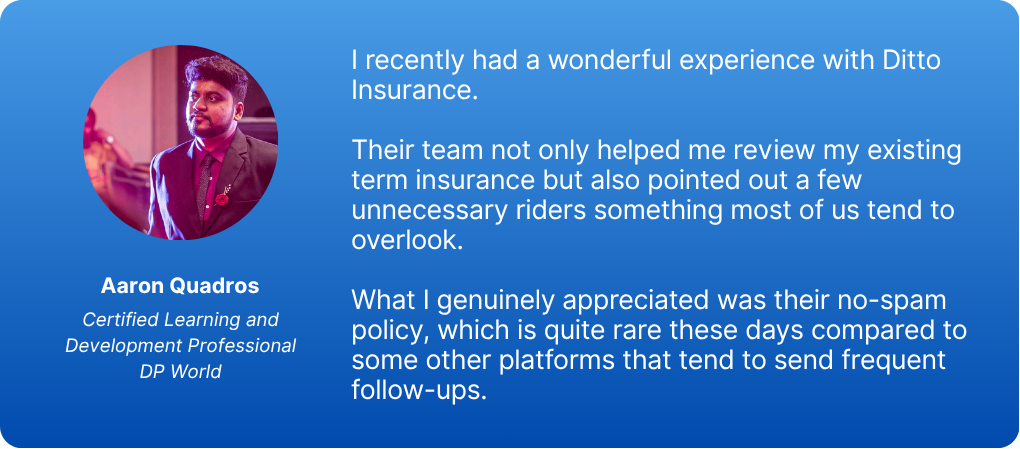
At Ditto, we’ve assisted over 9,00,000 customers with choosing the right insurance policy. Why customers like Aaron below love us:
Level Term Life Insurance
    • No-Spam & No Salesmen
    • Rated 4.9/5 on Google Reviews by 23,000+ happy customers
    • Backed by Zerodha
    • Dedicated Claim Support Team
    • 100% Free Consultation

You can book a FREE consultation. Slots are running out, so make sure you book a call now!

Conclusion

Level term life insurance remains one of the most practical and reliable ways to financially protect your family. The best level term life insurance plan is not simply the one with the lowest premium. The sum assured stays fixed throughout the policy term, premiums are usually predictable, and the plan is simple to understand. 

It works especially well when bought early and with a cover amount large enough to replace your income and support your family’s long-term needs. However, the biggest drawback is that the cover amount does not automatically increase with inflation or rising responsibilities over time.

Alternatives like increasing term insurance gradually raise the cover amount, while decreasing term insurance is mainly suited for loan repayment needs. Still, for most people, a level term plan with adequate coverage remains the preferred choice. If your responsibilities grow later, you can simply enhance protection by purchasing additional term cover instead of replacing the original policy.

Frequently Asked Questions

What is level term life insurance, and how does it work?

Level term life insurance is a type of term plan where your sum assured remains fixed for the entire policy duration. You choose a cover amount at inception, say a ₹1 crore term insurance, and your nominee receives exactly that amount if you pass away anytime during the term. The premium is calculated once based on your age, health, income, and habits, and does not change year on year. There is no maturity benefit in a pure term plan unless you have opted for a return-of-premium variant.

Is level term life insurance good?

Yes, for most buyers, it is the most reliable form of life insurance. The fixed cover ensures your family knows exactly what to expect, and the fixed premium makes budgeting simple. The main caveat is inflation; a fixed sum assured loses real value over time, so it is important to size your cover adequately from the start. If you calculate your cover requirement carefully and account for future expenses, level term life insurance remains the strongest long-term protection option available. You can use Ditto’s term insurance cover calculator to make things easier for you.

What is the difference between level term and increasing term insurance?

A level benefit term life insurance plan keeps your sum assured fixed throughout the policy term. If you buy a ₹1 crore cover, your nominee receives ₹1 crore whether the claim happens in year 2 or year 25. An increasing term insurance plan, on the other hand, gradually raises the cover every year, commonly by 5%, to partly offset inflation. However, increasing term plans are usually more expensive and do not provide higher cover immediately. At Ditto, we generally find level term plans more practical because they offer full financial protection from day one. 

What is a 30 year level term life insurance plan?

A 30 year level term life insurance plan simply means the policy term is 30 years. During this period, your sum assured remains fixed, and the premium generally stays constant throughout the tenure. For example, if you buy the policy at age 30, you stay covered until age 60 at the same premium from the second policy year onward. A longer policy term also means your family stays financially protected for a longer period, covering more years where they may depend on your income and support. 

How much cover should I buy with a level term plan?

You should account for outstanding loans (home loan, car loan), future financial goals (children's education, spouse's retirement), annual household expenses your income supports, and inflation over the policy term to find your ideal term insurance sum assured. Ditto’s term cover calculator will help you estimate this number more precisely. Buying insufficient term insurance coverage defeats the purpose of term insurance altogether, so err on the side of caution and purchase a higher sum assured instead of chasing a lower premium.

Can I increase my cover after buying a level term plan?

Some term insurance plans offer a Life Stage Benefit as a built-in feature that lets you raise your coverage at milestones like marriage, childbirth, or getting a home loan. Alternatively, you can buy a second term plan from any insurer, though premiums may get higher due to your increased age and any health changes, and the total cover you can get from all life insurance plans combined cannot exceed your total eligible amount. This is why sizing your cover correctly at the time of purchase is important. 

Are level premium term life insurance policies better than increasing term plans?

Generally, yes. However, the precision with which we can answer this question depends on your situation. Level premium term life insurance policies offer simplicity, full coverage from day one, and lower premiums compared to increasing term. They work best when you have already calculated a sufficient cover amount that accounts for long-term inflation and financial needs. Increasing term plans suit younger buyers whose income and responsibilities are still growing and who cannot yet afford the cover they will eventually need.

How do I get level term life insurance quotes and compare plans?

You can get level term life insurance quotes directly on insurer websites or through aggregator platforms like Ditto Insurance. The key variables that affect your term insurance premium quote include your age, gender, smoking status, medical history, annual income, and policy tenure. When comparing quotes, do not just look at the premium; check the insurer's Claims Settlement Ratio (CSR), complaint ratio, plan features (terminal illness cover, disability waiver, life stage benefits), riders, and the claim support process.

Last updated on: