



Quick Overview
Defence jobs come with honor, responsibility, and higher risk. Whether you’re serving in the Army, Navy, Air Force, CAPF, or as a police officer in high-risk zones, buying term insurance isn’t always as straightforward as it is for civilians.
This is because insurers classify military and combat-related roles as high-risk occupations, which can lead to stricter underwriting.
In this guide, we will discuss term insurance for defence personnel, how insurers assess risk, the different types of plans available, the realities of claims, and what to watch out for.
Why Defence Personnel Need Term Insurance Coverage
High Risk Profession Requires Dedicated Financial Protection
Income Replacement, Debt Protection & Lifestyle Continuity
Bridging Gaps in Government & Service Benefits
Flexible & Customizable Plans for Defence Lifestyles
Note: Defence personnel often face significant scrutiny when buying term insurance. They may need to complete occupation-specific questionnaires. For example, you can check out ICICI Prudential and HDFC Life’s questionnaires here.
There’s a high probability of counter-offers, premium loadings (sometimes up to 100%), and rider restrictions. Also, a high possibility of postponements for high-risk postings is present (for example: Jammu and Kashmir border/line-of-control).
Types of Military Life Insurance Plans Available
When we talk about military life insurance, there are broadly two routes:
Government-Backed Options
You can choose Army Postal Life Insurance (APLI) or other service-specific group insurance schemes. These are subsidized, trusted, and stable, but may not always offer high coverage.
Private Term Insurance Plans
Several private insurers offer term insurance for defence personnel, including HDFC Life, Axis Max Life, and Bajaj Life. Based on market experience, these insurers are relatively more open to underwriting defence profiles, though terms depend heavily on role and posting.
Programs Offered by Private Term Insurers
HDFC Shaurya is a specialized insurance initiative by HDFC Life, tailored mainly for serving and retired defence and paramilitary personnel and their families. It offers simplified policy issuance, dedicated servicing support (often with ex-servicemen teams), and enhanced claims facilitation, including documentation waivers and faster settlements.
The Prahri initiative from Pramerica Life Insurance in India provides life cover that explicitly accounts for risks associated with military service, including war, counterinsurgency, and disaster duties, with tailored products such as Rakshak Smart, RockSolid Future, and Magnum Assure. A key distinguishing feature is its focus on swift claim processing in field conditions, often accepting demi-official letters in lieu of formal death certificates.
Army Postal Life Insurance (APLI): Features & Benefits
Army Postal Life Insurance (APLI) is a government-backed life insurance scheme specially designed for members of the Indian Armed Forces and related groups. It offers tailored life coverage to military personnel, including:
- Active Defence Service Members: Army, Navy, Air Force personnel.
- Non-combatants associated with defence duties (e.g., clerical staff, support personnel).
- Coverage extends to eligible spouses and children under specific policy variants.
Eligibility generally requires applicants to be within specified age limits (19-55 for most plans), with the possibility of covering children from a young age under children’s policies.

Features and Benefits of Army Postal Life Insurance
Affordable Premiums
Premiums under APLI are generally lower than those of similar life insurance plans offered by private insurers, making coverage more affordable.
Sum Assured
Most APLI plans offer coverage from around ₹20,000 up to ₹50 lakh, depending on the plan and choice of benefits.
Bonus Facility
APLI policies typically include annual bonuses added to the sum assured. These bonuses accumulate over time and increase the maturity or claim benefit.
Loan and Surrender Options
After a minimum number of years in force (usually 3-4 years depending on the plan), policyholders can avail loans against their policies or surrender the policy for cash value.
Flexible Premium Payment
Premiums can be paid monthly, quarterly, half-yearly, or yearly, offering flexibility.
Tax Benefits
Premiums paid enjoy tax advantages under Section 80C (old regime) and the death benefit is tax-free under Section 10(10D) of the Income Tax Act, respectively.
Key Differences Between APLI and Private Term Plans
While APLI provides a government-backed savings-oriented life insurance option for eligible defence personnel, it is not optimized for high-value financial protection. On the other hand, private term insurance plans are designed with one clear objective: maximum life cover at the lowest possible cost.
For more details, you can also check out our detailed guide on the best term insurance plans in India.
Key Benefits & Coverage Offered Under Defence Term Insurance
Term insurance for defence personnel offers a high sum assured at relatively affordable premiums, ensuring substantial income replacement for families in case of untimely death. Depending on underwriting approval and role risk, coverage may extend to deaths occurring in war-like situations or hostile environments, subject to policy terms.
Plans typically provide flexible payout options (lump sum or monthly income), customizable policy tenure, and tax benefits under prevailing laws. While riders such as accidental death or disability may be restricted for high-risk postings, a well-structured term plan remains one of the most effective ways for defence personnel to secure long-term financial protection beyond government benefits.
How to Choose the Best Term Insurance for Defence Personnel
1) Choose Adequate Coverage Based on Income & Liabilities
Opt for a sum assured by factoring in outstanding loans, children’s education costs, and long-term household expenses. Since defence careers involve mobility and early retirement scenarios, ensure the coverage extends through your family’s most financially dependent years. You can calculate the total cover amount you need using the cover calculator on our website, too.
2) Evaluate the Insurer’s Underwriting Approach for Defence Roles
Not all insurers assess armed forces profiles the same way. Compare how companies treat your specific role (field vs. administrative), your posting location, and risk exposure. Look for insurers experienced in handling defence cases, as this can influence premium loading, approval chances, and policy terms.
3) Check Policy Exclusions & War Clauses Carefully
Review clauses related to war, hostilities, aviation duties, and hazardous activities. Some policies may have specific exclusions or conditions tied to active combat or high-risk deployments. Clear disclosure and understanding of these terms are crucial to avoid disputes over claims later. Once an insurer underwrites the policy based on disclosures about the high risk you face in your occupation and issues the policy, all types of death, including those in your occupation, will be covered as well.
4) Assess Premium Loading & Counter-Offer Scenarios
Be prepared for possible premium loadings (up to 100%), reductions in sum assured, or rider restrictions due to occupational risk. Compare final approved premiums, not just initial quotes, to determine the most cost-effective option after underwriting adjustments.
5) Prioritize Claim Settlement Track Record & Transparency
Choose insurers with a strong claim settlement history and clear communication standards. For defence personnel, transparency in documentation, full disclosure of role details, and insurer reliability are critical to ensure smooth claim processing for your family.
Why Choose Ditto for Term Insurance?
At Ditto, we’ve assisted over 8,00,000 customers with choosing the right insurance policy. Why customers like Aaron below love us:
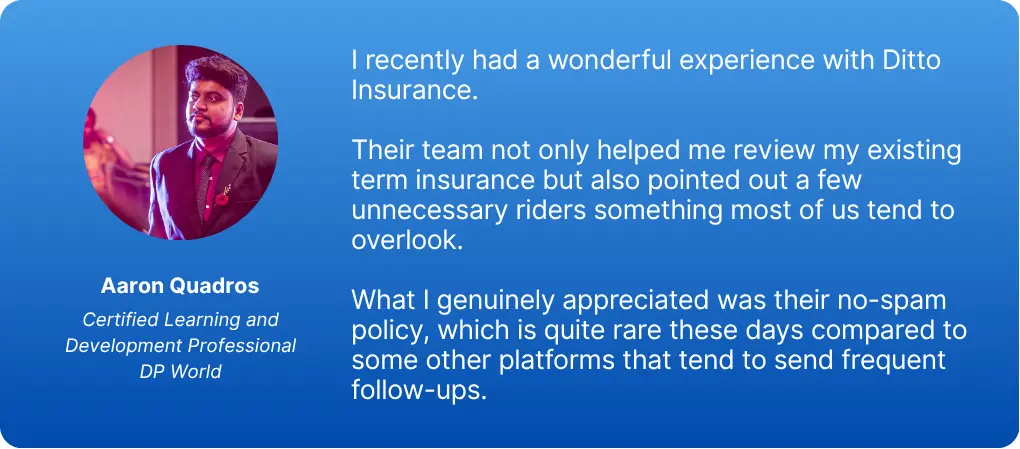
- No-Spam & No Salesmen
- Rated 4.9/5 on Google Reviews by 15,000+ happy customers
- Backed by Zerodha
- 100% Free Consultation
You can book a FREE consultation. Slots are running out, so make sure you book a call or chat on WhatsApp now!
Ditto’s Take on Term Insurance for Defence Personnel
From our experience, getting term insurance for defence personnel isn’t about just comparing premiums, but it’s about navigating underwriting correctly. Approval largely depends on role clarity, posting location, and honest disclosure, with field and high-conflict roles often facing loadings, postponement, or counter-offers. The key is to apply to insurers with prior experience underwriting armed forces profiles and to set realistic expectations around riders and pricing. With the right strategy, meaningful and high-value coverage is absolutely achievable, even in a high-risk profession.
Full Disclosure: Axis Max Life, Bajaj Life, HDFC Life, and ICICI Prudential are partner insurers of Ditto. This article is for informational purposes, and all the details mentioned above have been taken from IRDAI, insurer websites, and publicly available data.
Frequently Asked Questions
Last updated on: