




Quick Overview
If you’re looking for life insurance as a senior citizen, it likely comes from a place of responsibility and care. Questions like “Do I need to leave something behind for my family?” or “What if my spouse depends on me financially?” are completely natural at this stage of life.
In this guide, we will help you understand when buying life insurance makes sense for senior citizens, which options are available, and how to choose the right option for your needs.
Why Buy a Life Insurance Policy for Senior Citizens?
Financial Protection for Dependents
Cover Outstanding Liabilities and Debt
Coverage for Final Expenses and Estate Planning
Guaranteed Income
Life Insurance for Senior Citizens Over 60 & 65 Years
Getting life insurance for senior citizens over 60 is still possible, but it comes with some limitations.
What to Expect
- Higher Premiums
Insurers charge significantly higher premiums for senior citizens than for younger individuals because mortality risk increases with age. Even basic term plans that are affordable in your 30s or 40s become much more expensive at 60. Additionally, pre-existing health conditions such as diabetes, high blood pressure, or heart issues can further increase premiums or lead to an outright rejection. - Mandatory Medical Tests
Most insurers require a detailed medical examination (such as blood tests, treadmill tests, urine tests, blood pressure checks, and echocardiograms for heart conditions) before issuing a policy, as these tests help assess your overall health risk. Based on the results, insurers may increase premiums, limit coverage, or even decline the application. - Lower Coverage Amount
Since the risk to the insurer is higher at older ages, coverage amounts are usually restricted. Senior citizens are often offered smaller sum assured options, and getting large covers like ₹1 crore or more can be difficult unless the applicant is in excellent health. Policies with fewer medical requirements may have even stricter coverage limits. - Limited Policy Tenure
Life insurance policies for senior citizens typically have shorter durations than those for younger buyers. Most plans have a maximum maturity age of around 80-85 years, which limits long-term protection. However, certain whole life plans may extend coverage to 99 or even 100 years, making an already high premium even higher.
Buying Life Insurance When You’re Young (For Protection in Your 60s)
Options for Life Insurance for Senior Citizens Over 70
Getting life insurance for senior citizens over 70 is significantly more challenging, but not impossible. You can check out the following plans:
Term Insurance (If Eligible)
Term insurance is the most affordable life insurance option, even for seniors. It provides pure life cover where your nominee receives a payout if something happens during the policy term. However, eligibility becomes stricter after 60-65. For more details, you can check out our comprehensive guide on term insurance for senior citizens.
Annuity/Pension Plans
These plans focus on income rather than death benefits. You invest a lump sum (or pay premiums), and in return, you receive a guaranteed regular income for life. They are ideal for retirees who want financial stability without worrying about market risks. For example: ICICI Prudential Guaranteed Pension Plan, which provides a steady lifelong income after retirement
Whole Life Insurance
This plan provides coverage for your entire lifetime instead of a fixed term. Premiums may be paid for a limited period, but coverage continues until death, ensuring your family receives a payout upon your death.

How to Choose the Best Life Insurance for Senior Citizens
Be Clear About the Purpose
Life insurance for senior citizens should primarily serve as a financial safety net for dependents, offering a lump-sum payout in the event of an unfortunate event. It is not designed to cover medical expenses or generate a regular income. If you want healthcare coverage, explore health insurance instead.
Understand Product Trade-Offs
Certain features, such as getting your purchase price back later, may appear attractive at first glance. However, these often come at the cost of lower regular payouts, making it crucial to carefully evaluate the balance between returns, liquidity, and long-term benefits.
Use the Free-Look Period
As per the Insurance Regulatory and Development Authority of India (IRDAI) guidelines, you get a free-look period of at least 15 days (30 days for online). This window allows you to review the plan in detail and cancel it if it does not align with your needs.
Recommendations Based on Your Situation
- If you are 60-65, still earning, with dependents or outstanding loans
Start with pure term insurance. Focus on covering the exact duration of your financial obligations, such as loans or support for dependents. - If you are retired and want a steady monthly income
Consider immediate annuity or pension products. These are designed to convert a lump sum into regular income. Joint-life options can ensure that your spouse continues to receive income after your lifetime. - If you want a predictable income with some legacy benefits
Whole-life or guaranteed-income policies can be considered. However, these should be approached as conservative savings tools rather than efficient insurance coverage. The returns are typically modest, but they offer stability and a structured payout. - If you are 70+ with no financial dependents
Buying new life insurance is often unnecessary. Instead, you should focus on maintaining adequate health coverage, keeping a cash reserve, ensuring your spouse can access accounts easily, and organizing your will and estate documents.
Why Choose Ditto for Term Insurance?
At Ditto, we’ve assisted over 8,00,000 customers with choosing the right insurance policy. Why customers like Aaron below love us:
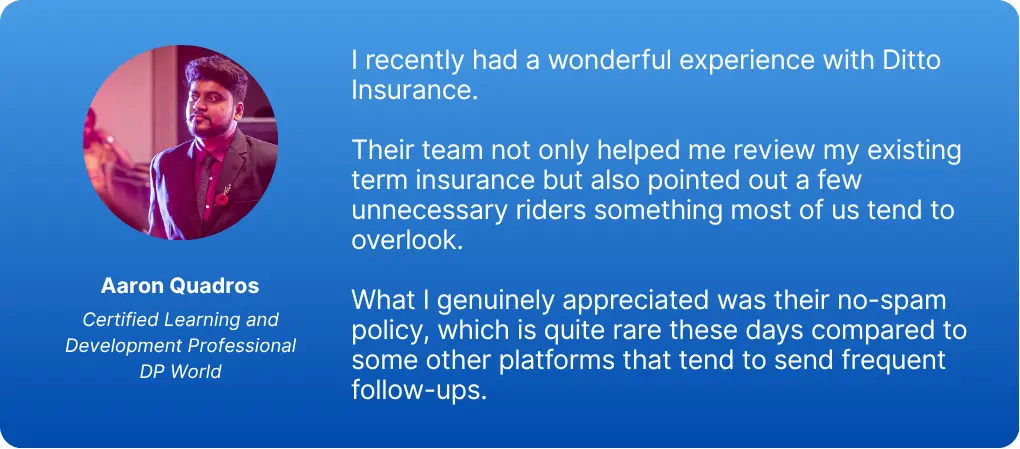
- No-Spam & No Salesmen
- Rated 4.9/5 on Google Reviews by 15,000+ happy customers
- Backed by Zerodha
- 100% Free Consultation
You can book a FREE consultation. Slots are running out, so make sure you book a call or chat on WhatsApp now!
Conclusion
Life insurance for senior citizens is less about maximizing coverage and more about solving specific financial needs. At this stage of life, the focus should shift from large-scale protection plans to practical goals such as supporting a dependent spouse, covering liabilities, managing final expenses, or ensuring a steady income stream.
While traditional term insurance becomes harder to access after 60-65, it’s still worth exploring if you’re eligible and have a clear need. For many others, annuity and pension plans often make more sense, as they provide predictable income and financial stability without the complexities of large cover approvals.
Frequently Asked Questions
Last updated on: