LIC New Jeevan Sathi-Limited Premium (Plan 889) is a joint-life endowment plan for married couples that combines life insurance with guaranteed savings. It covers both spouses under a single policy and includes a premium waiver benefit, where future premiums are waived if either spouse dies during the policy term.
The plan offers guaranteed additions at 7% of the total tabular annual premium, along with a maturity benefit comprising the basic sum assured plus accrued additions. Buyers can choose between two death benefit options. This LIC New Jeevan Sathi-Limited Premium review suits those who wish to understand the policy.
However, at Ditto, we do not recommend endowment plans because they combine insurance and investment, often resulting in lower returns and less efficient life cover compared to separate term insurance and investments.
For couples seeking certainty over market-linked returns, the LIC New Jeevan Sathi-Limited Premium plan offers predictable benefits and a structured payout framework. The limited premium feature reduces the payment commitment period, while the joint-life structure ensures continuity of benefits for the surviving spouse.
This guide breaks down LIC New Jeevan Sathi-Limited Premium, covering its features, benefits, eligibility, returns, and considerations before buying.
Eligibility Criteria and Premium Payment Term Options
Eligibility Parameter
LIC New Jeevan Sathi-Limited Premium
Minimum Entry Age
18 years completed for both lives
Maximum Entry Age: Option I
Depends on Premium Payment Term (PPT) and policy term, up to 50 years
Maximum Entry Age: Option II
Depends on PPT and policy term, up to 40 years in some combinations, lower for 25-year terms
Minimum Maturity Age
28 years completed
Maximum Maturity Age
Option I: 75 years, Option II: 60 years
Policy Term
10, 15, 20, or 25 years
Premium Payment Term
5, 10, or 15 years
Death Benefit Options
Option I and Option II
Basic Sum Assured
₹3,00,000 with no fixed limit (subject to underwriting)
Key Features of LIC New Jeevan Sathi-Limited Premium Plan
Premium Waiver Benefit: If the first death occurs during the premium paying term, future base premiums are waived, and the policy continues for the surviving spouse.
Choice of Death Benefits: Buyers can choose between Option I and Option II at the time of purchase. The selected option affects both premiums and benefits and cannot be changed later.
Guaranteed Additions: The policy earns guaranteed additions equal to 7% of the total tabular annual premium for premiums paid. This is a fixed policy benefit and should not be mistaken for a 7% annual investment return.
Guaranteed-Benefit Structure: The plan does not participate in LIC's profits and does not earn reversionary (annual and non-guaranteed profit share) or terminal bonuses. These benefits are predetermined.
Policy Loan Facility: Policyholders can take a loan after one policy year, provided at least one full year's premium has been paid. This offers liquidity without surrendering the policy. The maximum loan you can take is 75% of the surrender value for active policies and 50% for paid-up policies.
Optional Riders: Additional protection is available through riders such as the Accidental Death and Disability Benefit Rider, New Term Assurance Rider, and Critical Illness Health Rider, subject to eligibility and rider conditions. The Critical Illness Rider offers two coverage choices: Option I covers 15 major critical illnesses, while Option II expands protection to 40 major critical illnesses.
Take Note: The combined premium for all attached life insurance riders cannot exceed 30% of the premium payable under the base policy.
Talk to an expert today and find the right insurance for you.
Option I Sample Premiums Across Policy Terms
Age
15 Years (5 Years PPT)
20 Years (10 Years PPT)
25 Years (15 Years PPT)
20
₹68,505
₹33,045
₹20,715
35
₹75,705
₹37,035
₹25,095
45
₹1,12,470
₹50,265
₹35,055
Note: The table shows illustrative annual premiums for a ₹3 lakh basic sum assured, calculated for standard lives assuming both spouses are of the same age. Actual premiums may vary based on age, underwriting, and rider selection. These figures are sourced from LIC’s New Jeevan Sathi - Limited Premium brochure.
A ₹3 lakh sum assured is too little to provide meaningful financial protection for most families today. In many cases, life cover requirements can run into ₹1 crore to ₹2 crore, depending on income, liabilities, and financial goals. Use our online term cover calculator to estimate a more realistic coverage amount for your family's needs.
Death Benefit and Maturity Benefits Explained
01
First Death During the Policy Term
If one spouse passes away during the policy term, LIC pays the sum assured on death to the surviving spouse. The policy does not end and continues on the surviving life. If the death occurs during the premium paying term, all future base premiums are waived, though rider premiums may continue as per rider conditions.
02
Second Death During the Policy Term
Upon the surviving spouse’s death, LIC pays the sum assured along with all accrued guaranteed additions. The policy then terminates.
03
Simultaneous Death of Both Lives
In the rare event that both lives pass away simultaneously, LIC pays the combined value of the applicable first-death and second-death benefits before terminating the policy.
04
Maturity Benefit
If at least one life assured survives until the end of the policy term, LIC pays the basic sum assured plus all accrued guaranteed additions as the maturity benefit.
Note: Based on LIC’s illustrative projections, the estimated maturity return for New Jeevan Sathi Limited Premium is roughly 4.3% to 4.6% p.a. for Option I and 4.2% to 4.5% p.a. for Option II.
While the plan offers guaranteed benefits, joint-life protection, and premium-waiver support, buyers should view the 7% guaranteed addition as a benefit formula rather than an indication of actual investment return.
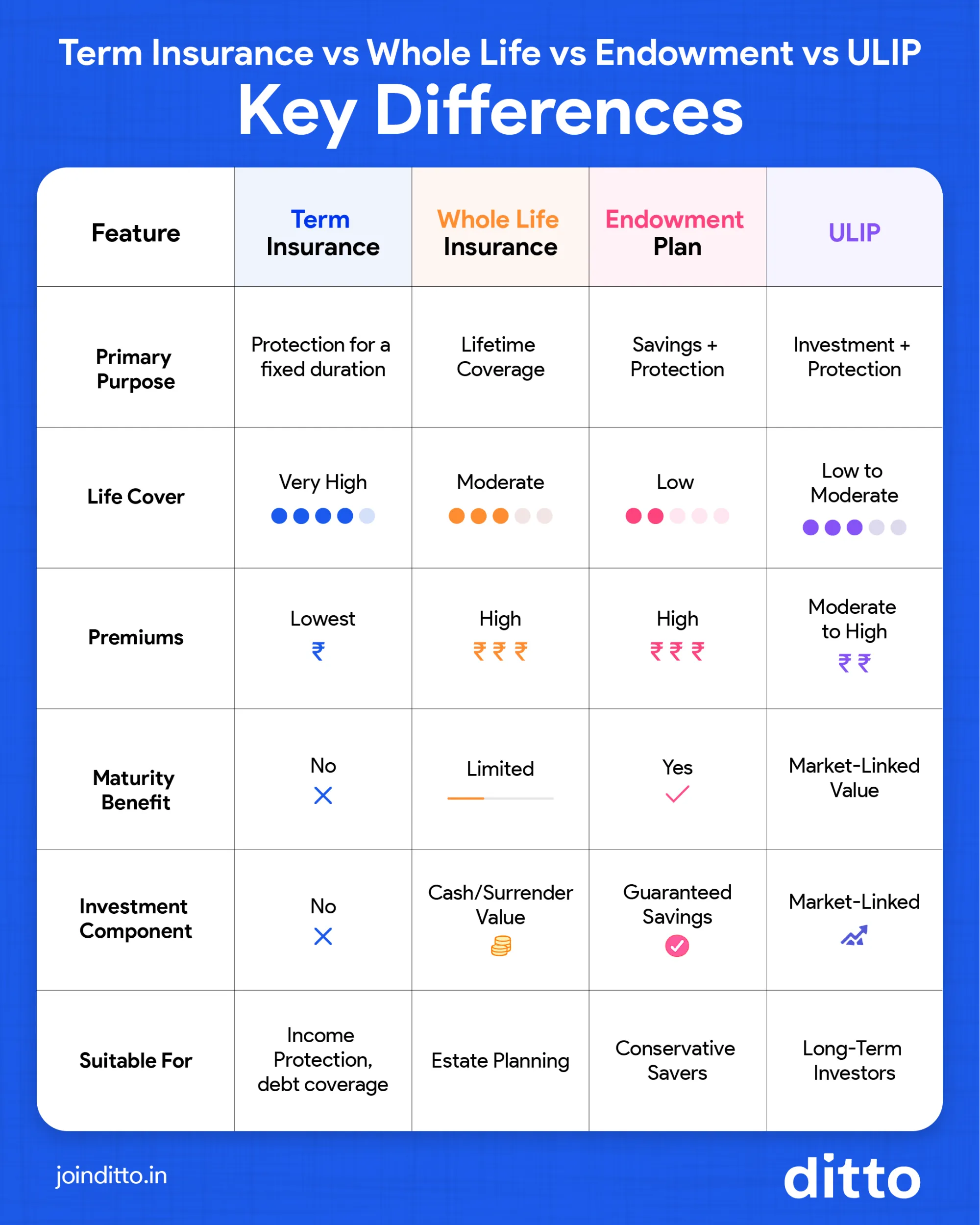
For most buyers, a more efficient approach is to use a term plan purely for life insurance protection and invest separately through products such as mutual funds or fixed deposits. This allows you to optimize both coverage and wealth creation instead of combining them in a single product.
At Ditto, we recommend pure term plans over other life insurance products like endowment plans because they focus entirely on protection and deliver significantly higher life cover at a much lower cost. Here’s how a term plan compares with other life insurance products.
If you're evaluating protection options, our guide to the best term insurance plans in 2026 can be a useful next step. In most cases, separate individual term plans work better than a joint term insurance for husband and wife, as they provide independent coverage, separate claim payouts, and greater flexibility as life circumstances change.
Single Premium vs Limited Premium: Which Variant Should You Choose?
Feature
Single Premium (Plan 888)
Limited Premium (Plan 889)
Key Insight
Plan Type
Joint-life endowment with one-time premium.
Joint-life endowment with premiums over 5, 10, or 15 years.
Single offers simplicity, Limited offers cash-flow flexibility.
Premium Payment
Pay once at inception.
Pay over a fixed premium paying term.
Single removes lapse risk while Limited reduces upfront burden.
Premium Waiver
Not applicable.
Future base premiums are waived on the first death during PPT.
A key advantage of the Limited Premium variant.
Loan Facility
Available after 3 months or free-look completion.
Available after one policy year.
Single Premium offers earlier access to loans.
Best For
Couples with surplus funds seeking a one-time commitment.
Working couples who prefer staggered payments.
Choice depends largely on cash-flow preference.
Avoid If
You need liquidity, high returns, or large life cover.
You may struggle with future premiums or seek investment growth.
Neither is a substitute for term insurance plus investing.
Overall View
Simpler structure with no future premium obligations.
More practical for salaried couples due to lower upfront cost.
Limited Premium is often easier to manage financially.
Should You Buy LIC New Jeevan Sathi-Limited Premium?
LIC New Jeevan Sathi-Limited Premium may suit conservative married couples who value guaranteed benefits, prefer the comfort of LIC, and want a single policy covering both spouses. The premium waiver benefit on the first death during the premium paying term is one of the plan's most meaningful features for family protection.
However, it may not be ideal for buyers seeking high life cover or strong investment returns. Those with uncertain cash flows or potential liquidity needs should also proceed carefully, as early exits can reduce overall value.
Why Choose Ditto for Life Insurance?
At Ditto, we’ve assisted over 8,00,000 customers with choosing the right insurance policy. Why customers like Aaron below love us:
No-Spam & No Salesmen
Rated 4.9/5 on Google Reviews by 24,000+ happy customers
LIC New Jeevan Sathi-Limited Premium is best viewed as a conservative joint-life savings and protection plan rather than a return-focused investment. Its key strengths include guaranteed benefits, joint-life coverage, guaranteed additions, and a premium waiver that keeps the policy active after the first death during the premium paying term.
For couples who value structured financial protection, it can be a reasonable option. However, those seeking higher returns or larger life cover may find separate investment products and term insurance more efficient.
What is LIC New Jeevan Sathi-Limited Premium, and how does it differ from the Single Premium version?
LIC New Jeevan Sathi-Limited Premium (Plan 889) is a joint-life endowment plan for married couples that combines life insurance protection with guaranteed savings. Unlike the Single Premium variant, where the entire premium is paid upfront, this plan allows premiums to be paid over 5, 10, or 15 years. It also includes a valuable premium waiver feature in which future base premiums are waived if the first death occurs during the premium paying term. This makes the plan more accessible to couples who prefer to spread payments over time rather than make a large one-time investment.
What is the premium waiver benefit in LIC New Jeevan Sathi-Limited Premium?
The premium waiver benefit is one of the plan's most important features. If either spouse dies during the premium paying term, LIC waives all future base premiums while keeping the policy active for the surviving spouse. For example, if death occurs in the fifth year of a 15-year premium paying term, the remaining 10 years of base premiums are waived. The surviving spouse continues to enjoy policy benefits without additional base premium payments. However, rider premiums will continue depending on the rider terms and conditions applicable to the policy.
How do guaranteed additions work in LIC New Jeevan Sathi-Limited Premium?
The plan offers guaranteed additions equal to 7% of the total tabular annual premium for premiums paid. These additions accumulate over the policy term and increase both the maturity and the eligible death benefits. For instance, if the total annual tabular premium is ₹1 lakh, the guaranteed addition amounts to ₹7,000 for each eligible year. Buyers should note that this is a policy benefit formula and not a 7% annual investment return. This rate may be increased through eligible incentives for higher basic sum assured, online purchases, and existing LIC policyholders or nominees/beneficiaries.
What are the two death benefit options available under the plan?
LIC New Jeevan Sathi-Limited Premium offers two death benefit structures that must be selected at policy inception. Under Option I, the death benefit is the higher of 7 times the tabular annual premium or the basic sum assured. Under Option II, the death benefit is the higher of 10.5 times the tabular annual premium or the basic sum assured. Option II generally provides higher protection but may result in different premium requirements. Since this choice cannot be changed later, couples should evaluate their protection needs carefully before selecting an option.
What premium payment terms are available under LIC New Jeevan Sathi-Limited Premium?
The plan offers flexible premium payment terms of 5, 10, or 15 years. While premiums are paid only during the chosen payment term, policy coverage continues for the full policy duration. A shorter payment term requires higher annual premiums but clears the obligation sooner. A longer payment term reduces annual outgo and may be easier on household cash flow. At Ditto, we recommend selecting a premium paying term that aligns with your income stability and long-term financial commitments to avoid future affordability concerns.
What is the minimum sum assured under LIC New Jeevan Sathi-Limited Premium?
The minimum basic sum assured under the plan is ₹3 lakh. The Jeevan Sath LIC plan has no predefined upper limit, although the maximum cover depends on LIC's underwriting guidelines and the buyer's financial eligibility. The chosen sum assured directly influences death benefits, maturity proceeds, and guaranteed additions. Higher sums assured provide greater financial protection but also increase premium obligations. Couples should select a cover amount that balances affordability with their long-term protection and savings objectives rather than focusing solely on the minimum eligibility requirement.
What are the entry age and maturity age limits for this plan?
The minimum entry age for both spouses is 18 years. Maximum entry ages vary depending on the selected option, policy term, and premium paying term. Under Option I, entry ages can go up to 50 years in certain combinations. Under Option II, the maximum age can be lower, often up to 40 years, depending on the chosen term. The maximum maturity age is generally 75 years under Option I and 60 years under Option II. Buyers should verify eligibility carefully because age limits differ across policy structures.
What is the surrender value rule in LIC New Jeevan Sathi-Limited Premium?
LIC New Jeevan Sathi-Limited Premium can be surrendered after completing one policy year, provided at least one full year's premium has been paid. However, the Jeevan Sathi LIC policy acquires a Guaranteed Surrender Value (GSV) only after payment of at least two full years' premiums. On surrender, LIC pays the higher of the guaranteed surrender value plus the surrender value of accrued guaranteed additions, or the Special Surrender Value (SSV). The GSV is calculated using the total premiums paid, excluding rider premiums, extra premiums, and taxes, multiplied by LIC's applicable surrender value factors. Early surrender can significantly reduce overall returns.
What happens if I stop paying premiums for LIC New Jeevan Sathi-Limited Premium Plan?
If you stop paying premiums, the outcome depends on how many premiums have already been paid. If less than one full year's premium has been paid, the policy lapses after the grace period, and no benefits remain payable. If at least one full year's premium has been paid and the policy has completed one policy year, the policy generally acquires paid-up status instead of becoming void. In this case, death and maturity benefits are reduced proportionately based on premiums paid. Accrued guaranteed additions remain attached, while future additions continue at a reduced paid-up rate. Rider benefits, however, do not continue under a paid-up policy.
What are the LIC Jeevan Sathi policy details?
The LIC Jeevan Sathi is a joint-life endowment plan designed for married couples. Among the most important LIC Jeevan Sathi policy details are joint-life coverage, guaranteed additions, maturity benefits, and protection for both spouses under a single policy. On the first death, the applicable death benefit is paid, and the policy continues for the surviving spouse. In the Limited Premium variant, future base premiums may also be waived if the first death occurs during the premium paying term. The plan also offers rider options, installment payout facilities, and guaranteed benefits that provide financial certainty throughout the policy term.