




Overview
Many retirees worry about what happens to their family's income after they're gone, especially when a spouse or dependent relies on their pension. Jeevan Akshay VII offered by the Life Insurance Corporation of India (LIC) addresses this concern through flexible joint-life annuity options.
This LIC Jeevan Akshay VII review compares its guaranteed income, liquidity, returns, and alternatives to help you make a more informed retirement decision.
What Is the LIC Jeevan Akshay VII Plan?
LIC Jeevan Akshay VII (UIN 512N337V07) is a non-linked, non-participating, individual immediate annuity plan designed for people seeking a guaranteed pension after making a one-time premium payment.
The plan can be purchased online through the official LIC website or offline through LIC agents, authorized intermediaries, Point of Sales Persons (POSP), and Common Public Service Centres (CPSC).
LIC Jeevan Akshay VII: All 10 Annuity Options Compared
Single Life Annuity Options
- Option A: Provides a guaranteed pension for your lifetime. The annuity starts immediately after purchasing the policy and stops after the annuitant's death. Option A offers the highest income when maximizing the annuity payout is the priority.
- Option B: Offers a minimum guaranteed pension for 5 years, even if the annuitant is no longer alive during that period. After the guaranteed term, the annuity continues only for the remainder of the annuitant's lifetime.
- Option C: Ensures the annuity is paid for at least 10 years, regardless of any eventuality during that period. After the guaranteed 10 years, the pension continues throughout the annuitant's lifetime.
- Option D: Guarantees pension payments for 15 years and then continues the annuity for life. This option suits individuals who want both long-term payment certainty and lifelong retirement income.
- Option E: Provides a minimum guaranteed annuity for 20 years followed by lifelong pension payments. It is designed for those who want extended income certainty along with lifetime financial security.
- Option F: Pays a lifetime pension and returns the entire purchase price to the nominee after the annuitant's lifetime. This option is popular among those who want regular income while preserving capital for their family.
- Option G: Starts with an immediate lifetime pension that increases by 3% every year at a simple rate. It is intended to provide gradually rising income to help partially offset the impact of inflation over time.
Joint-Life Annuity Options
- Option H: Provides a joint-life pension where the primary annuitant receives the full annuity during their lifetime. Afterward, the secondary annuitant continues receiving 50% of the original pension for the rest of their lifetime.
- Option I: Offers a joint-life pension where 100% of the annuity continues to the surviving annuitant. Pension payments continue without reduction for as long as either annuitant remains alive.
- Option J: Provides a joint-life annuity with the full pension payable to the surviving annuitant. After both annuitants are no longer alive, the entire purchase price is returned to the nominee or legal heir.
Key Insights
- Options B to E guarantee a minimum number of annuity payments. They do not provide extra money beyond those guaranteed payments. Once the guarantee period ends, Options B to E work like Option A and continue paying only while the annuitant survives.
- Options with purchase price return provide stronger capital protection, but the annual pension is usually lower. For joint-life options, continuing income for the surviving spouse comes at the cost of a lower initial pension.
- Under Option H, if the primary annuitant dies, the surviving secondary annuitant receives benefits according to the selected joint-life option. The secondary annuitant must meet LIC’s permitted relationship conditions. Eligible relationships include a spouse, sibling, parent, grandparent, child, or grandchild. If the secondary annuitant dies first, the primary annuitant continues receiving the applicable pension.
Note: The annuitant is the person whose life the pension contract is based on. They receive the regular annuity payments for as long as they are alive, subject to the terms and conditions of the chosen annuity option.
Talk to an expert
today and
find
the right
insurance for you.


Eligibility and Minimum Purchase Price for LIC Jeevan Akshay VII
Key Features
- Survival and Death Benefits: The benefits payable during the annuitant's lifetime or after the annuitant's lifetime depend on the annuity option selected. For option-wise benefit details, refer to pages 3 to 5 of the official LIC Jeevan Akshay VII policy brochure.
- No Maturity Benefit: LIC Jeevan Akshay VII is an immediate annuity plan, so it does not offer a maturity payout at the end of a fixed policy term. Instead, benefits are provided according to the annuity option chosen.
- Loan Facility: A loan is available only under Option F and Option J. Eligible policyholders can apply after three months from policy issuance or after the free-look period ends, whichever is later.
- Guaranteed Benefits With No Bonus: This is a non-participating plan, which means the annuity and other policy benefits are guaranteed and fixed. The policy does not earn bonuses or participate in LIC's surplus or profits.
Incentives That Raise Your LIC Jeevan Akshay VII Annuity Rate
1) Higher Purchase Price Can Increase Your Pension
LIC offers a higher annuity rate for larger purchase amounts. The exact increase depends on the purchase price slab you choose and the annuity payout frequency, such as monthly, quarterly, half-yearly, or yearly.
2) Benefits for Existing LIC Customers
Existing LIC policyholders, as well as the nominee or beneficiary of a deceased LIC policyholder, may receive an enhanced annuity rate when purchasing Jeevan Akshay VII through offline channels, subject to LIC's applicable incentive structure.
3) Extra Benefit for Direct Purchases
If you buy the policy directly from LIC without involving an agent or intermediary, you may qualify for an increased annuity rate. This direct sale incentive rewards customers who purchase the plan independently through LIC's authorized direct channels either as an existing policyholder or a new customer.
For exact details about the incentives offered, refer to pages 6 to 8 of the policy brochure.
LIC Jeevan Akshay VII Pension Illustration by Age and Purchase Price
The below annuity amounts are illustrative examples sourced from the policy brochure. They assume a purchase price of ₹10 lakh, entry age of 60 years, yearly annuity mode, and secondary annuitant age of 55 years. You can use a third-party LIC Jeevan Akshay VII calculator for rough estimates of your returns.
Note: Option F is best understood as a longevity-focused trade-off. An annual annuity of ₹64,000 on a ₹10 lakh purchase price implies roughly a 6.40% return, while the purchase price is returned on death.
The key benefit is not a higher return. It is that the ₹64,000 annual income continues for life, regardless of how long you survive. Option F may offer a lower return than alternatives such as a 10-year Government Security at around 6.81% or the Senior Citizen Savings Scheme at 8.20%. The trade-off is that you receive guaranteed lifelong income along with the return of the purchase price.
The Internal Rate of Return (IRR) depends on the option you choose. Let’s take a look at how the net returns work for Option A. In this case, the actual IRR depends on how long the annuitant survives and continues to receive annuity payouts.
Note: The IRR is calculated using the brochure’s arrears payment convention, meaning the first annuity is received one year after purchase. Under Option A, the effective return depends on how many annual payments the annuitant survives to receive.
Key Insight: Even if you assume 30 years of survival after age 60, the best-case IRR is only around 7.7%. Annuity rates vary across insurers, with differences of 30–60 Basis Points (BPS) being possible for similar ages.
Because an annuity is a long-term and largely irreversible decision, even a 40 BPS difference on ₹25 lakh can translate into lakhs of rupees over 25 years. It is advisable to compare rates across insurers like HDFC Life and ICICI Life before committing your retirement corpus.
Alternative Options
- Senior Citizen Savings Scheme (SCSS): At the current 8.2% interest rate, a ₹10 lakh investment generates about ₹82,000 annually, compared with ₹86,100 under LIC Jeevan Akshay VII. However, SCSS returns the ₹10 lakh principal at maturity, unlike a standard immediate annuity.
- Fixed Deposit (FD): At an assumed 7% interest rate, a ₹10 lakh FD earns about ₹70,000 annually. While the yearly income is lower than the annuity, the principal remains available during emergencies, can be renewed, and can be passed on to legal heirs.
- RBI Floating Rate Savings Bonds: Their interest rate resets every six months at NSC + 35 BPS, unlike annuities where the rate is locked at purchase. They have a 7-year maturity, offer easier exit rules for eligible seniors, pay interest half-yearly, and the interest is fully taxable.
- Debt Mutual Fund with Systematic Withdrawal Plan (SWP): A ₹10 lakh corpus with a ₹7,000 monthly SWP can provide regular income while keeping the remaining amount invested. However, at a ₹7,000 monthly withdrawal, a debt fund earning 6.5% annually could exhaust the corpus around age 83. An SWP offers greater liquidity and potential inheritance, but unlike an annuity, the income is not guaranteed for life, and the corpus can eventually run out.
LIC: Performance Metrics
Pros & Cons of the LIC Jeevan Akshay VII Plan
Pros of LIC Jeevan Akshay VII

No Market Risk
The annuity amount is fixed at the time of purchase and is not affected by equity markets, bond markets, or NAV fluctuations. This makes retirement income predictable and stable.
Protection Against Longevity Risk
The plan provides income for life, even if retirement lasts several decades. This shifts the risk of exhausting retirement savings from the annuitant to LIC.
No Medical Examination Required
You can purchase the plan without undergoing a physical medical examination.
Strong Institutional Backing
LIC is the largest life insurer in India, which significantly reduces concerns around insurer credit risk when considering a guaranteed annuity.
Joint-Life Protection
Selected options ensure the surviving spouse continues receiving pension after the primary annuitant's lifetime. This can provide financial stability for families that rely on a single retirement income.
Cons of LIC Jeevan Akshay VII
- Limited Liquidity: The single premium is largely locked in after purchase. This can reduce financial flexibility during retirement when unexpected healthcare costs, family needs, or emergencies may require access to capital.
- Inflation Risk: Most annuity options provide a fixed pension that does not automatically increase with inflation. Over time, rising living costs can significantly reduce the purchasing power of the income received.
- Lower Returns on Early Demise: Under options without a return of purchase price, the total annuity received may be much lower than the premium paid if the annuitant's lifetime is shorter than expected.
- Interest Rate Lock-In: The annuity rate is fixed when the policy is purchased. If market interest rates rise later, existing policyholders cannot switch to the higher annuity rates offered on newer plans.
- High Opportunity Cost: Investing a large lump sum in an annuity means that capital cannot be used later for equity investments, property purchases, business opportunities, or other financial goals.
Who Should Buy the LIC Jeevan Akshay VII Plan? (And Who Should Avoid it)
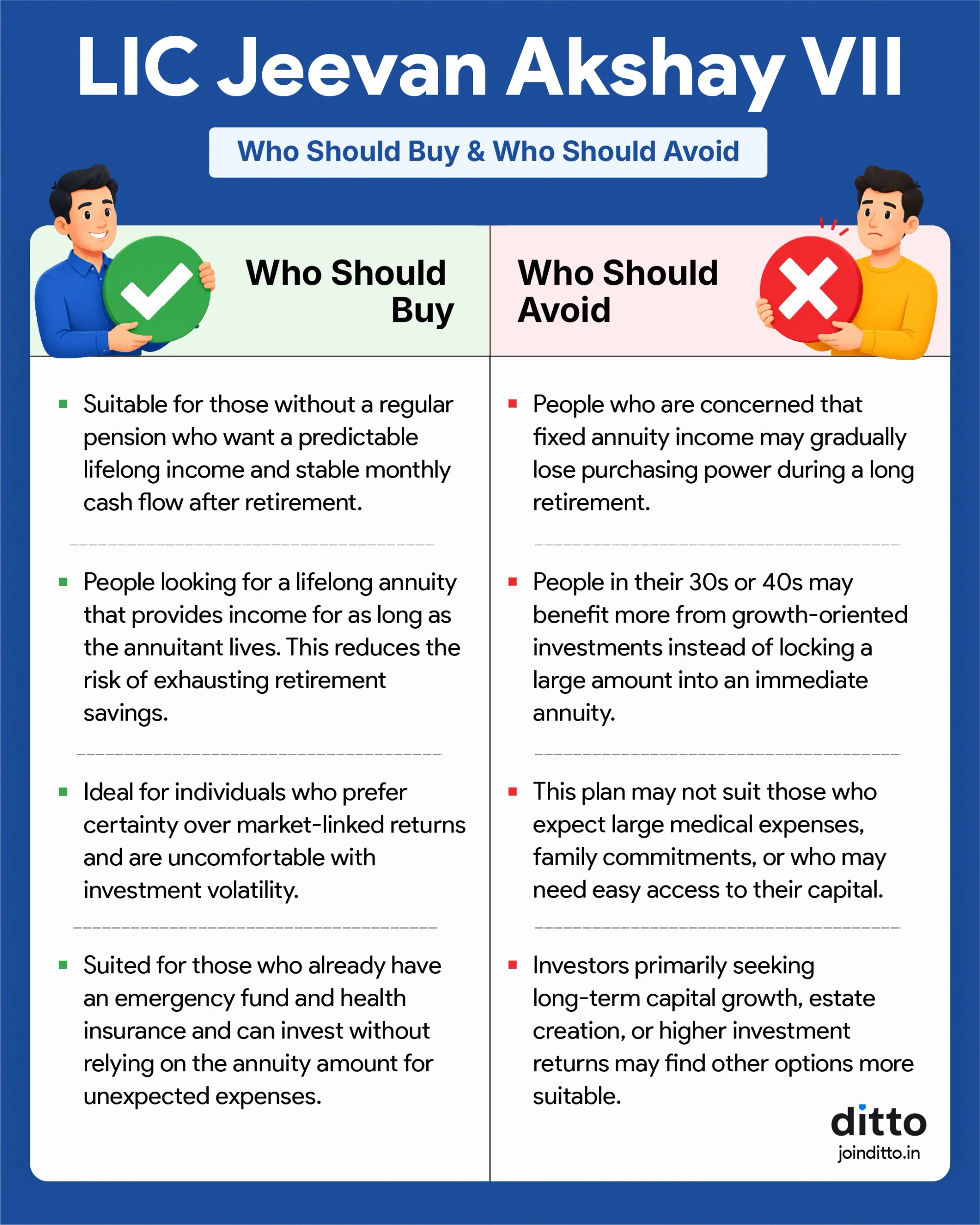
Take a look at the infographic, which helps you understand if this plan is right for you.
Why Choose Ditto for Life Insurance?
At Ditto, we’ve assisted over 12,00,000 customers with choosing the right insurance policy. Why customers like Aaron below love us:
- 100% Free Consultation
- No Spam. No Sales Pressure.
- Rated 4.9/5 on Google Reviews by 30,000+ Happy Customers
- Backed by Zerodha
- Dedicated Claim Support Team
- Compare Plans and Premiums with a Trusted Insurance Advisor
Confused about the right insurance? Speak to Ditto’s certified advisors for free, unbiased guidance. Book your call now or chat with us on WhatsApp. Slots fill up fast!
Conclusion
LIC Jeevan Akshay VII is best viewed as an income solution, not a wealth creation product. If your priority is guaranteed lifelong pension and financial certainty after retirement, it can play an important role.
However, before putting a large portion of your retirement corpus into an annuity or pension product, seniors should first secure the basics. Maintain a separate emergency fund and adequate health coverage to handle unexpected medical expenses without disrupting retirement income. Comparing the best health insurance plans is especially important because medical costs can rise sharply with age.
Additionally, for most investors, retirement planning is stronger with a combination of NPS, diversified investments, and choosing among the best term insurance plans during the accumulation phase.
In case you are approaching retirement, compare annuities with alternatives such as FDs and RBI Floating Rate Savings Bonds. This helps you choose the option that best matches your income needs, liquidity requirements, and inflation concerns.
Disclaimer: Ditto is not a SEBI-registered investment advisor. Please consult a SEBI-registered investment advisor before making investment decisions involving annuities, pension plans, or other investment products.
Frequently Asked Questions
Last updated on: